For a number of years I’ve been pondering the numerous relationships contained within TRIP. These are numerous and a few examples include:
- Relationships between articles e.g. via citations, by being in the same publication
- Relationships between users e.g. linked by clinical interests, by geographic location
- Relationships between articles and users e.g. looking at the same articles
I can’t help feeling there is value in these links and I do not mean in the financial sense.
Take a really simple example (click on image to enlarge it)
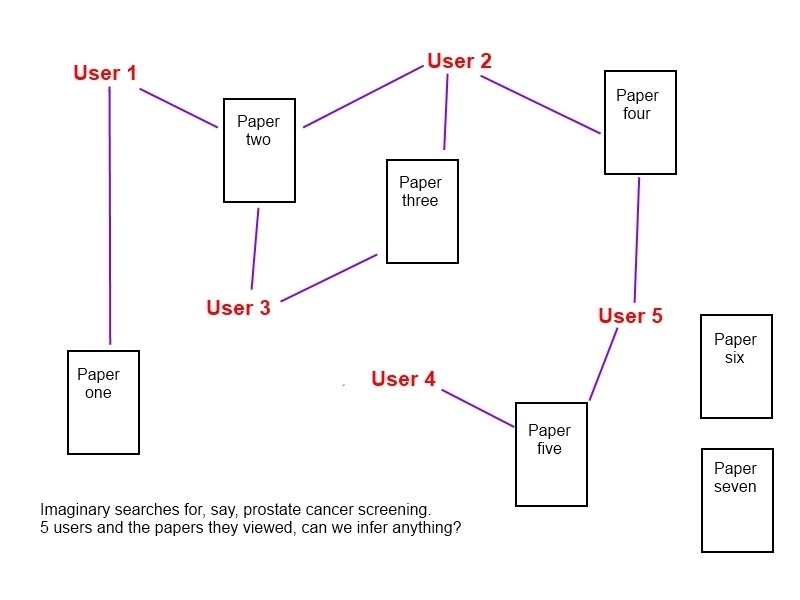
This is an imaginary search undertaken by 5 users and a line signifies which papers they looked at. We can deduce some things:
- Papers six and seven weren’t liked.
- Paper two looks the most popular
- Users 2 and 3 appear similar/close (both looking at two of the same papers)
Now, if we add an extra level of data:
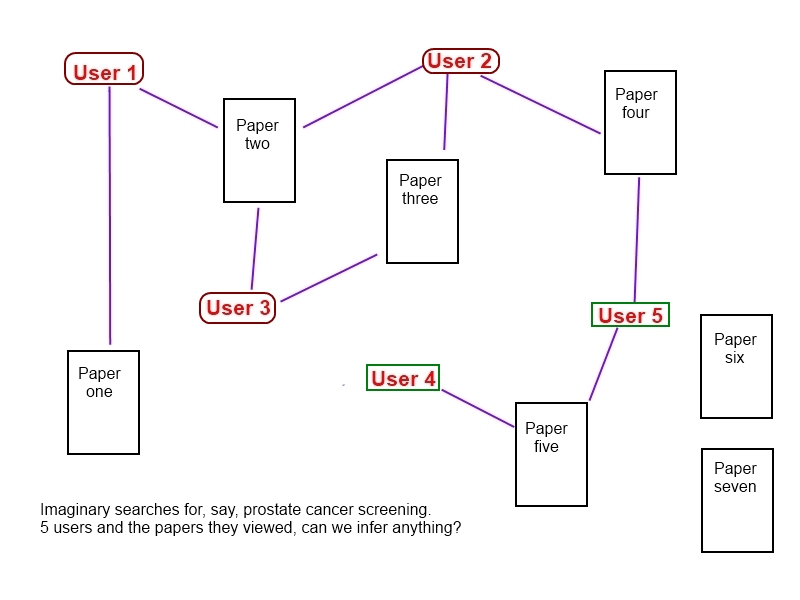
In this image the rounder reddish boxes signify doctors while the green boxes signify nurses. Do these inferences seem reasonable?
- Paper five is really suited to nurses while papers one (to a point), two and three are more ‘doctor’ focused
- Paper four has mixed interest.
Imagine if you can add extra detail (different types of doctors, different geographic location) and lots of data (something we have lots of in TRIP) you might be able to generate a really powerful system. Could it inform search results?
What do people think? I’ve really simplified things to make a point and I doubt the data will ever be as clear cut.


 Trip Database Blog
June 17, 2012 at 11:19 am
Good idea. Definitely worth pursuing, to address the question of if looking at an article is a good measure of a persons interest inan article. One problem though is that once you start flagging articles as 'likely to be of interest to X' you are affecting the underlying data that has led you to flag the article as being of interest to X.
LikeLike
June 19, 2012 at 5:55 pm
So how would this look to me as the end-user? My instinct is that I wouldn't like how my search results look to change but I wouldn't mind having another frame saying… 'rec'd by others in your network'.
When I do searches I rarely have problems working out what is relevant to me but I guess others may be different…
LikeLike