Connected articles launched at the weekend and we’ve explained how it works here. But this blog is more about why we’ve introduced it and the benefits.
Every time you search and click on an article the system starts to ‘understand’ your interests. This is important as it can be very difficult to convey, via a handful of search terms, what your intention is. In search, user intention is vitally important. Two users might both search for the same thing e.g. prostate cancer screening yet one is interested from the public health perspective while the other might be interested in the best test to use.
However, while search terms might hide the intention user’s clicks quickly ‘reveal’ their actual intention by clicking on document that they feel might answer the question they have. So, a public health search might click on articles that discuss the cost-benefit of screening at a population level. While someone else might click on articles comparing PSA to DRE.
The Secret Sauce: Co-Clicks, Semantics, and Citations
So, what makes Connected articles so clever? Three words: co-clicks, semantics, and citations.
- Co-clicks are like the search engine’s version of “people who bought this also bought…”. We have a huge and unique ‘library’ of co-click data that we can use to help build up connections between articles (see previous blogs Structure in Trip and Ok, I admit it, I’m stuck).
- Semantic similarity finds documents that are semantically similar to the ones you’ve already clicked on. You click on an article about cost-benefit of screening at a population level, it finds other similarly worded articles.
- Citation data is the final piece of the puzzle. Our system looks at the references used in the articles you clicked and also looks for any articles that have citated the articles you clicked on. Using citation data is starting to take off (e.g. Citation analysis) and more specifically in the evidence synthesis world (for instance Citation tracking for systematic literature searching: A scoping review and Citationchaser: A tool for transparent and efficient forward and backward citation chasing in systematic searching)
Our system takes the data available from the above sources and combines them using a special algorithm to ensure the most closely connected appears top.
Ok, so why should you care?
- You’ll find articles your keyword search might have missed. You might have searched for atrial fibrillation but a closely related – and useful – article is on arrythmias. Different clinical terms but closely connected.
- You’ll save time. Results more focussed on your interests will mean fewer articles to look at to obtain the answers you need.
- Safety! Whatever search you’ve done – superficial or in-depth – Connected articles is a really useful tool to ensure you’ve not missed really important articles!
An example of using Connected articles
Using a search for urinary tract infections we clicked on three articles on a similar topic (can you guess what that might be?) below are the top 6 results, but you can scroll down through the results and see many more:
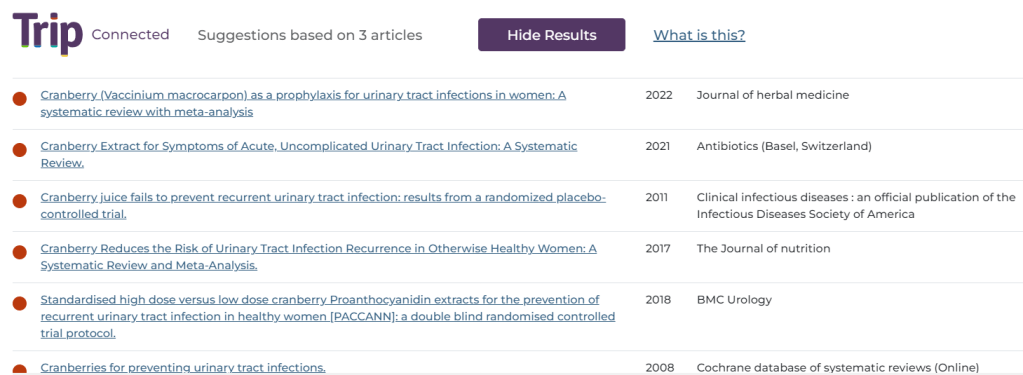
And the topic, I’m sure you can see it’s concentrated the results down to cranberry juice and UTIs!
Convinced? Curious? Sceptical? Give Connected articles a try and tell us what you think. Find an unexpected article that delighted or surprised you? Share it with us! We want you to be delighted!

 Trip Database Blog
4 Pingback