We’re undertaking a rapid review to answer the client’s question “Is there high-quality evidence to support the use of EMDA MMC in combination with BCG therapy for non-muscle invasive high-risk bladder cancer (NMIHRBC)“. It’s an interesting question and I thought it might be nice to show how we use Trip to help answer the question.
Understanding the Q: EMDA = ElectroMotive drug administration, MMC = Mitomycin C and BCG = BCG vaccine.
Initial search: I keep things simple and adjust if the initial search is problematic. In this case I searched (EMDA OR electromotive) AND (MMC OR Mitomycin) AND BCG AND (“bladder cancer” OR NMIHRBC). In this there are 4 elements:
- EMDA OR electromotive – covers the first part of the search
- MMC OR Mitomycin – using the abbreviation and the term ‘Mitomycin’. I didn’t add the C as it doesn’t seem necessary, in this case. If we got lots of results I could always replace ‘Mitomycin’ with “Mitomycin C” (note quotation marks to use it as a phrase search)
- BCG – As above there seems no real need to add the term ‘vaccine’
- “bladder cancer” OR NMIHRBC – bladder cancer might seem to be too vague (why not search for the fuller term ‘non-muscle invasive high-risk bladder cancer‘? Well, again, if it’s problematic – and we got too many results – I could always add it to make the search more specific
This is what it looks like via the Advanced Search:
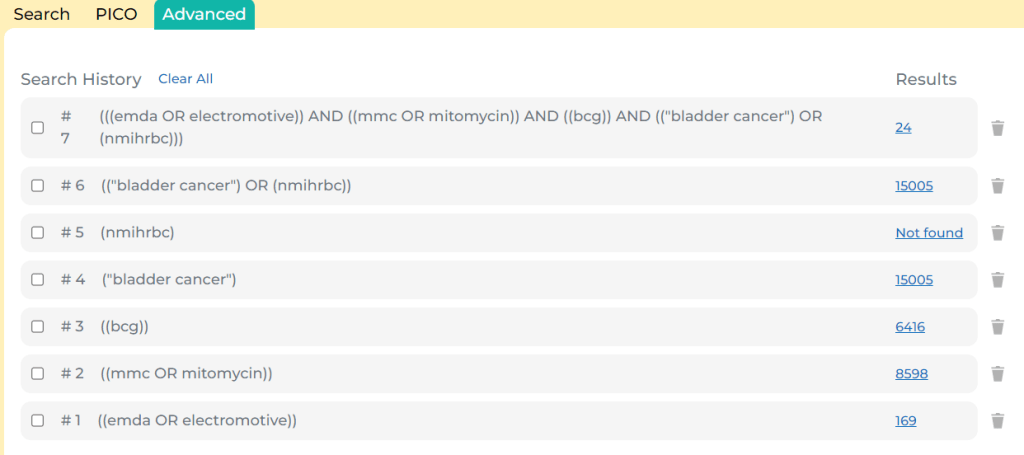
So, the search generates 24 results. I clicked on 14 articles that looked particularly relevant and then used the Connected Articles feature (BTW see our video explainer of Connected Articles) to reveal closely connected/linked articles. Here are the top results:
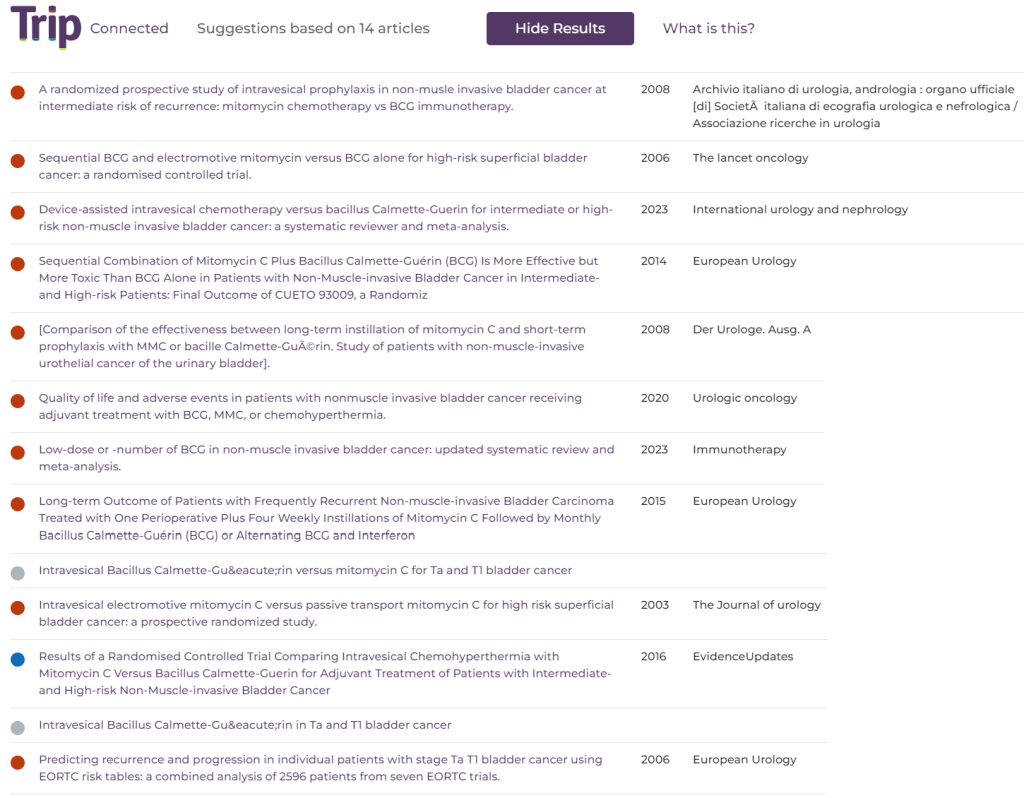
In total Connected Articles returns 100 results and even at the bottom many seem relevant:

Connected Articles goes beyond the Trip content and is great for helping minimise the chance of overlooking important articles. I need to work through these 100 to look for supplementary documents to enhance the review.
So, the above is a nice example of using Trip to highlight some highly relevant documents including guidelines from the European Association of Urology, some documents from NICE and Cochrane, as well as some other systematic reviews.

 Trip Database Blog
Leave a comment