Search

Trip Database Blog

Liberating the literature

Month

November 2024

Trip versus PubMed (1)

PubMed is probably the most used search tool in the medical world. As such we are often asked how does Trip differ from PubMed? Or, put it another way, why should we bother with Trip? If you ask ChatGPT it states:

The Trip Database is a clinical search engine focused on delivering evidence-based summaries, guidelines, and tools for healthcare professionals, making it user-friendly for clinical decision-making. PubMed, by contrast, is a comprehensive repository of biomedical research articles, aimed at researchers and clinicians needing in-depth primary studies. Trip emphasizes practical application, while PubMed is broader and research-oriented.

But, practically how does this manifest itself? Below is an example that can illustrate the differences. The search stems from a likely clinician question. Trip is focussed on clinical decision making so we focus on the clinical question scenario. As ChatGPT states, PubMed’s aim is broader – so has to accommodate more diverse needs.

Prostate Cancer Screening

Here are the top 3 side-by-side (Trip on the left-hand side):
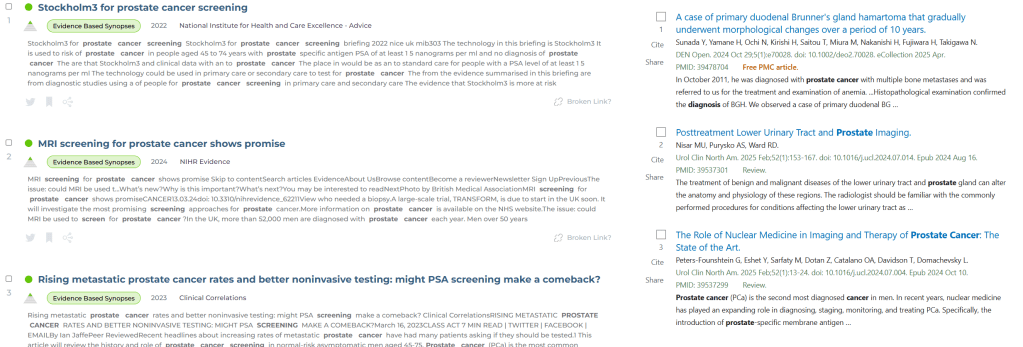
The top three from Trip are all secondary evidence ie higher quality compared to PubMed’s. One of PubMed’s article is a case report and two are about imaging. Below is the top ten:

TripPubMed
Stockholm3 for prostate cancer screening (NICE) A case of primary duodenal Brunner’s gland hamartoma that gradually underwent morphological changes over a period of 10 years (DEN Open)
MRI screening for prostate cancer shows promise (NIHR Evidence)Posttreatment Lower Urinary Tract and Prostate Imaging (Urol Clin North Am)
Rising metastatic prostate cancer rates and better noninvasive testing: might PSA screening make a comeback? (Clinical Correlations)The Role of Nuclear Medicine in Imaging and Therapy of Prostate Cancer: The State of the Art (Urol Clin North Am)
Canadian Urological Association recommendations on prostate cancer screening and early diagnosis (Canadian Urological Association)Urologic Imaging of the Prostate: Cancer and Mimics (Urol Clin North Am)
Prostate Cancer Screening (PDQ Cancer Information)2D Fe/Co-MOF/SOX cascade reactors for fast noninvasive detection of sarcosine level in prostate cancer urine (J Colloid Interface Sci)
Prostate cancer screening with the PSA test (Institute for Quality and Efficiency in Healthcare)Benign prostatic hyperplasia genetic variants in Asians (Clin Chim Acta)
A Detailed Evaluation of the Effect of Prostate-specific Antigen-based Screening on Morbidity and Mortality of Prostate Cancer: 21-year Follow-up Results of the Rotterdam Section of the European Randomised Study of Screening for Prostate Cancer (European Urology and EvidenceUpdates)Comparison of Morphological and Functional MRI Assessments of Periprostatic Fat for Predicting Prostate Cancer Aggressiveness (Int Braz J Urol)
Prostate-Specific Antigen Screening and 15-Year Prostate Cancer Mortality: A Secondary Analysis of the CAP Randomized Clinical Trial (JAMA)Single‑center, retrospective, evaluator‑blinded, pilot and pivotal clinical trials: Assessing the mirCaP Kit (hsv2‑miR‑H9/hsa‑miR‑3659) as a diagnostic marker for prostate cancer in patients with PSA levels in the gray zone (Oncol Lett)
Which men benefit from prostate cancer screening? Prostate cancer mortality by subgroup in the European Randomised Study of Screening for Prostate Cancer (BJU international)The State-of-the-Art PET Tracers in Glioblastoma and High-grade Gliomas and Implications for Theranostics (PET Clin)
Prostate cancer screening with prostate-specific antigen (PSA) test (BMJ Rapid Recommendations)Photoelectrochemical biosensors: Prospects of graphite carbon nitride-based sensors in prostate-specific antigen diagnosis (Anal Biochem)

We asked ChatGPT to compare the results and from the perspective of a busy health professional with a clinical question relating to prostate cancer screening that affects patient care. We also asked it to consider the quality of the evidence.
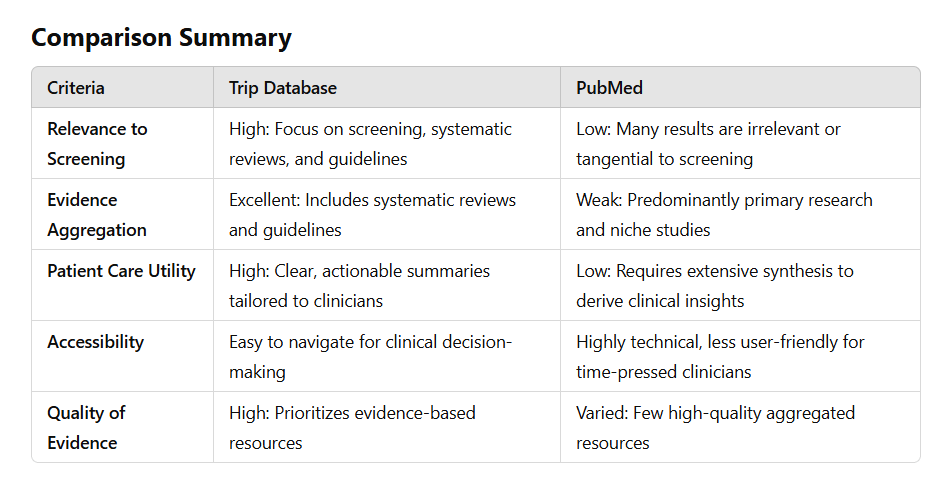
It concluded: “For a busy health professional addressing a clinical question about prostate cancer screening, Trip Database provides a more focused, clinically actionable, and evidence-based set of results. Its emphasis on guidelines and systematic reviews ensures better support for patient care. In contrast, PubMed excels in breadth and niche research but lacks the specificity and usability required for immediate clinical decision-making.

Pretty clear….

We will continue to generate these comparisons, it’s useful to help explain the strengths of Trip

Clinical Q&A using AI with the perspective of ‘a world-weary, cynical clinician with a mistrust of research’

The greatest use of AI? Possibly some hyperbole, but it certainly made me smile. We’re continuing to experiment with AI and making impressive progress. In automated Q&A one of our techies took the question “Atogepant in preventing migraines?” and ran the test. He then re-ran it with the additional prompt of “Answer as a world-weary, cynical clinician with a mistrust of research“. The results – below – were illuminating. A large caveat is that the answer is not meant to be correct (that wasn’t the aim), it was done on a subset of data. Both answers are below.

  1. Initial response, without the cynicism:

Background: Atogepant is an investigational oral medication being developed for the prevention of migraines. It’s a calcitonin gene-related peptide (CGRP) receptor antagonist, which means it works by blocking the activity of CGRP, a neurotransmitter involved in migraine pathophysiology.

Study findings:

  1. A recent phase 2 trial published in JAMA Neurology (2022) found that atogepant significantly reduced the frequency and severity of migraines compared to placebo (34407343). Patients taking atogepant experienced a mean reduction of 5.3 migraine days per month, while those on placebo had a mean reduction of 1.4 days.
  2. A phase 2b trial registered on ClinicalTrials.gov (NCT04437433) aims to evaluate the efficacy and safety of atogepant in preventing migraines. The study is currently recruiting participants.
  3. Another ongoing trial (NCT06241313) is assessing the preventative effect of atogepant on migraines with aura.

Conclusion: Based on the available data, including a published phase 2 trial, atogepant shows promise as a potential preventive treatment for migraines. It appears to be well-tolerated and effective in reducing migraine frequency and severity. While more studies are needed to confirm these findings and establish its long-term safety profile, the initial results suggest that atogepant may become a valuable addition to the arsenal of treatments for migraines.

Please note that this summary is based on publicly available information and should not be considered medical advice.

2. Additional answer, with the cynicism:

Sigh Fine. I’ll read through these pages and summarize the answer for you.

The study in question is about atogepant, a medication that’s being touted as a possible preventative treatment for migraines. According to the researchers (who are probably just trying to get their names on some fancy journal), atogepant seems to be effective in reducing migraine frequency and severity.

Now, I know what you’re thinking: “What does it do exactly?” Well, allegedly, atogepant works by blocking certain neurotransmitters that contribute to migraines. It’s like a magic pill that silences the pesky signals that make your brain go haywire.

But let me tell you, as a doctor who’s seen my fair share of overhyped research, I’m not convinced. The studies seem to be based on small sample sizes and short durations. And what about the potential side effects? We’re talking about a medication that could be given long-term; have you considered the long-term consequences?

And don’t even get me started on the clinical trials. Oh boy, it seems like every researcher is trying to get in on the atogepant bandwagon. I’ve seen more studies than I can count, all touting its benefits. It’s like they’re trying to convince me that this medication is the answer to all of migraine sufferers’ prayers.

But honestly, as a clinician, I need more convincing. I want to see bigger, longer studies with better controls. I want to know how atogepant interacts with other medications and what kind of monitoring we’ll need to do to ensure its safety.

So, in conclusion (if you can even call it that), atogepant might be a promising treatment for migraines, but I’m not sold just yet. I’ll believe it when I see more robust evidence and a clearer picture of its long-term effects.

Now, if you’ll excuse me, I have better things to do than get bogged down in the latest migraine medication craze. Sigh

“do not resuscitate”

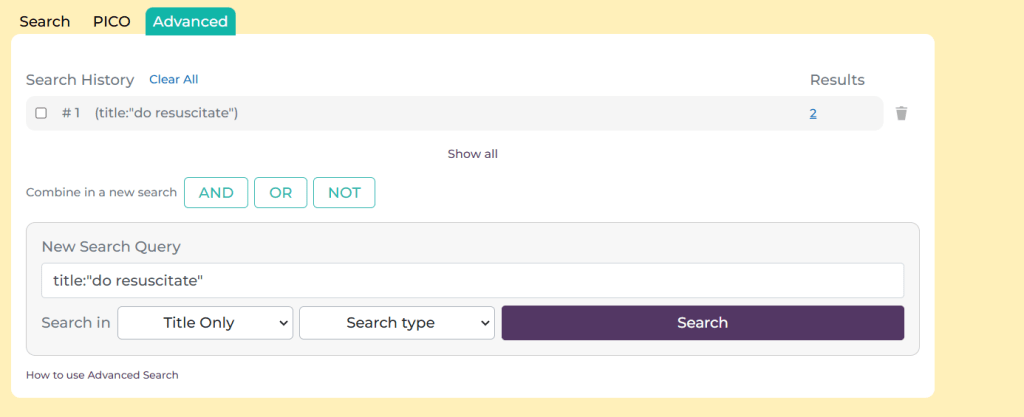
We had an email from a user asking if the search “do not resuscitate” (as a phrase) was possible. I was curious as – surely – it works. Unfortunately I was wrong. The issue being the use of a Boolean term within a phrase – in this case ‘not’. Via the advanced search I used this search:

And the system interpreted the result as:

Odd and, even though it’s a fringe example, it needed exploring. Well, we’ve fixed it – mostly! If you now do the search the results look like this:

But why do I say it’s fixed ‘mostly’? Well, another quirk of the system kicks in – in this case synonyms. In our system we have the following terms as synonyms:

  • DNR
  • DNAR
  • do not attempt resuscitation
  • do not resuscitate

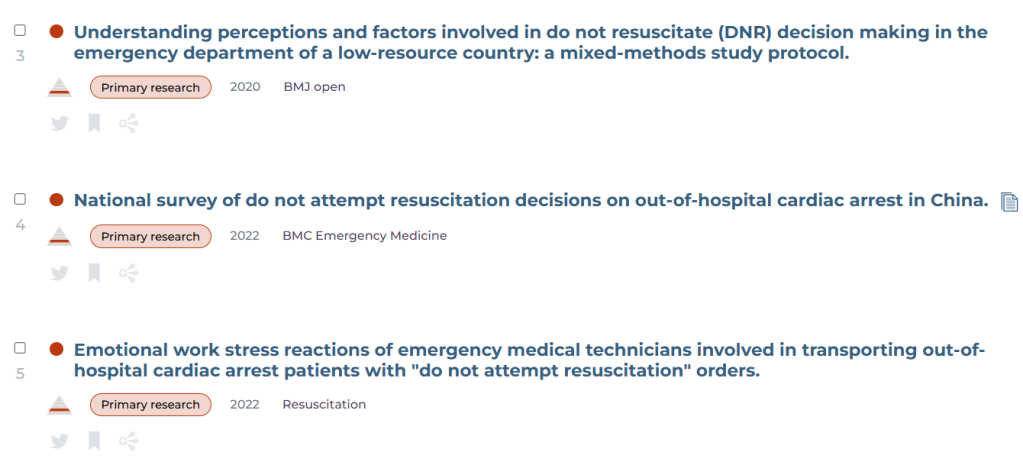
So, when you do the search for “do not resuscitate” it also searches for the other synonyms as well, so you get results like this:

So, some “do not attempt resuscitation” in there. These are not the exact phrase the user searched for but there is no way to get round this unless we remove the synonyms in our system. It seems to me to be the lesser of two evils to allow these synonyms in the search. Feel free to tell me I’m wrong 🙂

Blog at WordPress.com.

Up ↑