PubMed is probably the most used search tool in the medical world. As such we are often asked how does Trip differ from PubMed? Or, put it another way, why should we bother with Trip? If you ask ChatGPT it states:
“The Trip Database is a clinical search engine focused on delivering evidence-based summaries, guidelines, and tools for healthcare professionals, making it user-friendly for clinical decision-making. PubMed, by contrast, is a comprehensive repository of biomedical research articles, aimed at researchers and clinicians needing in-depth primary studies. Trip emphasizes practical application, while PubMed is broader and research-oriented.“
But, practically how does this manifest itself? Below is an example that can illustrate the differences. The search stems from a likely clinician question. Trip is focussed on clinical decision making so we focus on the clinical question scenario. As ChatGPT states, PubMed’s aim is broader – so has to accommodate more diverse needs.
Prostate Cancer Screening
Here are the top 3 side-by-side (Trip on the left-hand side):
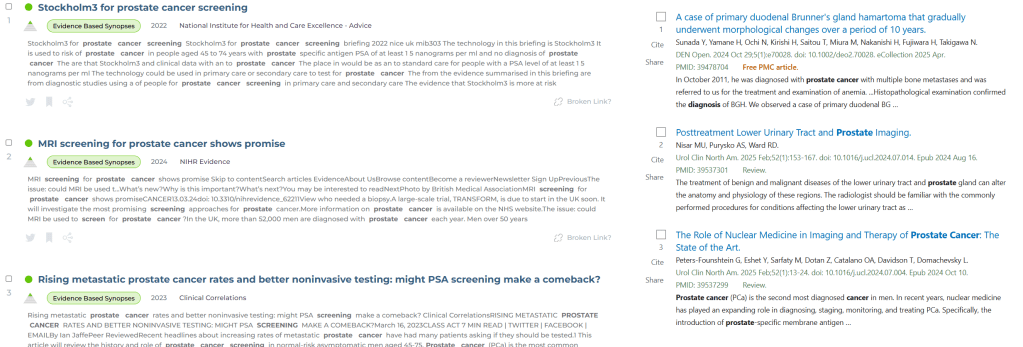
The top three from Trip are all secondary evidence ie higher quality compared to PubMed’s. One of PubMed’s article is a case report and two are about imaging. Below is the top ten:
We asked ChatGPT to compare the results and from the perspective of a busy health professional with a clinical question relating to prostate cancer screening that affects patient care. We also asked it to consider the quality of the evidence.
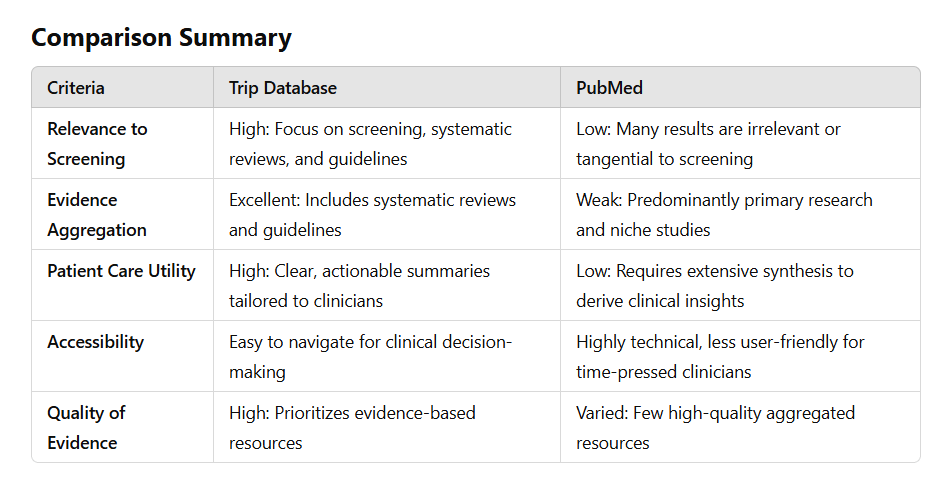
It concluded: “For a busy health professional addressing a clinical question about prostate cancer screening, Trip Database provides a more focused, clinically actionable, and evidence-based set of results. Its emphasis on guidelines and systematic reviews ensures better support for patient care. In contrast, PubMed excels in breadth and niche research but lacks the specificity and usability required for immediate clinical decision-making.“
Pretty clear….
We will continue to generate these comparisons, it’s useful to help explain the strengths of Trip

 Trip Database Blog
January 16, 2025 at 1:17 pm
Hi Jon,
I like this comparison, but I wonder if it would be more meaningful to compare TRIP with a PubMed Clinical Queries search (Clinical Queries – PubMed). I still think TRIP would “win” because of your emphasis on the evidence hierarchy, inclusion of SRs and EB guidelines, but I think it would be a more refined comparison.
I respect and admire your work and your dedication to it!
John
LikeLike
January 16, 2025 at 1:20 pm
Great idea, when I do the next one I’ll do it against that. Thanks for the suggestion
LikeLike
January 16, 2025 at 1:46 pm
I wasn’t sure which filter to use for prostate cancer screening so did a quick test against the asthma diagnosis comparison (https://blog.tripdatabase.com/2024/12/15/trip-versus-pubmed-2-asthma-diagnosis/). I compared the top 5 Trip results and top 5 PubMed CQ (narrow diagnosis options) ‘most recent’ https://pubmed.ncbi.nlm.nih.gov/?term=(asthma%20diagnosis)%20AND%20(Diagnosis/Narrow%5Bfilter%5D)&sort=date and ‘best match’ https://pubmed.ncbi.nlm.nih.gov/?term=%28asthma+diagnosis%29+AND+%28Diagnosis%2FNarrow%5Bfilter%5D%29
I pasted the results into ChatGPT and asked ChatGPT to compare the results exploring issues like clinical relevance, quality of the evidence and recency. ChatGPT’s response was:
Summary
Trip:
Strengths: Comprehensive, relevant, high-quality, and recent evidence tailored for clinical use.
Weaknesses: Limited exploration of emerging or niche research topics.
PubMed CQ Most Recent:
Strengths: Very recent, peer-reviewed research with methodological rigor.
Weaknesses: Niche focus limits practicality for general clinical questions on asthma diagnosis.
PubMed CQ Best Match:
Strengths: Some valuable studies, including systematic reviews.
Weaknesses: Outdated evidence and inconsistent relevance reduce its utility.
Conclusion
For a busy health professional addressing a clinical question about asthma diagnosis, Trip is the most reliable and practical resource. It offers high-quality, recent, and directly applicable evidence. PubMed CQ Most Recent provides insights into emerging and niche research but lacks broad utility, while PubMed CQ Best Match is hampered by outdated and less relevant evidence.
LikeLike