The current PICO search has not much changed since it was launched in 2012
At launch
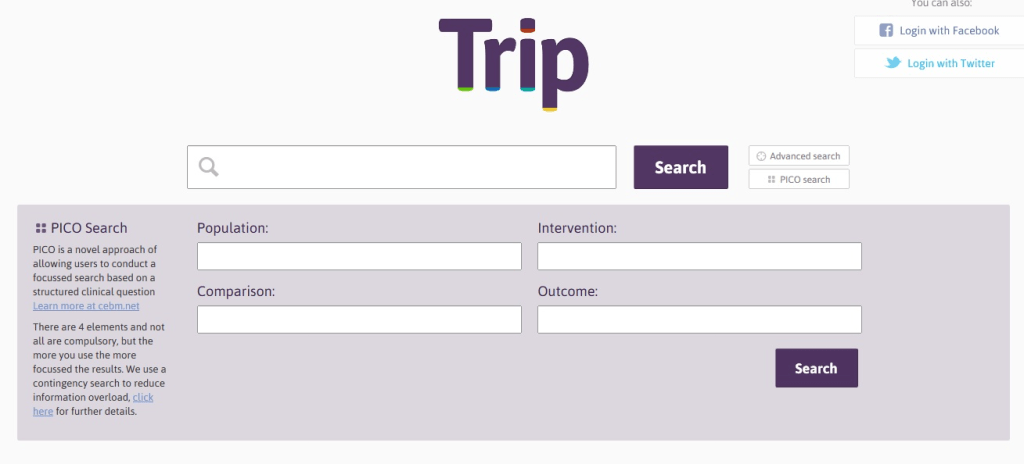
Currently:
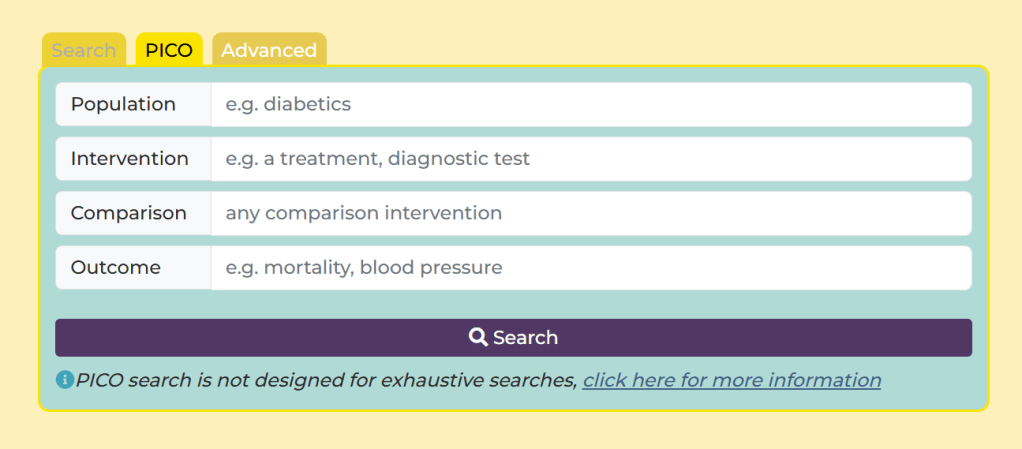
So, there has been a design change but the underlying mechanism has not changed much ‘under the hood’ (read about it here). Well, we’re currently working on enhancing it… I’ve not loved the feature for two main reasons:
- I was answering clinical questions before PICO was widely known. The history is vague but it’s believed it was first described between 1995- 1997 but was not widely adopted till the early 2000s. By then I had answered thousands of questions and was comfortable with converting a question to search terms. However, I acknowledge I’m an edge case!
- It was sometimes disappointing with the results
I was pleased to have the opportunity to trial a new approach—combining our existing method with a newer one that embraces AI and large language models (LLMs). Interestingly, this wasn’t the original intention. I had assumed we would replace the old with the new, but testing has shown that this may be sub-optimal.
To illustrate, consider this PICO example:
P – deep vein thrombosis
I – D-dimer
C – ultrasonography
O –
Using both approaches, we identified several overlapping articles. However, each method also surfaced four relevant articles that were unique to it:
Current PICO system
- Serial 2-point ultrasonography plus D-dimer vs whole-leg color-coded Doppler ultrasonography for diagnosing suspected symptomatic deep vein thrombosis: a randomized controlled trial
- A randomized trial of diagnostic strategies after normal proximal vein ultrasonography for suspected deep venous thrombosis: D-dimer testing compared with repeated ultrasonography
- D-dimer testing as an adjunct to ultrasonography in patients with clinically suspected deep vein thrombosis: prospective cohort study
- Left Rule, D-Dimer Measurement and Complete Ultrasonography to Rule Out Deep Vein Thrombosis During Pregnancy
AI/LLM approach
- Safety of D-dimer as a stand-alone test for the exclusion of deep vein thrombosis compared to other strategies
- Lower-Extremity Venous Ultrasound in DVT-Unlikely Patients with Positive D-Dimer Test
- Comparison of the Accuracy of Emergency Department-Performed Point-of-Care-Ultrasound (POCUS) in the Diagnosis of Lower-Extremity Deep Vein Thrombosis
- Test Characteristics of Emergency Physician-Performed Limited Compression Ultrasound for Lower-Extremity Deep Vein Thrombosis
We’re excited to be releasing this updated feature over the summer. It’s been a rewarding challenge to modernise such a longstanding system by integrating cutting-edge AI and LLM technology. While the core mechanism remains familiar, the enhancements deliver a clear improvement, broadening the scope of results and offering deeper insights. It’s a great example of how old and new can work better together than either alone.

 Trip Database Blog
August 8, 2025 at 8:12 am
I’m a bit ambivalent about PICO. So many people try and force their clinical question into it – often with disappointing results, as its not suitable for the question at hand. This is because it is seen as the gold standard or the only one people are aware of – while the reality is that there are many similar types of search aids, each suited to a particular type of question
LikeLike
August 8, 2025 at 10:07 am
Thanks for the comment and it’s another issue with PICO. It’s surprisingly popular though!
One thing we’re doing – for AskTrip – is taking a free-text question and transforming that into a search. I dare say that will be introduced as a search option in Trip in the future
LikeLike