Trip began in 1997 from our work in clinical question answering, designed to make answering questions manually more efficient. With AskTrip, we’ve come full circle: Trip is now helping to automatically answer clinical questions.
Last week we began indexing AskTrip Q&As into the main Trip database, allowing users to discover them directly through search:
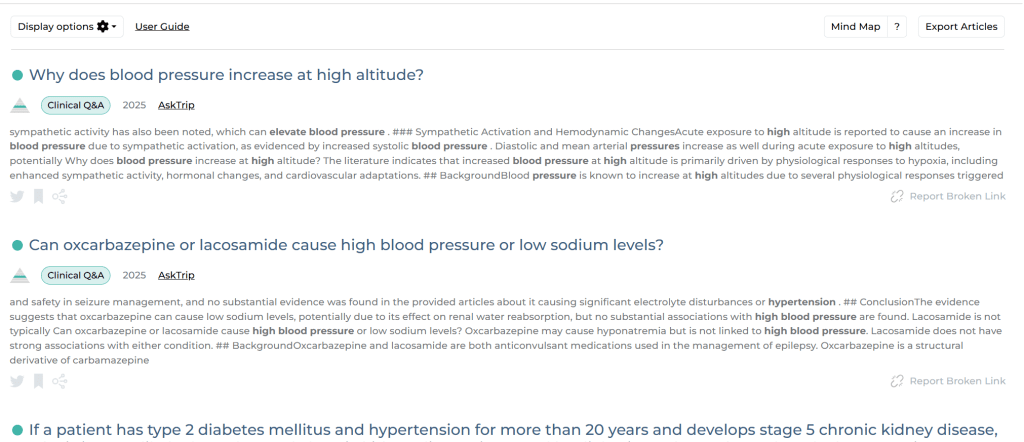
We’re also developing a system to integrate the two more closely, intelligently suggesting clinical questions as users engage with Trip. Here’s a real example from our test site: when a user searches for “measles”, a broad query, the system responds by suggesting broad clinical questions:
- What are the common signs and symptoms of measles in pediatric patients?
- What are the current vaccination recommendations for preventing measles in adults?
- How should complications of measles, such as measles encephalitis, be managed in hospitalized patients?
The user then scrolls down and clicks on the document ‘Guidance for risk assessment and infection prevention and control measures for measles in healthcare settings‘. This gives the system more ‘signal’ and updates the questions to:
- What are the current risk assessment strategies for managing measles outbreaks in healthcare settings?
- What are the recommended infection prevention and control measures for measles in hospitals and clinics?
- How should healthcare facilities handle exposure to measles in patients and staff?
These new questions reflect the user’s interest. When the user next clicks on ‘Managing measles in asylum seeker accommodation settings‘, the system adapts again::
- What are the guidelines for risk assessment and infection prevention and control measures for measles in healthcare settings?
- How should measles outbreaks be managed in asylum seeker accommodation settings?
- What infection prevention strategies are most effective in controlling measles transmission in densely populated accommodation settings like those for asylum seekers?
This seamless integration makes finding evidence faster and more intuitive. By turning a search into a precise, question-driven process, we’re helping clinicians move quickly from a general need to targeted, evidence-based answers. It’s an effortless way to bridge the gap between searching for information and getting the exact answers you need.

 Trip Database Blog
Leave a comment