Search

Trip Database Blog

Liberating the literature

Month

September 2025

AskTrip: Beyond Trip

AskTrip currently generates answers from content in the Trip Database. When little is available, we “back fill” using ChatGPT. While answers are clearly labelled, relying on ChatGPT alone (or mostly) doesn’t feel entirely comfortable.

Twenty years ago, when we answered clinical questions manually, we often had to search beyond Trip or Medline to find reliable evidence. That spirit of search expansion has inspired Beyond Trip (working name). If AskTrip finds little or no evidence in Trip, it will now automatically search other sources to strengthen the answer.

Our approach now searches both OpenAlex and Google Scholar – two vast, general academic databases. Even when limited to peer-reviewed medical journals, this still represents a huge increase in coverage compared to Trip alone.

Take one example question What psychiatric adverse effects are associated with the use of antileukotrienes in asthma treatment? that was asked today. AskTrip’s standard answer cited 2 references. With Beyond Trip, the system retrieved 11 references, including:

  • Adverse drug reactions of leukotriene receptor antagonists in children with asthma: a systematic review
  • Neuropsychiatric reactions with the use of montelukast
  • Psychiatric adverse effects of montelukast—a nationwide cohort study
  • Suspected Adverse Drug Reactions Associated with Leukotriene Receptor Antagonists Versus First Line Asthma Medications: A National Registry-Pharmacology Approach
  • Risk of psychiatric adverse events among montelukast users

Beyond Trip won’t activate for the majority of questions. But when AskTrip turns up little or no supporting evidence, it will automatically engage, taking around 60 seconds longer while drawing on a much broader pool of references.

We expect to release it within the next two weeks. Believe me, this is a major step forward for AskTrip 🙂
Responding to Concerns About AI at Trip

As part of our commitment to quality with AskTrip (and Trip more broadly), we actively encourage feedback. We recently received the following comment, which I’d like to respond to in case it reflects a view held by others:

I believe that generative AI tools should not be promoted and positioned as equivalent to expert searching, and feel that it is completely inappropriate that TRIP has devoted so many resources to this. There is extensive evidence that AI tools lack the precision and recall of equivalent systematic searches performed by human beings, and treating them as search engines — especially in medicine and healthcare — causes serious risks when it comes to the reliability of evidence used to support clinical practice. Generative AI is fancy predictive text, not a search engine, and the fact that TRIP has devoted significant resources towards this pivot to AI is extremely disappointing. This irresponsibility has meant that I am less likely to use TRIP as a database, and less likely to recommend it to the healthcare professionals I support.

My response is:

Thank you for taking the time to share your concerns. We take all feedback seriously, and it’s important to us to listen and reflect when people raise issues around the use of AI in healthcare.

We’d like to reassure you on a few points. AskTrip is not designed to replace systematic searches or the expertise of information professionals. Instead, it builds on our nearly 30 years’ experience in making high-quality evidence accessible to healthcare professionals. The system is supported by extensive quality-control processes, which we’ve written about in more detail on our blog. These safeguards mean that AskTrip is very different from generic generative AI tools, even if it may look similar on the surface.

We also want to emphasise that using AskTrip is entirely optional – it sits alongside the existing Trip Database, which continues to work as it always has. For some clinicians, especially those without ready access to specialist librarian support, AskTrip provides an additional way to quickly access evidence in a clinically relevant timeframe. For others, it won’t be the right fit, and that’s absolutely fine.

More broadly, we recognise that AI is here to stay. The real challenge – for Trip and for information specialists – is to understand where it adds value, where it falls short, and how to use it responsibly in service of healthcare professionals. Ultimately, both Trip and expert searchers need to offer solutions that meet user needs. If we don’t, clinicians will inevitably look elsewhere.

Finally, on resources – while we have invested in this area, it’s relative and has not been at the expense of our core database. We remain committed, as ever, to delivering trusted evidence to healthcare professionals worldwide.

We share your belief that evidence in healthcare needs to be robust, reliable, and used responsibly. That’s why we’re keen to be transparent and to have these conversations.

AskTrip in Trip

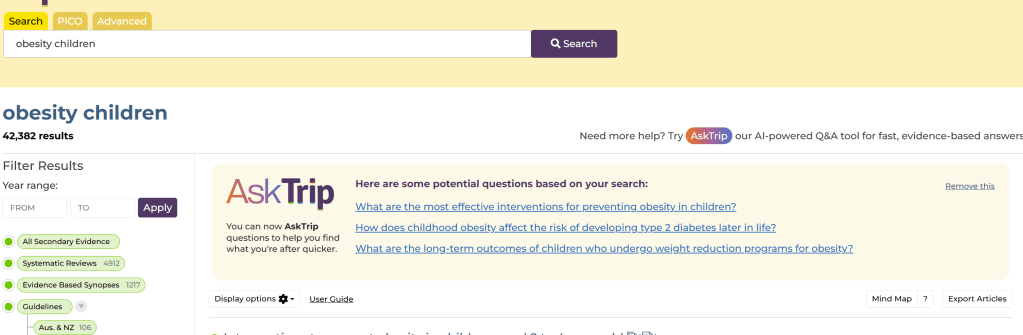
We’ve just rolled out an exciting new feature that brings the Q&A power of AskTrip directly into the Trip Database. Using AI, the system predicts questions based on a user’s search terms and the articles they view. By analysing session activity and identifying user intentions, it suggests the most relevant questions to support clinical decision-making.

If a user runs a simple search, there’s little indication of intent, so no questions are shown. Once an article is clicked, the AI gains enough context to understand the intention and generate relevant questions. In this example, a user searches for obesity children (indicating intent) and these are the suggested questions:

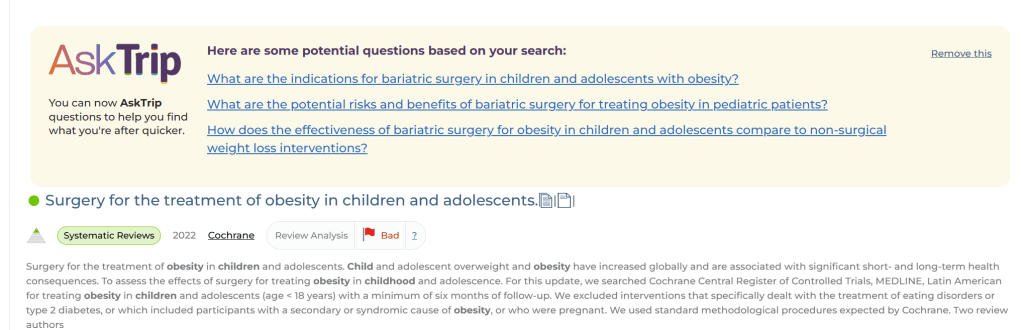
The user then scrolls down and clicks on the article Surgery for the treatment of obesity in children and adolescents. This indicates an interest in surgery, so the questions update (appearing above the clicked article):

As a user clicks on additional articles, the suggested questions are updated further.

In short, AskTrip transforms a user’s browsing into a dynamic, question-driven experience—helping clinicians move from search to evidence faster, with AI guiding them to the answers that matter most.

Blog at WordPress.com.

Up ↑