Search

Trip Database Blog

Liberating the literature

Month

December 2025

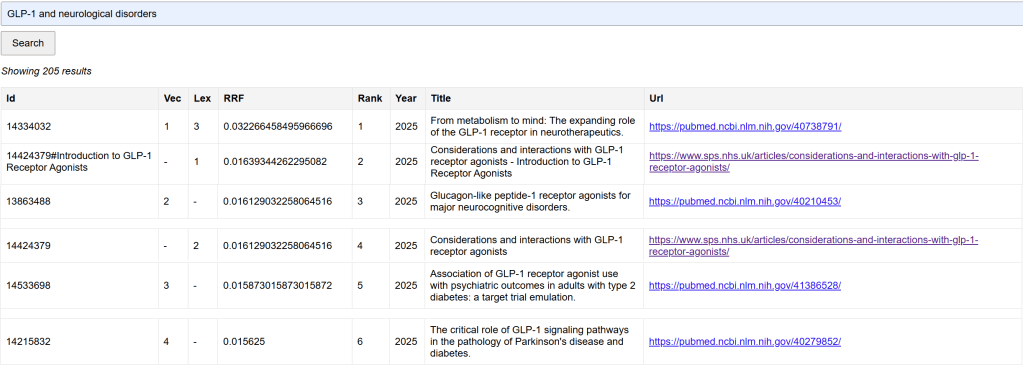
A great example of the power of vector search

I posted an outline of vector search the other week and shortly afterwards became aware of some work Google has been involved in: Accelerate medical research with PubMed data now available in BigQuery. In essence, Google has created a vector-based search system over PubMed Central.

We set up a small test-bed to explore whether this approach could be incorporated into Beyond Trip. We’ve been testing it using clinical questions, traditional keyword searches, and queries that sit somewhere in between – and the results have been genuinely impressive.

One search in particular, “Creatine use and cognitive ability”, clearly demonstrated the value of vector search. When we ran this query through the test-bed, the top result was The effects of creatine supplementation on cognitive function in adults: a systematic review and meta-analysis.

I then repeated the same search in Trip using the identical wording (Creatine use and cognitive ability), and that paper was not retrieved. However, when I reran the Trip search using “cognitive function” instead of “cognitive ability”, the paper appeared immediately. The content of the paper is the same in both cases – only the phrasing of the query changed. So, seamlessly the vector search was able to ‘understand’ that cognitive function and cognitive ability are virtual synonyms.

What this neatly illustrates is how vector search moves beyond literal term matching and begins to reflect clinical meaning. By recognising that “cognitive ability” and “cognitive function” are effectively synonymous, vector search bridges the gap between how clinicians think and how evidence is described in the literature. For tools like Beyond Trip, this has the potential to reduce missed evidence, lower the cognitive burden of searching, and make high-quality research easier to find – even when the wording doesn’t line up perfectly.

A fresh new look for Bookmarks & Search History in Trip

We’ve just released a visual overhaul of Bookmarks and Search History in Trip. The functionality is exactly the same — but it now looks a million times better.

Bookmarks

Bookmarks let logged-in users save articles they’ve read or want to come back to later.

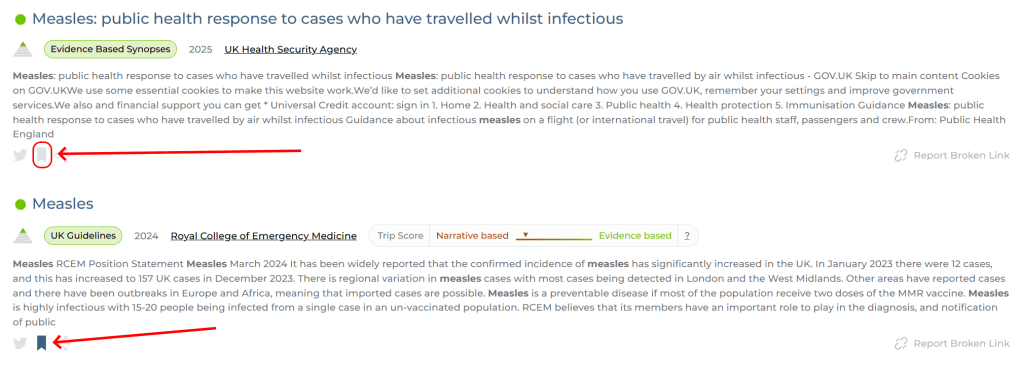
  • On the results page, you’ll see a bookmark icon on each article.
  • Click the icon to bookmark the article.
  • Once saved, the icon appears darker, confirming it’s been bookmarked.

Viewing your bookmarks

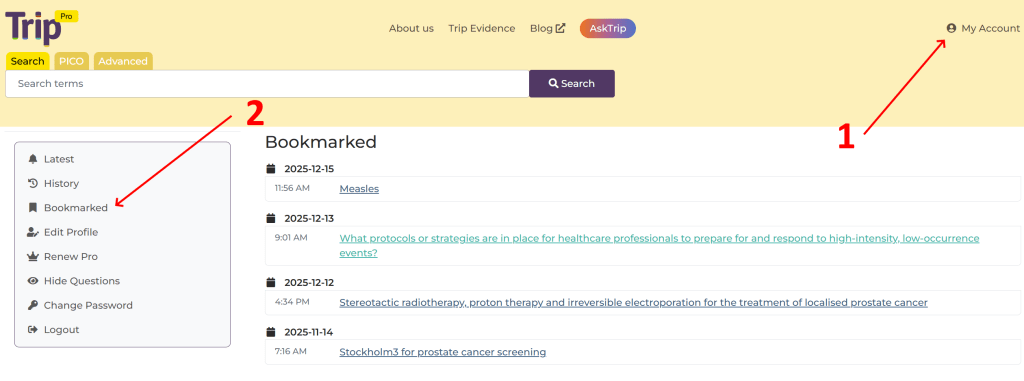
To see all your saved articles:

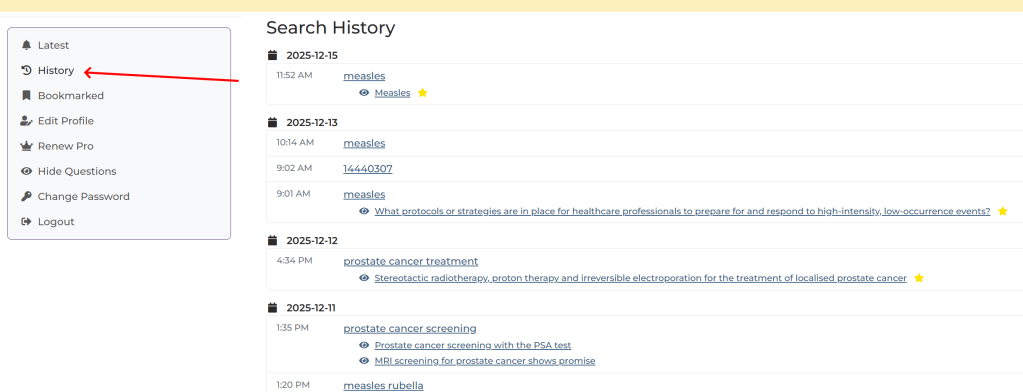
  1. Go to My Account (1)
  2. Select Bookmarked (2)

Search history

In the same area of My Account, you’ll find Search History.

Search History keeps a record of:

  • The searches you’ve run in Trip
  • The articles you’ve viewed

This makes it easy to revisit previous searches, retrace your steps, and quickly find evidence you’ve already explored.

Where Evidence Is Thinnest: What 100 Real Clinical Questions Reveal

Looking across clinical questions over time can be revealing, but looking specifically at those where the evidence is limited is particularly instructive. The analysis below draws on the most recent 100 questions submitted to AskTrip that were judged to have limited supporting evidence. Together, they offer a clear view of where uncertainty persists in everyday clinical practice.

Rather than cataloguing all 100 questions, it is more useful to look for patterns. When grouped thematically, these questions highlight recurring areas where research evidence struggles to keep pace with the complexity of real patients, real decisions, and real healthcare systems.

1. Defining “Normal” in Diverse Populations

Illustrative questions

  • What are the standard reference ranges for hemoglobin levels in neonates, and how do these vary by gestational age?
  • What is the prevalence of supraspinatus tendinosis in individuals over the age of 30?

These questions expose a recurring challenge: concepts such as “normal” or “prevalence” are often less stable than assumed. Reference ranges may vary by population, measurement method, or clinical context, while prevalence estimates are frequently drawn from heterogeneous or dated studies. The result is uncertainty at precisely the point where clinicians are expected to be definitive.


2. High-Risk Decisions Without Definitive Trials

Illustrative questions

  • Is there a recommended waiting period to start anticoagulant treatment with rivaroxaban or apixaban after intracranial hemorrhage in a patient with atrial fibrillation?
  • What are the recommended therapeutic strategies for patients with both COPD and CCF, and are there any contraindications for treatments?

These are situations where the consequences of error are substantial, yet randomised trials are difficult or impossible. Evidence tends to be indirect, observational, or consensus-based, requiring clinicians to weigh competing harms rather than follow clear algorithms.


3. Pharmacology at the Edges of the Evidence Base

Illustrative questions

  • How does flucloxacillin’s penetration of the blood–brain barrier compare to other beta-lactam antibiotics for CNS infections?
  • Can patients who develop a rash from prednisone take prednisolone as an alternative?

Questions like these reveal how much clinical pharmacology relies on extrapolation. Differences in molecular structure, metabolism, or formulation are assumed to translate into clinical effects, but direct comparative evidence is often lacking – particularly in uncommon or high-risk scenarios.


4. Mental Health, Culture, and Neurodiversity

Illustrative questions

  • How do cultural expressions of mental health differ among Yoruba, Igbo, Swahili, Arabic, and Twi-speaking communities, and how can understanding these differences improve AI-based mental health assessments?
  • How does neurodivergence in older adults influence the manifestation and management of hoarding behaviors compared to neurotypical populations?

These questions highlight areas where biomedical models alone are insufficient. Evidence is frequently qualitative, context-specific, or culturally bound, yet these considerations are increasingly important – particularly as digital and AI-driven tools are used to assess and support mental health.


5. How Care Is Organised and Delivered

Illustrative questions

  • What is the quality of and adherence to moving and handling safety precautions for patients post-CABG via median sternotomy in ICU, and does this correlate with patient outcomes?
  • How does collaboration between nurses and health assistants affect patient outcomes in a clinical setting?

Here, uncertainty arises not from disease mechanisms but from systems of care. These questions affect safety, efficiency, and patient experience, yet they are often under-studied because they sit outside traditional disease-focused research frameworks.


6. Highly Context-Specific Clinical Judgements

Illustrative questions

  • What dose of cefuroxime is appropriate for a frail patient weighing 40 kg with urosepsis?
  • What is the appropriate action for a pediatric patient taking methylphenidate with a heart rate of 115 bpm?

These questions reflect the everyday reality of clinical work: patients rarely match trial populations. Evidence may exist in general terms, but applying it to a specific individual often requires judgement, adaptation, and tolerance of uncertainty.


Concluding Reflection

Taken together, these 100 questions show that limited evidence is not evenly distributed across medicine. It clusters where patients are complex, risks are high, contexts vary, or outcomes resist simple measurement. In many cases, the absence of strong evidence reflects the limits of current research methods rather than a lack of clinical importance.

Recognising where evidence is thinnest is not an admission of failure. It is a necessary step toward more honest clinical decision-making, better conversations with patients, and a clearer sense of where future research effort might be most usefully directed.

Moving Fast: How User Feedback Is Powering AskTrip’s Evolution

Earlier this week I published AskTrip Hits 8,000 Q&As: A Perfect Moment to Deepen User Engagement, noting the importance of building closer connections with our users to elevate the AskTrip experience, and we’ve wasted no time.

AskTrip User Group

We’ve now built a strong AskTrip user group and expect to start gathering their insights from next week. It’s not too late to join. If you’re interested – no heavy lifting required, we’re simply looking for your perspectives – just email me at jon.brassey@tripdatabase.com

Question feedback mechanism

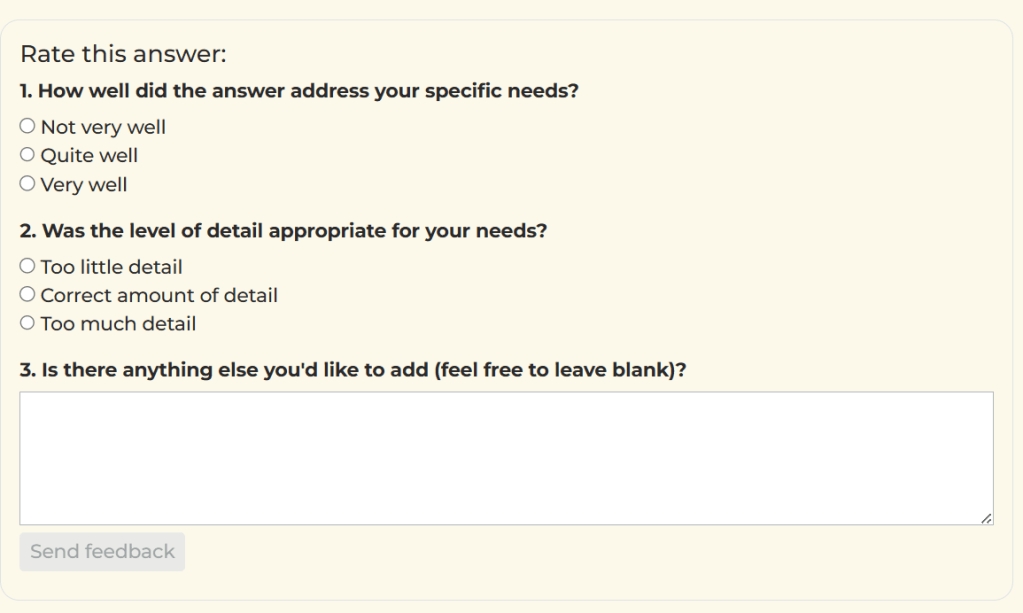
We’ve introduced a new feedback form beneath every question:

Within 24 hours we received a steady stream of comments – mostly positive – but two responses were especially valuable. They not only validated an issue we’d suspected but also pointed us toward a strong opportunity for a major upgrade.

We’ll now take this feedback and quietly get to work. There’s a lot to do behind the scenes, but the direction is clear, and we’ll be ready to share something new in the near future. As ever, user insight remains one of the most valuable drivers of AskTrip’s evolution – every comment helps us refine, rethink, and improve.

We’re looking forward to more question-level feedback and to engaging even more closely with our user community. Our users really are remarkable: they tell us what they need, they spot what matters, and they ultimately shape what AskTrip becomes. In the end, they always know what they want – and we’re here to build it.

AskTrip Hits 8,000 Q&As: A Perfect Moment to Deepen User Engagement

The question What is the first-line treatment for heart failure? became the 8,000th clinical question AskTrip has answered. It’s a milestone that highlights both the scale and the value of what we’re building. And it comes at the perfect moment, as we step back to reflect on how AskTrip can evolve – and how we can make it even better for the clinicians who rely on it.

We realised we were flying blind

Shortly after hitting that milestone, Phil, our main AskTrip techie, and I were talking about what we should improve next. Should we focus on better recall? Provide more detailed answers? Make the system even faster?
We tossed around ideas, but it slowly dawned on us: we were making assumptions. For all the analytics and backend tinkering, we were still flying blind. The obvious question was the one we hadn’t asked: what do our users actually want us to improve?
It was a slightly humbling moment, but a helpful one. If AskTrip exists to serve our users, then users should help shape where it goes next.

Launching the AskTrip User Group

So we’re changing how we work.

We’re going to start an AskTrip User Group — a simple, open way for us to connect with the people who use AskTrip every day. This might mean occasional emails from us sharing ideas or updates, but just as importantly, we hope it creates an easy avenue for users to talk to us.

We’d love you to be part of it. If you use AskTrip and are willing to share your thoughts — big or small — please get in touch.
Email me at jon.brassey@tripdatabase.com if you’d like to participate.

Ask us questions. Tell us what works. Tell us what doesn’t. Point out what’s confusing, what’s missing, or what’s brilliant. If AskTrip is going to get better, it should get better with its users, not just for them.

A built-in feedback mechanism

Alongside the user group, we’re also adding a lightweight, easy-to-use feedback mechanism to every answer AskTrip generates. A quick tap or comment will help us understand what landed well and what needs attention.
This kind of direct, contextual feedback – at the point where a user is actually reading the answer – will be invaluable. It means we can spot patterns, fix blind spots, and continuously refine how AskTrip responds.

Looking ahead

Crossing 8,000 clinical questions is a milestone, but it’s just one marker on a much longer journey. What matters now is making AskTrip sharper, faster, clearer, and more aligned with the needs of the people who trust it.
By opening up new ways for users to talk to us, and by building feedback directly into the product, we’re hoping to create a virtuous cycle: better communication leading to better answers, leading to a better AskTrip.
We’re excited for the next 8,000 questions – and this time, we won’t be flying blind.

Blog at WordPress.com.

Up ↑