Our new index was seemingly all fine, but, we now know that we have a problem!! The problem lies with how we categorise articles as systematic reviews. So, you will find that many articles are being incorrectly labelled as systematic reviews. Apologies for this and we’re racing to fix this.
The release of the new update to Trip (A momentous milestone) has, so far, gone without a hitch. And, as such we’re building on this and improving the way we work. One area has been how we grab articles from PubMed. We’ve found some important issues that affected the timeliness of adding documents and these are being ironed out. We have also taken the opportunity to review the journals we add to Trip.
Years ago, when we started adding journals to Trip, we started with around 25 ‘core’ journals. That then expanded to around 100 and more recently (possibly last 7-8 years) we increased it to around 450. We typically focussed on journals with a high impact factor and ones that were clinically focussed. We had no desire – and still don’t – to include all 5000+ journals that PubMed currently includes.
With our review we have identified a number of new journals to add. These might have been new publications that weren’t available when we last reviewed journals and other might have risen up the impact factor ‘ranks. In total we’ll be adding just over 100 extra journals and these include the likes of:
- Nature Medicine
- Lancet Global Health
- Annual Review of Public Health
- Lancet Digital Health
- Journal of Clinical Investigation
- JAMA network open
- Journal of Thrombosis and Haemostasis
- Sports medicine
- Military Medical Research
- Health systems in transition
- Social Science and Medicine
- BMJ Quality and Safety
With the solid base of a new system improving Trip is becoming so much easier. The next year should see dramatic improvements across the site.
This weekend Trip released the latest update; hopefully you won’t have noticed. The new index has gone live! Last year we released the new site design, that was a rewrite of the front-end of the site, the bit users interact with. The latest rewrite, which went live yesterday, was the back-end. The index is the bit that’s responsible for how we grab and process new documents. Using a car analogy – the front-end is the bodywork and the back-end is the engine!
We announced the rewrite back in February 2020 and I said at the time it will be a massive undertaking, but it was even more complex than we imagined. But, it was necessary. Some nerd bits here:
- We’ve moved from a monolithic architecture to a series of cloud-based microservices.
- We’re using the latest javascript framework for both front and back ends.
- Out has gone Cold Fusion and C# and in has come React and nodeJs.
- In total there are now over half a million lines of code.
Due to the rewrite we have not really been developing new features to the site, but we’ve been planning them. The next few weeks will be monitoring the site and checking things are working as expected. After that, we can start to move forward with improving the functionality of the site.
One important thing to note, the results will be slightly different from the results you’d have got last week and this is for two reasons:
- Fewer results – due to us removing a load of dead links that had accumulated in the index.
- More results – due to us improving the automated grabbing of articles from the likes of clinicaltrials.gov, RCTs from RobotReviewer.
If you spot any problems then please let me know: jon.brassey@tripdatabase.com
Trip has had patient information for many years. The logic being that a health professional may see a patient and then want to print off a patient information leaflet (PIL) to hand to the patient. Recently a contact asking if we’d heard of PIF TICK, we hadn’t! PIF TICK is:
“Having the PIF TICK on leaflets, websites, videos or apps shows an organisation’s health information has been through a professional and robust production process. To be awarded the PIF TICK an organisation must show its health information production process meets 10 criteria.“

To cut a long story short, we had a great conversation with Patient Information Forum (the ‘PIF’ in ‘PIF Tick’) and they alerted the organisations with the PIF TICK that Trip was interested in adding their content. Since then we’ve had lots of great new content from the likes of Target Ovarian Cancer, Crohn’s & Colitis UK and Mesothelioma UK.
This is a great initiative so please let us know of any great sources of patient information. Although PIF TICK is a UK-based initiative, we want global content. Don’t be shy…
I’ve just received the following from Twitter:
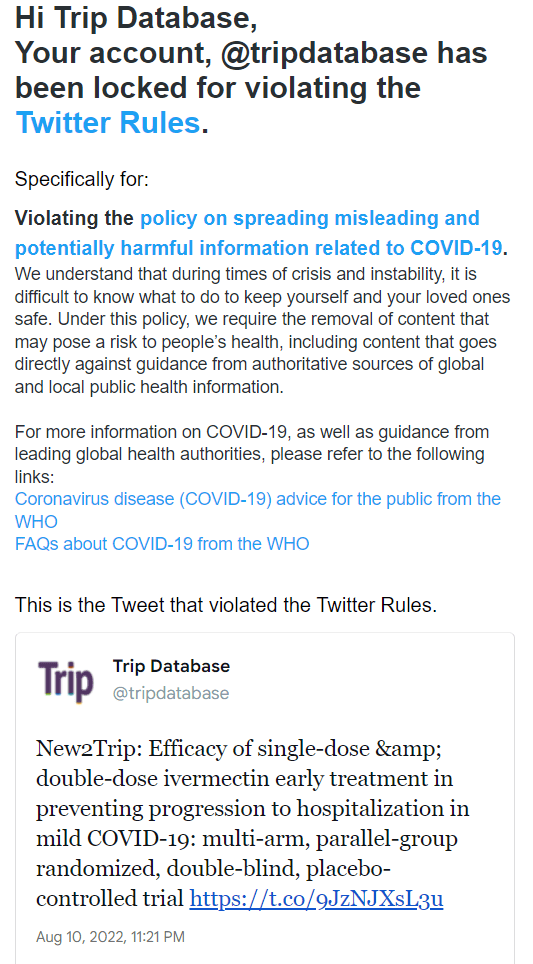
The article in question was Efficacy of single-dose and double-dose ivermectin early treatment in preventing progression to hospitalization in mild COVID-19: A multi-arm, parallel-group randomized, double-blind, placebo-controlled trial. This is featured in Trip as ‘Key Primary Research’ as it has gone through additional layers of quality control via the wonderful EvidenceAlerts system. As they say on their site:
“EvidenceAlerts is an Internet service that notifies physicians and researchers about newly-published clinical studies. Researchers at the McMaster Health Information Unit find the highest quality studies, reviews, and evidence-based clinical practice guidelines from 112 premier clinical journals and these articles are rated by practicing physicians for clinical relevance and interest. Alerts are curated to your own clinical interests.“
Their rating for that particular paper (the banned one) can be seen here. The raters gave it this score:

The conclusion of the actual paper was:
“Conclusion: Single-dose and double-dose ivermectin early treatment were not superior to the placebo in preventing progression to hospitalization and improving clinical course in mild COVID-19.“
So, is the mis-information the claim that ivermectin is no better than placebo?
There is so much information out there on ivermectin e.g.:
“We found no evidence to support the use of ivermectin for treating COVID-19 or preventing SARS-CoV-2 infection” (Cochrane)
“Why You Should Not Use Ivermectin to Treat or Prevent COVID-19” (FDA)
“Do not use ivermectin to treat COVID-19 except as part of an ongoing clinical trial” (NICE)
This is appalling!
UPDATE: the ban was temporary and our account is now back!
Below is a selection of the latest content added to Trip (Click here for a bit of background).
- Mega-Map on Child Well-being Interventions in LMIC’s (UNICEF)
- How FAST Can You Spot a Pneumothorax? Breaking Down a Surprising Result Comparing Ultrasound and Chest Radiograph in Traumatic Pneumothorax (Annals of Emergency Medicine Journal Club)
- Compulsory licensing for expensive medicines (KCE – Belgian Health Care Knowledge Centre)
- British Society of Gastroenterology guidelines on the management of functional dyspepsia (British Society of Gastroenterology)
- Online interventions for reducing hate speech and cyberhate: A systematic review (Campbell Collaboration)
- What is the role of positron emission tomography (PET) in the clinical management of patients with cancer, sarcoidosis, epilepsy, or dementia (Cancer Care Ontario)
- Telehealth for Women’s Preventive Services (AHRQ)
- Nonopioid Pharmacologic Treatments for Chronic Pain (AHRQ)
- Monkeypox multi-country outbreak – first update (European Centre for Disease Prevention and Control)
- Progressive Pulmonary Fibrosis (James Lind Alliance Priority Setting Partnership)
- What are the biggest gaps in evidence about the impacts of climate change on population health in Canada, and adaptation and mitigation strategies that are applicable to Canada? (McMaster Health Forum)
- Multiple sclerosis in adults: management (NICEP
- Monkeypox (NHS England)
- Was the NHS overwhelmed last winter? (Nuffield Trust)
- Multi-Jurisdictional Monkeypox Outbreak 2022 – What We Know So Far (Public Health Ontario)
- The effectiveness of comprehensive health assessments for people with disability (Sax Institute)
- Predicting pain outcomes in primary care (SBU)
- Physical activity is medicine: Prescribe it (Therapeutics Initiative)
- Vitamin, Mineral, and Multivitamin Supplementation to Prevent Cardiovascular Disease and Cancer: Preventive Medication (U.S. Preventive Services Task Force)
- WHO guideline on self-care interventions for health and well-being, 2022 revision: executive summary (WHO)
More evidence = more joy = more support for evidence-based practice
While we released the new front-end to the site last year we have been busy rewriting the back-end portion of the site. The back-end being the whole document grabbing, processing and indexing side of things – the brain of the site. I visualise it as a car – the body-work is the front-end and the rest is the back-end!
We have virtually finished the back-end work and are currently building a whole new index consisting of over 5 million documents. We’re processing around 275,000 documents a day. Once that’s in place it’ll hopefully be a quick test and then make things live.
The advantages of the new back-end are numerous, including:
- A higher level of automation than before
- Indexing is much quicker
- A lot of the work is cloud-based/distributed making it more resilient/flexible
- Modern code means easier to maintain and fix
Most users won’t notice much difference; possibly more up-to-date content
Once we’re happy we can then start to have fun and develop the site. Given the rewrite has taken over 2 years we’re very keen to start to improve the site and we’ve got lots of threads of work, for instance:
- Guideline and RCT ‘scoring’ system in the short-term and systematic reviews in the longer term
- Experiment with a 3rd layer of search (the site currently only has specific and sensitive)
– Title (specific)
– Abstract
– Body (sensitive) - Experimenting with a machine learning/deep learning search algorithm – this is a project we’ve recently started and will have the initial results mid-summer
- Improve the Advanced search
Happy days!
As part of Trip’s work with Ariadne Labs (helping to support the roll-out of Trip Pro across Africa) I ran an online webinar on using Trip. One question related to restricting content to African evidence. While we don’t support that, we do have a filter for LMIC (Low and Middle Income Countries) content. It can be found here on the results page:
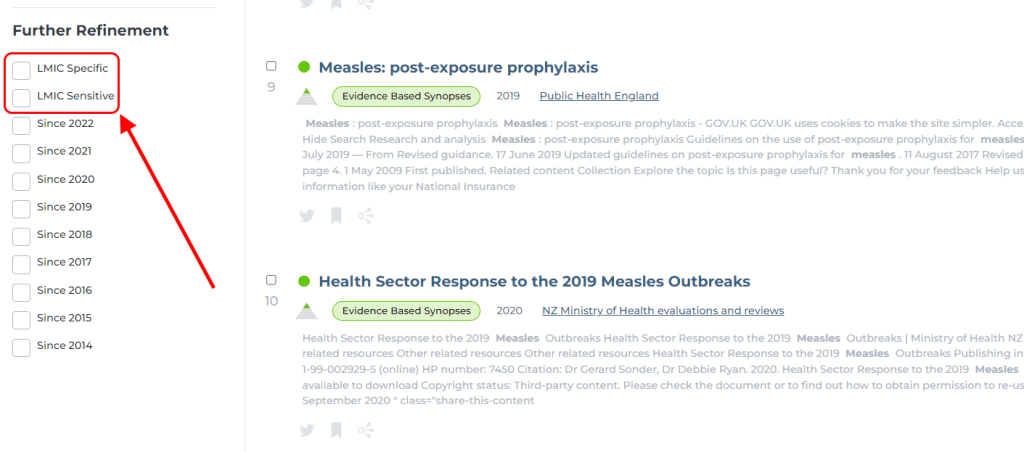
There are two options:
- Specific – if the document contains any of the filter terms in the title
- Sensitive – if the document contains any of the filter terms anywhere in the document
Below is an example search
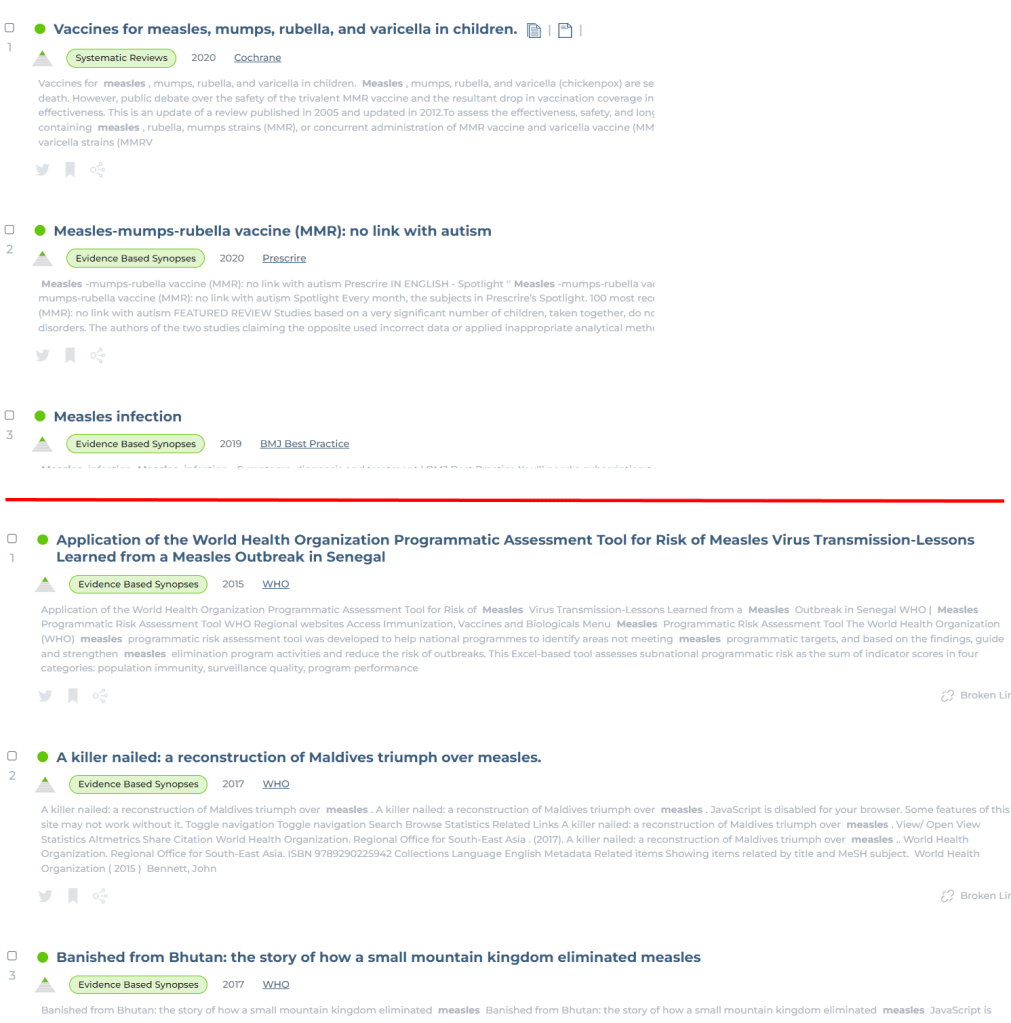
It’s a simple system but works well and, pleasingly, the feedback was very positive.
I’ve just uploaded the latest batch of manually curated records, a total of 613 new articles. This number is small, relative to the larger number we automatically grab, but it typically represents the content at the top of the evidence pyramid.
Each month hundreds of sites are visited to explore if they have published any new evidence, if they have this is placed in a spreadsheet before uploading to the site. We record the following bits of data for each record:
- Publication
- Title
- URL
- Year
When we have finished the monthly collection we upload it to our system and that does the rest. New content is typically available by the next day and often much sooner.
Below is a small sample of the records added this month:
- Opioid Treatments for Chronic Pain (AHRQ)
- Acute Lymphoblastic Leukemia in Adults (Cancer Care Alberta)
- Systematic review of needs for medical devices for ageing populations (WHO)
- Addressing Social Determinants of Health and Mitigating Health Disparities Across the Lifespan in Congenital Heart Disease (American Heart Association)
- Remote monitoring of patients with COVID-19 (KCE – Belgian Health Care Knowledge Centre)
- Pacritinib (Vonjo) – To treat intermediate or high-risk primary or secondary myelofibrosis in adults with low platelets (FDA)
- Factors associated with outbreaks of SARS-CoV-2 in nursing homes (HIQA, Ireland)
- Paediatric Intensive Care Nutrition (James Lind Alliance Priority Setting Partnerships)
- Gout: diagnosis and management (NICE guideline)
- Digital smartphone intervention to recognise and manage early warning signs in schizophrenia to prevent relapse: the EMPOWER feasibility cluster RCT (NIHR HTA)
- Peanut allergy: peanut-avoidant diet and access to adrenaline injector pens (Prescrire)
- Lipoedema – diagnosis, treatment, and experiences (SBU)
- Impaired Visual Acuity in Older Adults: Screening (US Preventive Services)
- Monkeypox: diagnostic testing (UK Health Security Agency)
- Regulation and financing of prenatal screening and diagnostic examinations for fetal anomalies in selected European countries (Austrian Institute for Health Technology Assessment)
The evidence above is a joy to see and represents a small fraction of the total uploaded each and every month.
Having great content is a key element of Trip’s continued success, that’s why we spend so much resource on it!


Recent Comments