Search

Trip Database Blog

Liberating the literature

Author

jrbtrip

Trip tiles

We’ve been live, as a Freemium service, for a little over two weeks.  In my more pessimistic (pre-launch) moments I was thinking that at this stage I may be having to abandon the whole idea as no-one was purchasing Trip.  However, I’m delighted that this is not the case!  We’re massively ahead of schedule and as such we’re accelerating various upgrades that we’d hoped to do towards the end of 2015.

Even more exciting, we’re thinking of new ideas!

One idea springs from my desire to do something interesting with the Timeline.  The Timeline records your searches and articles viewed on Trip and not much else.  So, one idea is to create something called Trip Tiles!  A fresh tile would be created with every new search and at the top of the tile would be the search terms and underneath would be the articles viewed.  In many ways this is what the timeline currently does.  But I think there’s the potential to link other people’s searches.  So, you might search and find three articles and as part of that process we highlight that 1 or more of the articles has been viewed in someone else’s timeline and offer you the chance to see their tile.

Best illustrate that with one of my legendary attempts at a picture (if we roll out this feature we’ll get them properly designed):
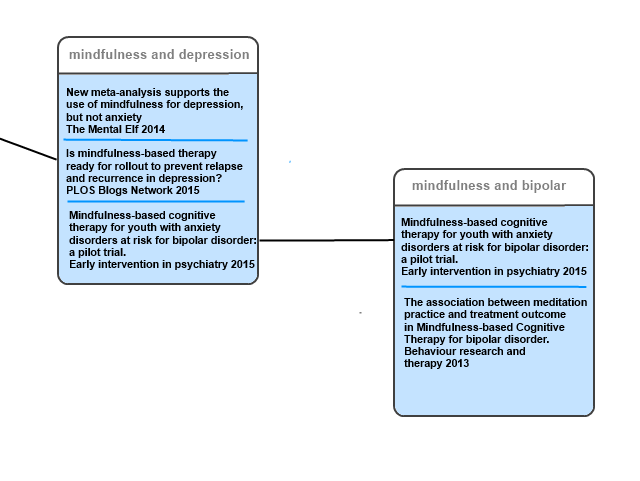
You could go from tile to tile both browsing and looking to see if you’ve missed any useful articles that someone else has already found.  Not only that you can see what search terms they’ve used – again possibly useful.
How we’d implement this would be a challenge, but I’d see that as an interesting challenge not a particularly tough one!  Any feedback on the idea would be appreciated – comments on the blog or via email: jon.brassey@tripdatabase.com
Clinical Trials in Trip

Clinical trials are a vital element of evidence-based healthcare.  And, increasingly, trial registries are being searched as part of evidence synthesis activities.

As Trip’s main role is to help users find important evidence it’s natural we wanted to include clinical trials in our search index.  The fewer barriers there are to finding evidence the more likely it is to be used.  So, combining clinical trials in our search index makes them easy to find and therefore more likely to be used – simple really!

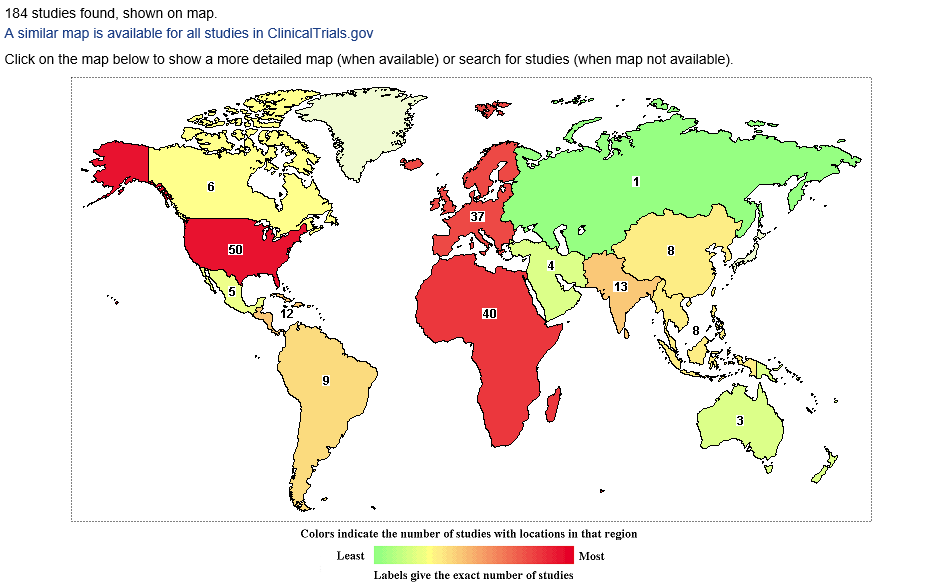
Trip obtains trials from the American ClinicalTrials.gov website, a site with over 190,000 clinical trials.  The site is a registry and results database of publicly and privately supported clinical studies of human participants conducted around the world.  To be clear, it is a global database as the image below shows (for a search for measles).

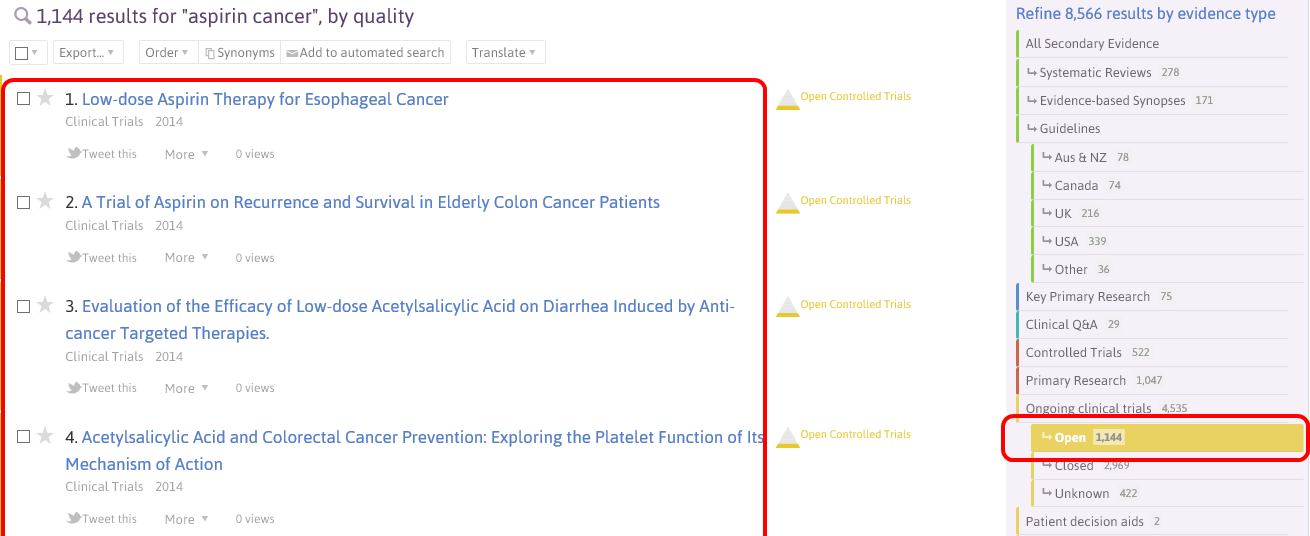
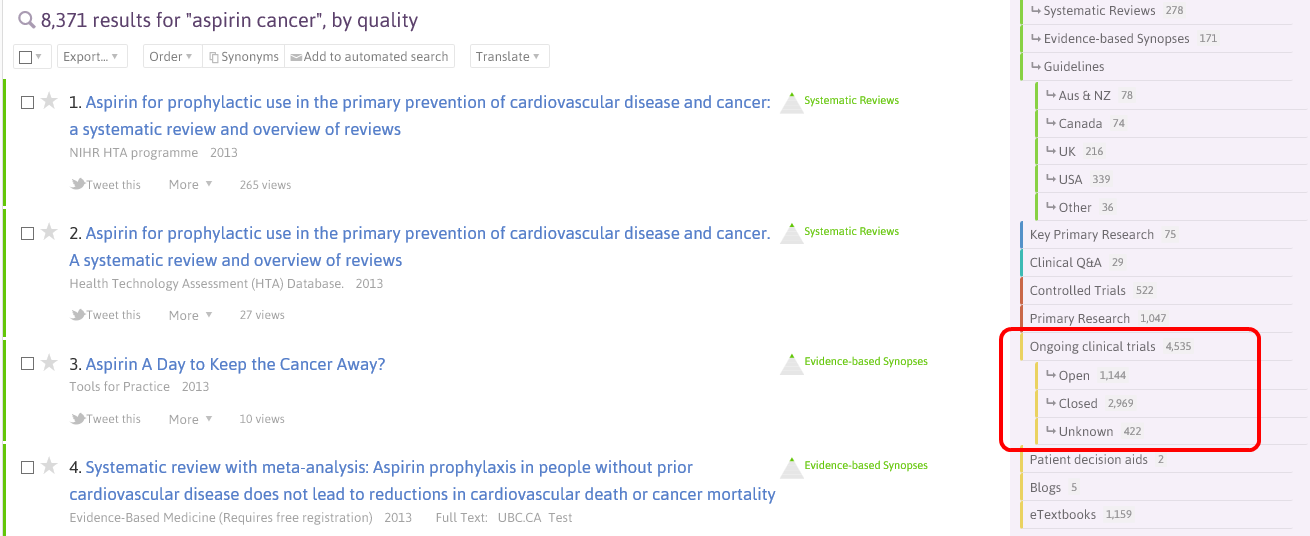
As ever one of Trip’s mains strengths is simplicity.  Log in with your Premium account and search, this example is for a search for aspirin and cancer

In the above image the clinical trials are highlighted and you can see that there are three types:

  • Open – trials that are recruiting
  • Closed – trials that are either not yet open or have finished recruiting
  • Unknown – often the trials aren’t updated so clinicaltrials.gov are unsure of the status

If a user clicks on the ‘Open’ clinical trials you get the following:

It really is simple.  Evidence really is simple with Trip.

To access this and the many other benefits of Trip Premium sign-up now via this link (NOTE: Institutional subscriptions are available).  If you’re unsure or you require further details of Trip’s great power see our beautiful infographic

Institutional pricing

Who thought it’d be so complicated to secure a suitable scheme for institutions.

Initially we had intended for institutions to estimate the number of likely users and this has had two unforeseen consequences:

  • Those purchasing the license are uncomfortable guessing. It requires extra work and a bit of guesswork, which leads to the second point…
  • What if they’re wrong – are there consequences?

So, between them it doesn’t work!

The next method I explored was by size of organisation but is that an accurate way to assess size?  Some publishers use full-time equivalent staff while others use full-time equivalent users!  The latter is to ensure students are counted in a universities ‘head count’ – otherwise the majority of users could be unpaying students!

The current favourite is based on the PsychInfo method which is slightly more complex but more flexible.  How we’re planning to adopt it is to have four main types of organisations:

  1. Universities
  2. Hospitals/health centres
  3. Government/public sector
  4. Corporations

Each of these will be divided into 3-4 sizes e.g. very small, small, medium and large.

This approach should be familiar with those involved in purchasing so hopefully it’ll be less problematic.  But what I am keen to stress is, if in doubt, get in touch and discuss AND negotiate..!

The first 24 hours

Its been 24 hours since the new, Freemium, version of Trip went live.  A few things I’ve learnt:

  • People have not been openly hostile about us moving to the new business model, I was expecting some abuse. I got some mild complaints from Twitter – but if that’s the worst of it.
  • People seem happy to pay and we have a number of paying customers.  Before we went live I was trying to think what might be good, bad and terrible and couldn’t actually come up with anything sensible.  However, the response so far has been encouraging.  But, I do need to stop checking the payments system every hour.
  • Institutional interest has exceeded expectations and it’s been really interesting dealing with many of the queries.
  • Internet Explorer (version 8) is not liked by Stripe, our payment system.
  • The system to reset passwords was a bit naughty and refused to send out links to reset the passwords.  Fortunately, that is now fixed!
  • I’m beginning to better understand some of the background functionality that I’d been not really thinking about.
  • I really need to think about VAT when setting up a payments system.

I think the biggest realisation is that, to make this model work, will require significant hard work on my part!  Anyone out there with (a) good sales skills (b) spare time (c) will to work on payments by results??

The New Trip Database

The new version of the Trip Database is live and to help celebrate we’ve produced a beautiful infographic.

While to many the new site will not look massively different there have been some huge changes.  Perhaps the biggest has been the adoption of the Freemium business model.  What was previously freely available at Trip remains, largely, free but for those who want an enhanced service there is a Premium (paid for) service.  We have adopted this model based on the absolute need for financial security. 

So, what do those purchasing the Premium model get?

More content

  • Approximately an extra 100,000 systematic reviews (including systematic review type content such as HTAs), more than double available via the free Trip.
  • Millions of free full-text articles
  • Ongoing clinical trials database of over 175,000 clinical trials
  • Access to a large medical image database
  • Tens of thousands of clinical videos

More functionality

  • Export of records to reference management software
  • The ability to easily exclude certain content types (e.g. eTextbooks)
  • Trip educational credits
  • Article views, see which articles are most popular for your search

Other things

Another new feature is moving to a more secure site with a new password system (this is for both free and premium users).  This will require users to renew their login/password details but it’s a one-off – so hopefully not too traumatic.

Finally, and mentioned above, is the new Trip Evidence Service. Run by experienced and skilled information experts the Trip Evidence Service can provide various services: formal literature searches, horizon scanning and evidence reviews. Given the varied staff skills the service can also offer bespoke information services.

So, why delay, click here to upgrade to the new Premium Trip today (click here).  NOTE: Institutional subscriptions are available,

Coming soon

We’ve moved in to the final stages of testing for the new site.  If you’ve not seen it already, we posted a ‘taster’ around ten days ago. Assuming the testing goes well, we aim to go live over the weekend of the 16/17th May.

As well as the upgrades we’re moving to a new and more secure site.  The only thing you’ll notice is the need to change your login and password.  This is a necessary ‘discomfort’ as the old system was very old and not particularly secure, so there was a pressing need to upgrade!

This is a really important milestone for Trip.  Assuming it goes well and a reasonable number of users (and organisations) sign-up to we will be financially stable – the first time in years.  It should give us a solid foundation to base on next tranche of improvements – based on the work highlighted in this blog post.

Dental evidence

As part of a wider piece of work I’ve been looking through the search logs and clickstream data associated with the dental specialty.  It’s interesting, and the following information is based on the 1,100+ registered users on Trip who have ticked the clinical specialty of dentistry. 

Top twenty search terms, most frequently used at the top

  • caries
  • gingivitis
  • periodontitis
  • dentistry
  • orthodontics
  • dental caries
  • dental implants
  • restorative dentistry
  • periodontal disease
  • oral cancer
  • Caries Risk Assessment
  • Medical errors
  • dental public health
  • fluoride
  • hypnosis
  • dental materials
  • endodontic outcome
  • pit and fissure sealants
  • pediatric dentistry
  • Patient Safety

And the top twenty articles are as follows:

  1. Pregnancy and gingival inflammation – Dental Elf
  2. Patients with Amalgam Restorations Are Not at a Significantly Greater Risk for Developing Health Complications Than Those With Composite Restorations – UTHSCSA Dental CATs
  3. The Use of Dental Crowns for Vital and Endodontically Treated Teeth: A Review of the Clinical and Cost-Effectiveness and Guidelines – CADTH
  4. Dental interventions to prevent caries in children – SIGN
  5. Dental Implants and Conventional Prosthetics: Comparative Clinical Effectiveness and Safety – CADTH
  6. Composite Resin and Amalgam Dental Filling Materials: A Review of Safety, Clinical Effectiveness and Cost-effectiveness – CADTH
  7. Conscious (Moderate) Sedation Can Be Used Safely On Patients With Obstructive Sleep Apnea – UTHSCSA Dental CATs
  8. Diagnosis and Treatment of Obstructive Sleep Apnea in Adults – AHRQ
  9. 12-Year Survival of Composite vs. Amalgam Restorations – J Dent Res.
  10. Methods of Diagnosis and Treatment in Endodontics – SBU
  11. A Randomized Clinical Trial Comparing At-Home and In-Office Tooth Whitening Techniques: A Nine-Month Follow-up – J Am Dent Assoc.
  12. Composite resin and amalgam dental filling materials: a review of safety, clinical effectiveness and cost-effectiveness – NHS CRD (HTA record of number 6 above!)
  13. Fluoride varnishes for preventing dental caries in children and adolescents – Cochrane
  14. Community Water Fluoridation in Canada ? Trends, Benefits, and Risks – National Collaborating Centre for Environmental Health
  15. Flossing for the management of periodontal diseases and dental caries in adults – Cochrane
  16. Interventions for replacing missing teeth: antibiotics at dental implant placement to prevent complications – Cochrane
  17. Oral Appliance Therapy and Continuous Positive Airway Pressure Demonstrate Similar Improvements in the Treatment of Mild/ Moderate Obstructive Sleep Apnea – UTHSCSA Dental CATs
  18. Cost-effectiveness of a long-term dental health education program for the prevention of early childhood caries – NHS EED
  19. Prosthetic rehabilitation of partially dentate or edentulous patients – SBU
  20. Primary clinical care manual (7th edition, 2011) – The State of Queensland (Queensland Health) and the Royal Flying Doctor Service (Queensland Section)


Evidence Live, systematic reviews and the US Air Force

I’m just back from the wonderful Evidence Live.  While I was away I saw this news story Is the West losing its edge on defence? and I was particularly drawn to the following passage:

The military have also contributed to their own misfortunes by conspiring with defence contractors to build ever more expensive weapons that can only be afforded in much smaller numbers than those they are supposed to replace.

Pierre Sprey, chief designer on the F-16 fighter noted the ruinous consequences of buying stealth aircraft at hundreds of millions of dollars a copy.

“It’s a triumph of the black arts of selling an airplane that doesn’t work,” he said.

This fits in very nicely with my perspective on systematic review methods, and was one of the main threads in my presentation on the future of evidence synthesis.  The current methods of systematic review production are costing way too much for what they deliver.  If you consider that the majority of systematic reviews rely on published trials they are inherently unreliable.

In the EBM world we’re buying F-16s…!

More to follow on this theme.

UPDATE: The wonderful Anne Marie Cunningham has pointed out (see comments) has pointed out that the consequence is of buying the really expensive stealth fighters (not F16s).  That’s a consequence of rushing a blog post so soon after a vigorous conference!  The point remains – purchasing too expensive planes has caused massive problems. 

Blog at WordPress.com.

Up ↑