A user asked if we could bring Trip’s evidence lozenges into AskTrip references, so evidence levels are easier to spot at a glance. You asked, we delivered.

A user asked if we could bring Trip’s evidence lozenges into AskTrip references, so evidence levels are easier to spot at a glance. You asked, we delivered.

Just over six months ago, we quietly launched AskTrip with a simple aim: to help clinicians get clearer, evidence-based answers to real clinical questions. Yesterday, AskTrip answered its 10,000th question – a milestone that genuinely makes us pause. The 10,000th Q&A was What are the legal obligations of healthcare institutions when allegations of abuse arise concerning safeguarding vulnerable individuals? Not a typical clinical question but it still a small moment that represents thousands of clinical uncertainties explored, clarified, and shared.
For me personally, this marks a much longer journey. Trip originally began with ATTRACT, a manual Q&A service started in Gwent, Wales in 1997 alongside Chris (my business partner at Trip), with the simple aim of helping clinicians get evidence-based answers to real clinical questions. AskTrip feels like a natural continuation of that mission: lowering the barriers to high-quality evidence and making it easier to disseminate trustworthy answers at scale.
We’re already looking ahead. The next 2–3 months will bring significant changes and improvements as AskTrip enters its next phase. But before ploughing on, it feels right to pause, reflect, and briefly bask in this milestone. Ten thousand questions answered – and many more to come.
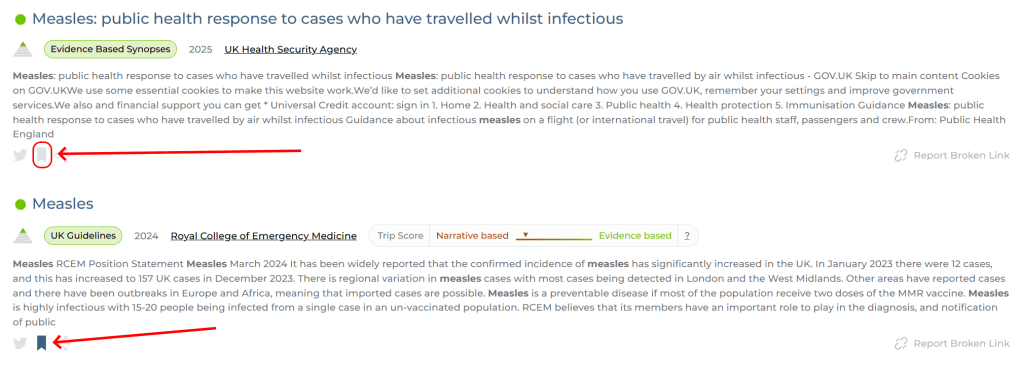
At the end of last year we rolled out a fresh new look to our bookmarks and search history in Trip. We have followed on with this by extending the bookmarking to AskTrip.
You can see the bookmark icons on the results pages for search and also, as shown below, Past Questions. The red arrow indicating the icon:
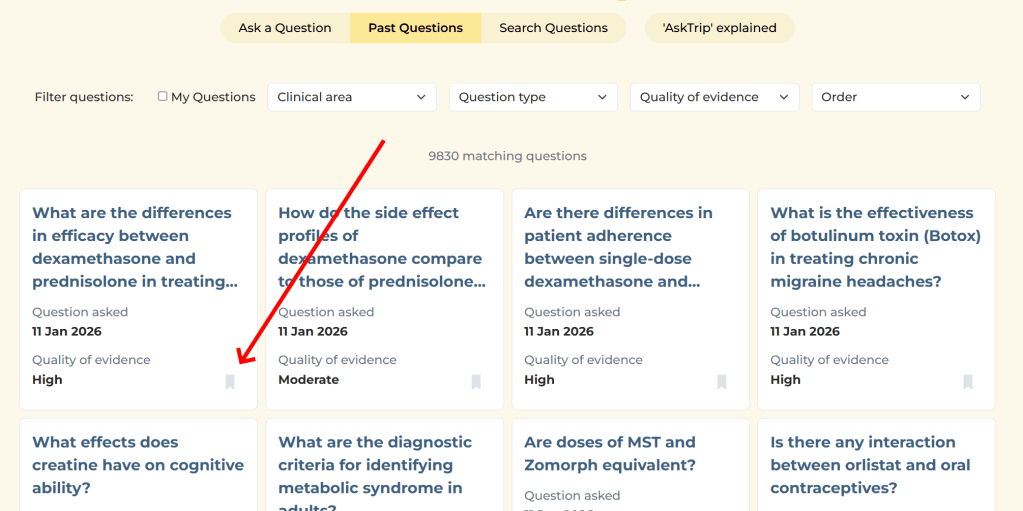
And, on individual answers:
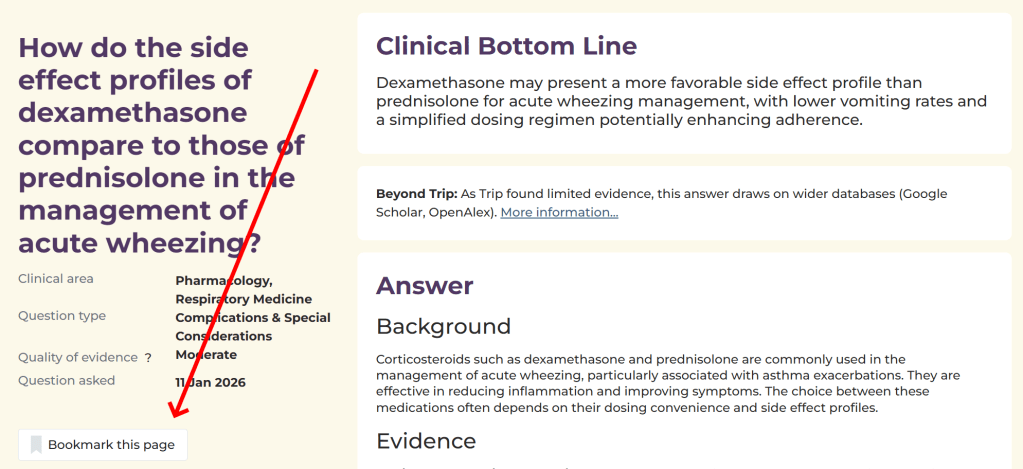
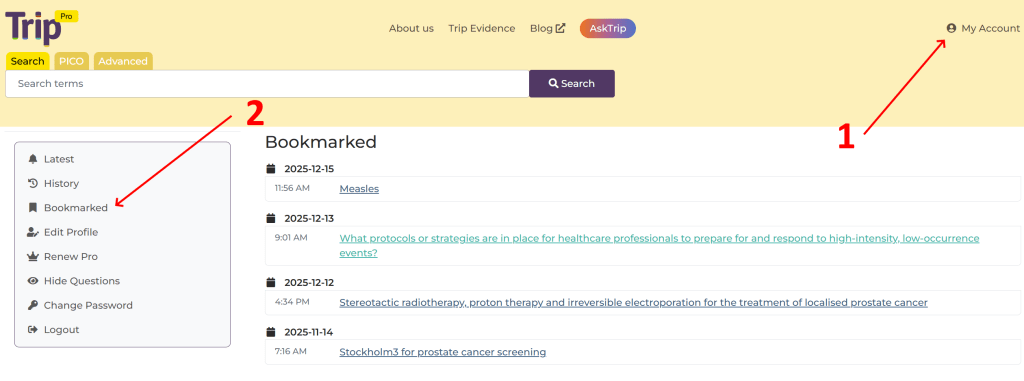
And, to view them, I go to Bookmarked (via My Account) and you see this:
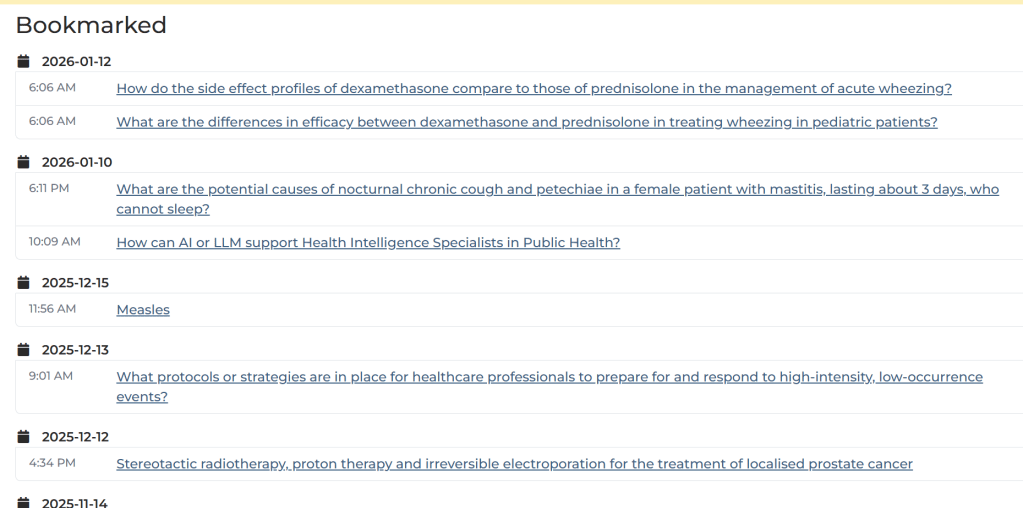
Simple and powerful.
This year-in-review reflects on what Trip achieved during 2025 and looks ahead to our plans for 2026. A major milestone this year was the launch of AskTrip, which has rapidly become a core part of Trip’s mission to support clinical decision-making. Alongside continued development of the main Trip platform, 2025 was a year of meaningful progress in how clinicians and information specialists access, explore, and use trustworthy evidence.
Over the past year, Trip experienced substantial growth, with a 60% increase in unique users and a 43% year-on-year rise in page views generated by clinicians and information specialists worldwide.
When viewed alongside our previously published impact evaluations – which showed that 40.77% of searches led directly to improvements in patient care – these usage figures suggest that Trip continues to play a meaningful and growing role in clinical decision-making and patient care globally.
(See: The impact of Trip parts 1 and 2)
Systematic Review and RCT scores launched
We introduced scores for systematic reviews and randomised controlled trials, accompanied by a published critique of their strengths and limitations. This reflects Trip’s ongoing commitment to transparency, methodological rigour, and responsible use of evidence indicators.
Improved mobile interface
A redesigned mobile experience now makes Trip much easier to use on the go, supporting faster access to evidence at the point of care.
Expanded journal coverage
We added new journals to Trip, broadening coverage and strengthening the depth and breadth of evidence available to users.
Linking trials across the evidence ecosystem
Randomised Controlled Trials are now directly linked to their trial registrations and to relevant systematic reviews, allowing users to verify trial details easily and see how individual studies fit into the wider evidence base.
Our blog activity increased markedly in 2025, with 91 posts published, compared with 34 in 2024, a 168% increase, driven in large part by the growing number of AskTrip-related posts.
This increase in output was matched by strong audience growth. The blog attracted 40,000 views from 23,700 visitors in 2025, representing a 44% increase in views (from 27,700) and a 57% increase in visitors (from 15,100) compared with 2024. Together, these figures point to both sustained publishing momentum and a steadily expanding readership for Trip’s writing on evidence, search, and clinical decision-making.
AskTrip launched on 25 June 2025, and it quickly became clear that it was meeting a real need. As we approach 10,000 clinical Q&As (a milestone we expect to reach by mid-January) AskTrip has significantly strengthened one of Trip’s core purposes: connecting clinical decision-makers with the best available evidence.
Since launch, we have learned a great deal and made numerous improvements to the service, with further substantial enhancements already planned for early 2026.
The AskTrip sub-site has been viewed nearly 100,000 times by almost 20,000 unique users, demonstrating that this growing repository of clinical questions is not only heavily used, but also valued as a distinctive resource in its own right.
Stepping back, it is hard not to feel a sense of excitement about what this represents. Trip was originally created in 1997 to support the ATTRACT clinical Q&A service, helping answer questions manually using the best available evidence at the time. Nearly three decades later, returning so strongly to clinical Q&A – now at scale, powered by a vastly richer evidence base and modern technology – feels like coming full circle. It is a powerful reminder of why Trip exists: to help clinicians ask better questions, find better answers, and ultimately improve patient care worldwide.
Looking ahead, we already have a full and ambitious programme of work planned for 2026. A major focus will be on improving search, including the use of document chunking and a hybrid lexical–vector search approach. These techniques will enhance both core Trip search results and AskTrip answers by improving relevance, recall, and precision.
For the main Trip platform, we plan to significantly expand the number of indexed clinical guidelines and to explore indexing full-text journal articles, moving beyond abstracts to provide deeper access to the underlying evidence.
AskTrip will continue to evolve rapidly in early 2026, with several major enhancements already in progress:
Looking further ahead, there remain areas where we know we can do better, particularly for certain types of clinical questions. These include country-specific questions, where the academic literature does not always align neatly with national practice or policy, and recency-focused questions such as “What is the latest evidence for…?”, which place additional demands on how evidence is identified and prioritised. We have clear ideas about how to address these challenges, and they will become a focus once the current development programme is complete.
Trip delivered an extraordinary amount in 2025 – made all the more remarkable by the size of our team. What we have achieved this year is a testament not to scale, but to focus, commitment, and a shared belief in the value of trustworthy clinical evidence.
Huge applause goes to Phil, Abrar, AD, and Chris for their outstanding work throughout 2025. None are employees of Trip; all are contractors working part-time – and in some cases very part-time – making their collective contribution even more impressive. Their expertise, care, and persistence underpin much of what Trip and AskTrip have become.
We are also deeply grateful to our users and user group members, whose feedback, questions, and challenges continue to shape everything we do. Trip has always been built with its users, not just for them.
Finally, we have never been the loudest voice in healthcare – but we are quietly committed to helping clinicians make better decisions, every single day.
Inspired by the work of Google (see our post A great example of the power of vector search), we’ve developed a test system based on a subset of Trip documents covering GLP-1 receptor agonists. Rather than relying on a single search method, the system effectively runs two searches at the same time – one keyword-based and one vector-based – and combines what each finds.
Here’s an illustration based on a search for “GLP-1 and neurological disorders”:
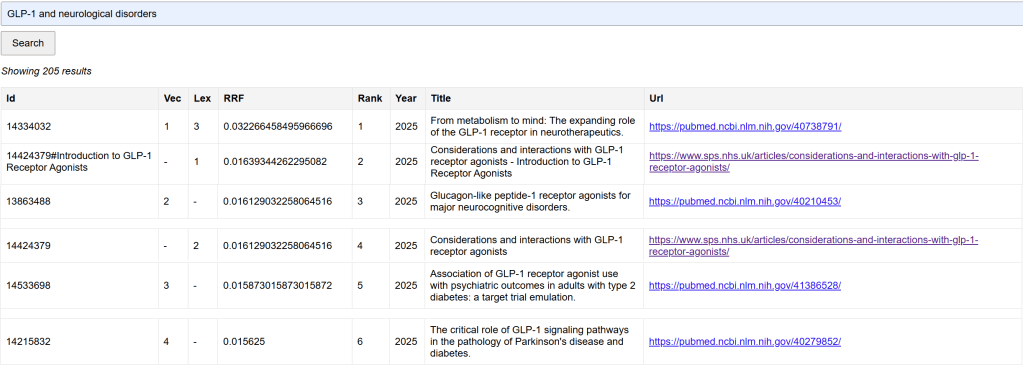
The top result appears in both the vector (Vec) and lexical (Lex) searches. Results #2 and #4 appear only in the lexical search, while #3, #5, and #6 appear only in the vector search.
The vector-only results do not contain the exact term “neurological disorders”. As a result, a traditional keyword-based search would have missed them unless extensive term expansion or synonymisation had been applied. This illustrates how vector search can surface conceptually related evidence that would otherwise be invisible to purely keyword-based approaches.
Another example comes from a search for “GLP-1 and anxiety”. The top results break down as follows:
Appeared in both vector (Vec) and lexical (Lex) searches
Vector (Vec) only — no explicit mention of anxiety
Lexical (Lex) only
The vector-only results are closely related to anxiety through overlapping concepts such as depression and suicidality, despite the term itself not appearing. This illustrates both the strength of semantic search and the potential for ambiguity in how relevance is interpreted.
Final thoughts
These examples highlight both the potential and the challenges of vector-based and hybrid search. The ability to surface conceptually related evidence that would be missed by traditional keyword search is powerful, while also raising important questions around relevance, explainability, and user trust – particularly in a clinical context.
We will continue to develop and refine this technology, with the intention of rolling it out across Trip and AskTrip in the near future. Our focus is on striking the right balance between precision and discovery, and ensuring that any changes meaningfully improve the search experience for clinicians and information specialists. This represents a significant evolution in how Trip works.
Crucially, this will remain a user choice. Users will be able to opt in to – or opt out of – vector-based and hybrid search, retaining full control over how their searches are performed.
This is an exciting new addition to AskTrip: you can now browse Q&As by most viewed.
Ever wondered which clinical questions other users are spending time on? This feature lets you see, at a glance, what’s capturing the most attention across AskTrip.
First, navigate to Past Questions:

Next, open the Order drop-down menu and select Most viewed:

The Q&As will then automatically rearrange based on popularity:
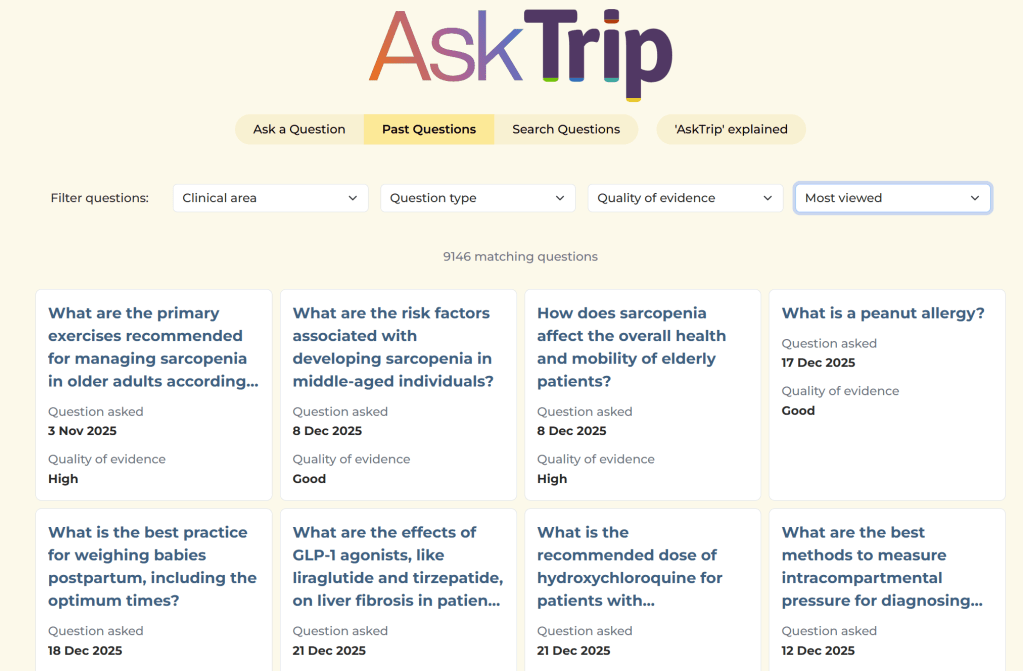
At the moment, the most viewed Q&As are all focused on sarcopenia, highlighting strong interest in muscle health and ageing. The top questions include:
This kind of insight offers a fascinating snapshot of what clinicians are actively looking for – and may even prompt ideas for learning, teaching, or service development.
NOTE:
I posted an outline of vector search the other week and shortly afterwards became aware of some work Google has been involved in: Accelerate medical research with PubMed data now available in BigQuery. In essence, Google has created a vector-based search system over PubMed Central.
We set up a small test-bed to explore whether this approach could be incorporated into Beyond Trip. We’ve been testing it using clinical questions, traditional keyword searches, and queries that sit somewhere in between – and the results have been genuinely impressive.
One search in particular, “Creatine use and cognitive ability”, clearly demonstrated the value of vector search. When we ran this query through the test-bed, the top result was The effects of creatine supplementation on cognitive function in adults: a systematic review and meta-analysis.
I then repeated the same search in Trip using the identical wording (Creatine use and cognitive ability), and that paper was not retrieved. However, when I reran the Trip search using “cognitive function” instead of “cognitive ability”, the paper appeared immediately. The content of the paper is the same in both cases – only the phrasing of the query changed. So, seamlessly the vector search was able to ‘understand’ that cognitive function and cognitive ability are virtual synonyms.
What this neatly illustrates is how vector search moves beyond literal term matching and begins to reflect clinical meaning. By recognising that “cognitive ability” and “cognitive function” are effectively synonymous, vector search bridges the gap between how clinicians think and how evidence is described in the literature. For tools like Beyond Trip, this has the potential to reduce missed evidence, lower the cognitive burden of searching, and make high-quality research easier to find – even when the wording doesn’t line up perfectly.
We’ve just released a visual overhaul of Bookmarks and Search History in Trip. The functionality is exactly the same — but it now looks a million times better.
Bookmarks
Bookmarks let logged-in users save articles they’ve read or want to come back to later.
To see all your saved articles:
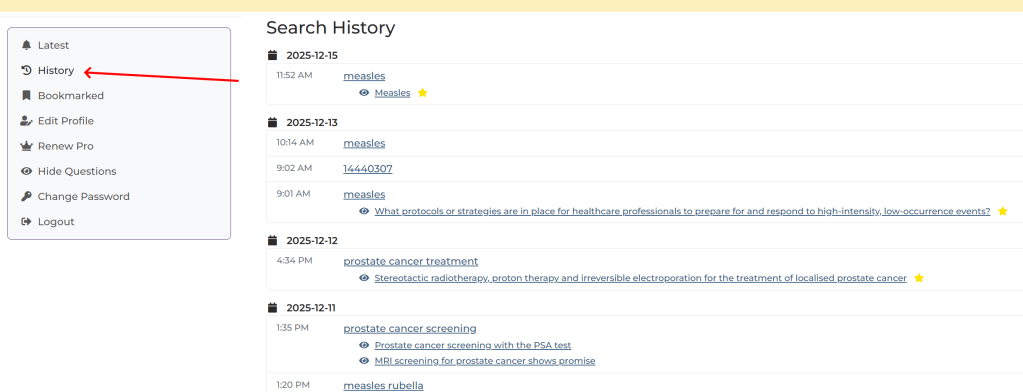
Search history
In the same area of My Account, you’ll find Search History.
Search History keeps a record of:
This makes it easy to revisit previous searches, retrace your steps, and quickly find evidence you’ve already explored.
Looking across clinical questions over time can be revealing, but looking specifically at those where the evidence is limited is particularly instructive. The analysis below draws on the most recent 100 questions submitted to AskTrip that were judged to have limited supporting evidence. Together, they offer a clear view of where uncertainty persists in everyday clinical practice.
Rather than cataloguing all 100 questions, it is more useful to look for patterns. When grouped thematically, these questions highlight recurring areas where research evidence struggles to keep pace with the complexity of real patients, real decisions, and real healthcare systems.
Illustrative questions
These questions expose a recurring challenge: concepts such as “normal” or “prevalence” are often less stable than assumed. Reference ranges may vary by population, measurement method, or clinical context, while prevalence estimates are frequently drawn from heterogeneous or dated studies. The result is uncertainty at precisely the point where clinicians are expected to be definitive.
Illustrative questions
These are situations where the consequences of error are substantial, yet randomised trials are difficult or impossible. Evidence tends to be indirect, observational, or consensus-based, requiring clinicians to weigh competing harms rather than follow clear algorithms.
Illustrative questions
Questions like these reveal how much clinical pharmacology relies on extrapolation. Differences in molecular structure, metabolism, or formulation are assumed to translate into clinical effects, but direct comparative evidence is often lacking – particularly in uncommon or high-risk scenarios.
Illustrative questions
These questions highlight areas where biomedical models alone are insufficient. Evidence is frequently qualitative, context-specific, or culturally bound, yet these considerations are increasingly important – particularly as digital and AI-driven tools are used to assess and support mental health.
Illustrative questions
Here, uncertainty arises not from disease mechanisms but from systems of care. These questions affect safety, efficiency, and patient experience, yet they are often under-studied because they sit outside traditional disease-focused research frameworks.
Illustrative questions
These questions reflect the everyday reality of clinical work: patients rarely match trial populations. Evidence may exist in general terms, but applying it to a specific individual often requires judgement, adaptation, and tolerance of uncertainty.
Taken together, these 100 questions show that limited evidence is not evenly distributed across medicine. It clusters where patients are complex, risks are high, contexts vary, or outcomes resist simple measurement. In many cases, the absence of strong evidence reflects the limits of current research methods rather than a lack of clinical importance.
Recognising where evidence is thinnest is not an admission of failure. It is a necessary step toward more honest clinical decision-making, better conversations with patients, and a clearer sense of where future research effort might be most usefully directed.
 | User feedback on the… on User feedback on the AskTrip A… |
 | Stephen Edwards on User feedback on the AskTrip A… |
 | Ms GL on User feedback on the AskTrip A… |
 | kavyapharmaindia on Finding Evidence or Watching I… |
 | raspberryspeedily3c9… on User feedback on the AskTrip A… |
 Trip Database Blog
Recent Comments