Search

Trip Database Blog

Liberating the literature

Author

jrbtrip

Professions in Trip Profile

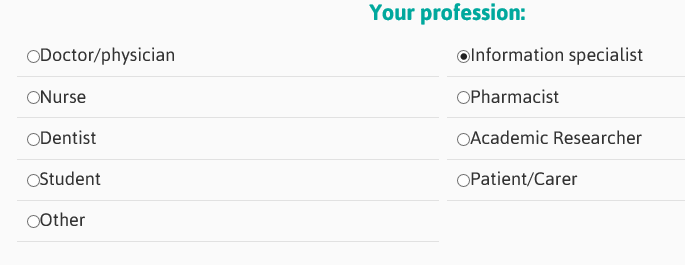
When you register with Trip you are asked to select your profession, the current list is shown below:

The above 9 options are simply not good enough as around a quarter of users select the ‘Other’ option (and I can’t imagine these users are made to feel particularly special!).  Also, as we want to offer increasingly personalised information, the more granular the detail we have on a person the better.  So, in our recent surveys I asked people to tell us their profession and from that I have come up with a more comprehensive list:

Academic researcher
Dentist
Dental – other
Dietician/nutritionist
Doctor/physician – other
Doctor/physician – primary care
Doctor/physician – secondary care
Educator
Librarian/Information specialist
Medical laboratory scientist
Midwife
Nurse
Nurse lecturer
Nurse practitioner
Nurse, clinical specialist
Ophthalmologist
Optometrist
Paramedic
Patient/carer
Public health professional
Pharmacist
Physical therapist/physiotherapist
Physician assistant
Retired
Speech and language
Student
Other

Expect to see the changes in early 2015

Communicating the evidence ‘types’

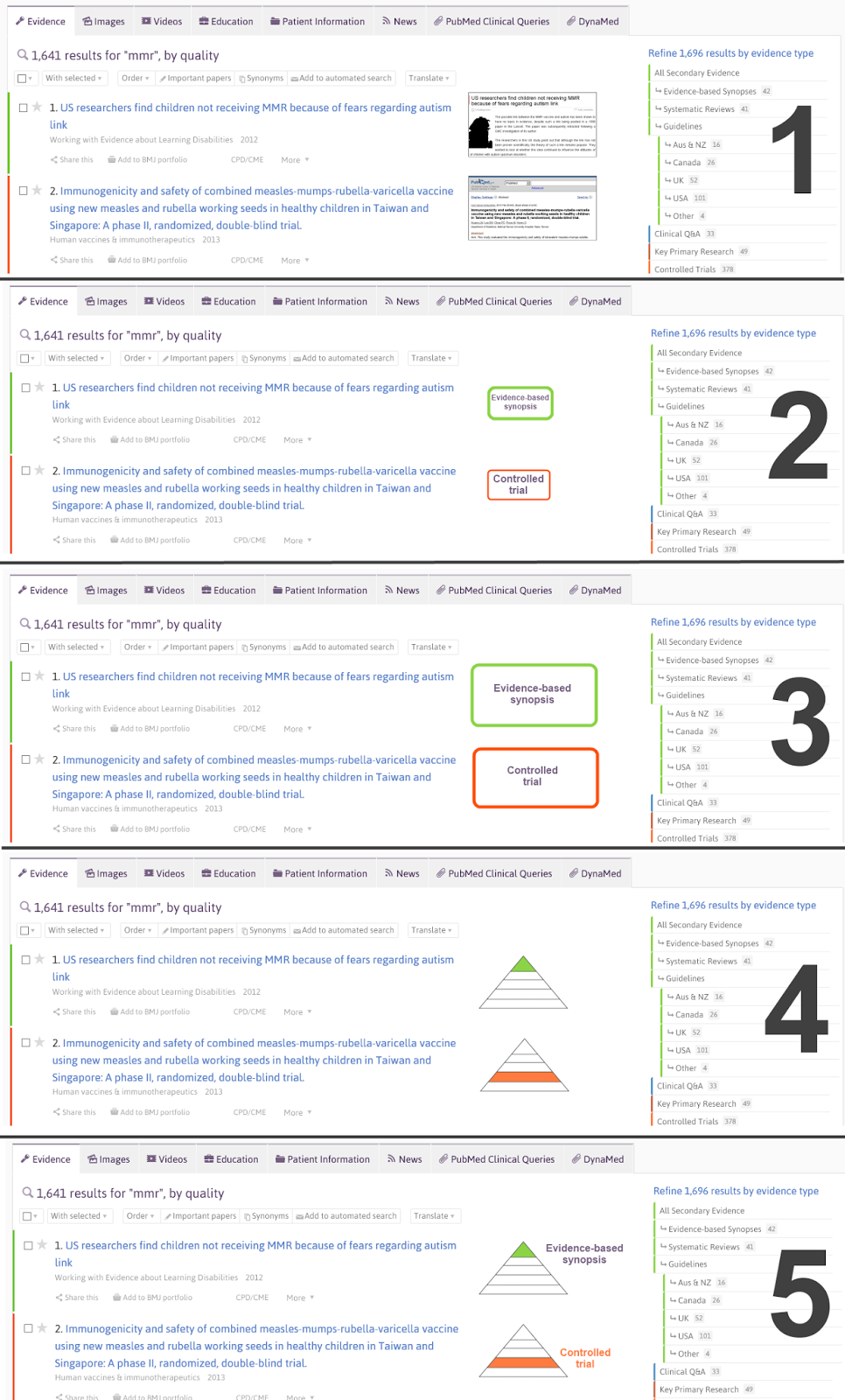
Those who use Trip will possibly have noticed small thumbnails to the right of each search result (see image 1 below).  The idea is that they are a small screenshot of the actual page which people can rollover to see a preview of the actual result  They are problematic as it’s currently broken so we only have screenshots for around half of them.  Also, they are moderately resource intensive.

So, we need to decide to fix them or remove them or replace them with something else – hence this post.

One idea I’ve got is to use the space to give additional information to users to help them understand the evidence they’re looking at.  For instance, we could use it to give a clearer idea of the likely strength of evidence.  We currently do this via the use of colour flashes but unfortunately many people miss this.  The colour flashes link the individual article to the colours used in the filter section (so green indicates higher quality evidence etc.).  Below are some images that are an attempt to show what it might look like.  I’d appreciate you looking at them (click on the image to enlarge it) and then go to this survey to let us know what you think.  There are only 4 questions so it shouldn’t take long.

Thank you in advance.

Strange results

Barb, one of our volunteers on our Twitter accounts, commented a while ago about seeing some strange results on Trip, so I asked her to send any news ones she found to help me understand what was going on.  She was looking for new articles in Trip that are returned for the search ‘immunisations’.  Many were fine but a few weren’t, for instance:

  • Multiple sclerosis: management of multiple sclerosis in primary and secondary care
  • Health visiting
  • Economic Evaluation of Complex Health System Interventions: A Discussion Paper
  • British Guideline on the management of asthma
  • Developing and Evaluating Methods for Record Linkage and Reducing Bias in Patient Registries

Now, these are not specifically about immunisations but they’ll all make reference to it.  For instance the top result has the following:

Vaccinations
1.4.2 Be aware that live vaccinations may be contraindicated in people with MS who are being treated with disease-modifying therapies.

We return all the results that match the search terms (and/or synonyms).  However, our algorithm is designed to emphasise those results which are more relevant.  So, ordinarily, if you do a search with lots of results the relatively irrelevant results don’t appear (well they do, but not till way down the results).  However, if you look for things with few results (perhaps an unusual condition or you heavily restrict the results) you are more likely to see ‘strange’ results.

So, what can we do? I see three options:

  1. Leave it ‘as is’ and hope people don’t get put off by the occasional result they find strange.
  2. We allow users to set a relevancy cut-off themselves.  Each search result gets a score from 0 to 1 (with 1 being very relevant) and every result that matches the search term gets at least 0.0001 and therefore can be shown in the results.  We could give users a ‘slider’ to allow them to chose what cut-off they want, So some might chose 0.1 while others might chose 0.3.
  3. We effectively borrow a concept from PubMed’s Clinical Queries which has a narrow and broad search.  The narrow search returns fewer results, they’re more relevant but you may miss a few (it’s a specific search) while the broad search gets more results but more irrelevant results (it’s a sensitive search).  So, in effect, Trip currently does a highly sensitive search.  You can see the effects in PubMed for a broad and narrow search for prostate cancer screening:

 My ‘gut’ instinct is the third option.  We, at Trip, experiment to try and arrive at a reasonable relevancy cut-off which is introduced by default on all searches. On the result’s page we highlight that the search is narrow and to make it broad simply press a button.

Feedback please and thank you – again – Barb for the input 🙂

The Trip Answer Engine (again)

With the move to the next upgrade – and a freemium Trip the notion of the Answer Engine appears again. I’ve talked about the Answer Engine for at least 4 years but previously I’ve never had the conviction that it’ll work.  The idea is great: infer a question from the search terms and show ‘the’ answer.

It’s because I like the idea so much I keep coming back to it. I’ve done a mock-up of how it might look.

I’m waiting to hear from one publisher about using their content. If they agree that I can re-use their content it’ll be thousands of Q&As ready to go and I’ll be ready to commit to getting it off the ground.

I’m also talking to other publishers about their willingness to participate. We get Q&As and they get their content in a prime position on Trip, a win:win in my book! Other than that I’ll be undertaking another user survey and will ask then if people want to volunteer to add a few Q&As. If everything falls into place we’ll have a reasonable chance of making it work!

Survey 2014 – initial results

Trip users are amazing – in less than 48 hours of releasing the survey we had 1,0001 responses, at which stage SurveyMonkey closed the survey saying we’d reached the limit!  Apologies if you feel your voice hasn’t been heard, if that is the case email me (jon.brassey@tripdatabase.com), I’d love to hear from you. Given your generosity of time I thought I’d share the initial results highlights…

The top 5 professions represented in the survey

  • Doctor – secondary or tertiary care
  • Doctor – primary care
  • Librarian
  • Other
  • Researcher/scientist

75% of respondents have been using Trip for more than a year with 35% using it for longer than 3 years.

I asked about the most important features relating to our content and these are the top 6 responses (those that were highlighted by more than 30% of the respondents):

  • Largest single searchable collection of ‘evidence-based’ content
  • Largest global collection of clinical guidelines
  • Many more systematic reviews than Cochrane
  • Content is from around the globe, for example USA, UK, Canada, Australia, New Zealand, France, Germany, Japan, Singapore, South Africa
  • Selected collection of PubMed’s leading clinical journals
  • Database of over 500,000 clinical trials

I also asked if there were many surprises – and there were lots of responses.  The main one being the lack of awareness of our image and video collections.  We clearly need to work hard on getting that message out.

I asked about the most important key features of Trip, the following are all those that polled over 30%:

  • Easy filtering of results to restrict to evidence types e.g. systematic reviews, guidelines
  • Monthly alert of new evidence linked to your interests
  • PICO search interface
  • Order the results by quality, relevance or date
  • Easy/Friendly interface with no steep learning curve
  • Advanced search interface
  • Colour coding scheme to make it easier to highlight high quality evidence

Our users seem keen to be alerted to clinical trials, jobs, conferences and books (most polled over 50% approval).

We asked about a Trip Evidence Service and most thought it was a good idea.  However, only 11% thought they would be able to find the money within their organisation.  But I’m encouraged as 11% is still high, given our large user base.

Most people appeared to be broadly supportive/understanding of our need to move to a freemium business model.

I listed a number of possible new premium features and those that polled greater than 20% (only the top 3 were higher than 30%):

  • Add in additional full-text articles
  • Creation of an ‘Answer Engine’ giving you instant answers to your clinical questions
  • PICO+. Based on the popular PICO search make it more user friendly and powerful
  • A ‘Help’ feature so if you can’t find what you need you can ask the wider Trip community
  • Providing education points based on your time using Trip
  • Improved emails highlighting evidence that is more likely to be useful to you
  • Introduce a ‘People who looked at this article, also looked at these articles’ features to highlight related articles
  • Improved export of records

Due to us using colour we asked about colourblindness and 3.2% said they were colourblind.  I’ve no idea how that compares to the wider population.  nearly 30% of the users reported “I am not colour blind and I was not aware that you used colour to help highlight the quality of the results”.  So, another communication challenge for us.

Finally, in looking through the ‘Any other comments’ section I was completely overwhelmed by the messages of love and support.  Knowing that makes my work so much easier.

Survey time

We are planning to make significant changes to Trip in early 2015.

An important aspect of this is better understanding our users; how they use Trip and what features they value.  In addition we’re keen to explore attitudes to various proposed changes.

This is a really important survey so can you please take 5-10 minutes to go through the 14 questions.

Click here to take part in the survey

Thank you.

Economics and EBM

Conflict of interest declaration: Trip’s main aim is to help clinician’s answer their questions using the best available evidence.  As such we have worked, and continue to develop, techniques to hugely reduce the costs of doing systematic reviews.  See (Trip Rapid Reviews – systematic reviews in five minutes, Ultra-rapid reviews, first test results and Trip Rapid Review worked example – SSRIs and the management of hot flashes)

In my presentations to Evidence Live I was (constructively) critical of Cochrane.  This was distilled into two blog posts A critique of the Cochrane Collaboration and Some additional thoughts on systematic reviews.  In the first article I quoted Trish Greenhalgh:

“Researchers in dominant paradigms tend to be very keen on procedure. They set up committees to define and police the rules of their paradigm, awarding grants and accolades to those who follow those rules. This entirely circular exercise works very well just after the establishment of a new paradigm, since building systematically on what has gone before is an efficient and effective route to scientific progress. But once new discoveries have stretched the paradigm to its limits, these same rules and procedures become counterproductive and constraining. That’s what I mean by conceptual cul-de-sacs.”

I quoted Trish as I felt that Cochrane had come to dominate and lead the systematic review paradigm.  But one thing I didn’t write-up at the time and linked with Trish’s quote was my feeling that the methodological rigour and standards set by Cochrane was actually an economic barrier to entry for competitors.  The Wikipedia article on barriers to entry reports:

“In theories of competition in economics, barriers to entry, also known as barrier to entry, are obstacles that make it difficult to enter a given market. The term can refer to hindrances a firm faces in trying to enter a market or industry—such as government regulation and patents, or a large, established firm taking advantage of economies of scale—or those an individual faces in trying to gain entrance to a profession—such as education or licensing requirements.

Because barriers to entry protect incumbent firms and restrict competition in a market, they can contribute to distortionary prices. The existence of monopolies or market power is often aided by barriers to entry.”

Cochrane, due to their dominance, effectively set the standards of what’s deemed acceptable (irrespective of the significant evidence to the contrary – see the previous two blog posts for further information).  This effectively stifles competition. If systematic reviews could be done quickly and easily by anyone the business model of Cochrane would be severely compromised – I can see no other losers (except perhaps pharma).

Perhaps it is a coincidence that most changes to systematic review methods over the years appear to have more to do with increasing the methodological burden (by squeezing increasingly small amounts of bias out of the results) than with reducing the costs?

What has prompted the above post has been the announcement of the winner of the Nobel Prize for Economics. Jean Tirole has won for his work on market power and regulation.  The BBC reports:

“Many industries are dominated by a small number of large firms or a single monopoly,” the jury said of Mr Tirole’s work. “Left unregulated, such markets often produce socially undesirable results – prices higher than those motivated by costs, or unproductive firms that survive by blocking the entry of new and more productive ones.”

Now, that’s got to be a good link – EBM, Cochrane and the Nobel Prize for Economics!

But the point of the post, is not to moan at Cochrane, but to suggest that the systematic review ‘market’ is problematic and there appears to be little appetite to radically change things.  If we want to improve care we need more systematic reviews which means we need to innovate.  And by innovate I don’t mean small iterative improvements, more substantial changes are needed.

Perhaps we could start at first principles and ask why do we do systematic reviews in the first place?  I used to think it was to get an accurate assessment of effect size.  However, if you look at the evidence it’s fairly clear that systematic reviews – based on published trials – are pretty poor in this regard.  But if it’s not that, then why do we do them?  Once we can clearly articulate why we can perhaps better understand how to produce them more efficiently.
Highlighting clinical uncertainties

I’ve been involved in clinical uncertainties for many years.  I had the pleasure of helping create the DUETs database (UK Database of Uncertainties about the Effects of Treatments).  Around the same time Trip released the Tag Cloud of Clinical Uncertainty which was a great experiment. In all aspects of my professional life I like to highlight the importance of clinical uncertainty.  Although the term often unnerves people, I think they feel threatened by the notion.  But, it could be worse, the likes of Iain Chalmers and Muir Gray have often used the phrase clinical ignorance – which is far harsher.

My interest in uncertainties stems from my desire to improve the research procurement process.  The main drive with Trip is to help clinicians answer their clinical questions.  Without knowing the gaps in their knowledge and the evidence base how can you procure suitable primary research or even secondary, evidence synthesis?  Myself and my teams have answered over 10,000 clinical questions so we know how frequently the research base is lacking or not focused on clinical care.  So things need to improve and I think recording uncertainties is a great way to help.

I raise all this as, in my business planning, I’ve spoken to one of the UK’s largest research ‘agency’ and they are keen to work with Trip to better understand users questions and gaps in the evidence base.  So, for me, the answer is to try and capture the clinical questions our users have and when Trip has let them down.  I have a few ideas around this, including creating a PICO+ tool; a step-by-step tool to allow users to easily answer their clinical questions.  The user would start by adding the full question and then we would guide them through the PICO steps (e.g. what is the population, what is the intervention).  At the end they can tell us if their question has been answered.  If not, it’s got a good chance of being a clinical uncertainty. 

Seems like a plan!

The Answer Engine and The Journal of Clinical Q&A

Trip prides itself as a great tool for answering clinical questions. Over 80% of users find the information they need, all or most of the time.  But that’s still not perfect and one idea I keep coming back to is the ‘answer engine’.  The wonderful Muir Gray said, in relation to finding evidence, that three clicks was two clicks too many.  So, the challenge is, is there a way of getting answers based on a single mouse click?

The answer (or perhaps ‘My answer’) is the answer engine.

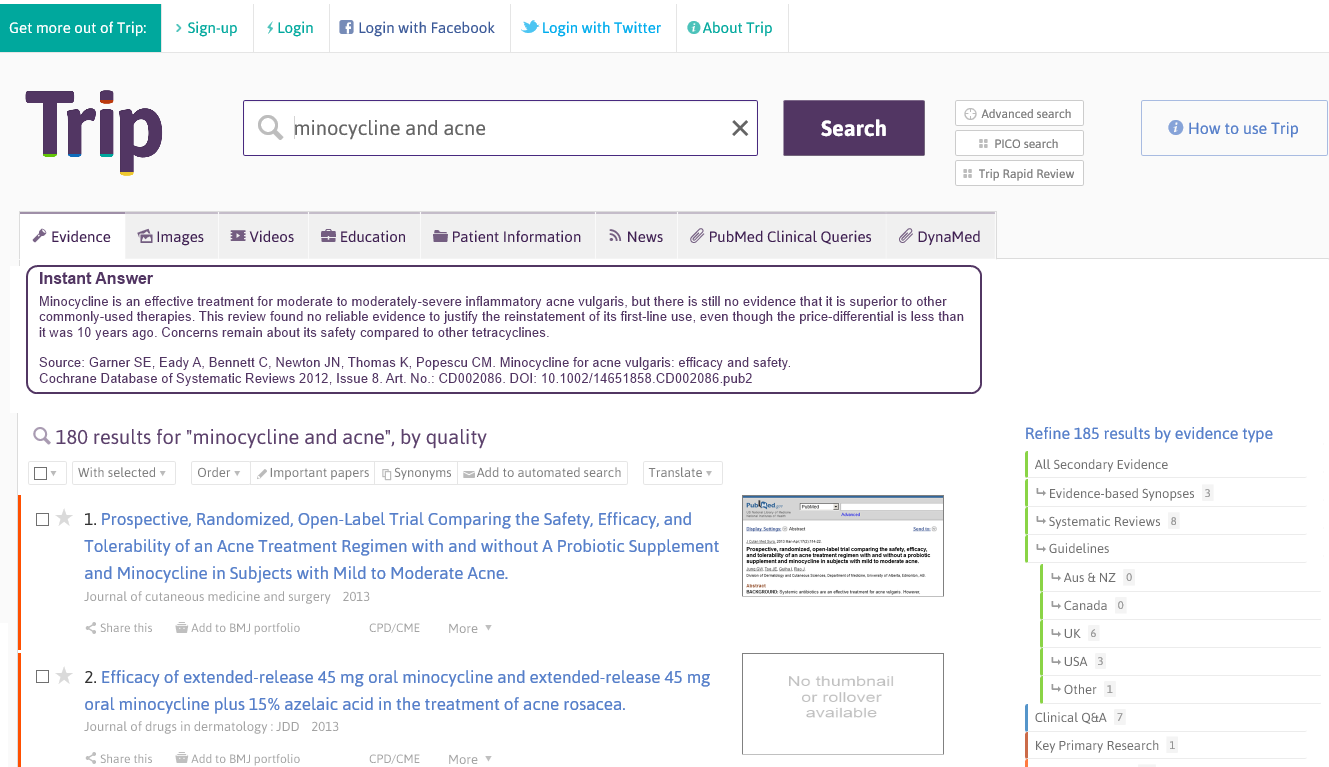
This would involve a system to try and understand the search and display a suitable answer.  So, if a user searches for minocycline and acne we can be fairly confident that they’re interested to know if minocycline is effective in treating acne.  Therefore, we could drop in the following answer:

Minocycline is an effective treatment for moderate to moderately-severe inflammatory acne vulgaris, but there is still no evidence that it is superior to other commonly-used therapies. This review found no reliable evidence to justify the reinstatement of its first-line use, even though the price-differential is less than it was 10 years ago. Concerns remain about its safety compared to other tetracyclines.

This has been taken from a recent Cochrane Systematic Review.  The normal search results would appear beneath the ‘answer’.  The user gets a great answer in one click.

There are a few issues with the above and one is scalability.  Parts of this can be automated but much of it will be manual.  Also, relying of sources – such as Cochrane – means it’s led by the evidence producers not the user.  So, the challenge is to have users supply answers.  Which leads to the Journal of Clinical Q&A.

The idea is to set up a brand new journal dedicated to answering real clinical questions.  Based, roughly on the BestBETs site it will follow a similar structure (e.g. Steroids in lateral epicondylitis).  The clinical bottom line will be pulled through into Trip to act as the ‘answer’ and then users can click to see the full article.

Peer-review is problematic on many levels and Richard Smith (former editor of the BMJ) has frequently criticises the current peer-review process (e.g. A woeful tale of the uselessness of peer review and Scrap peer review and beware of “top journals”).  But how can we improve on it?  I’m not sure we can but I’m open to help!  My current proposal is as follows:

  • Each answer will be reviewed by an in-house team, a sanity check.  Those that seem reasonable will be released into the answer engine as an ‘answer pending approval’
  • We would then ask the wider Trip community to read and rate the answer.  This would borrow from the F1000 approach which uses three classes: Approved, Approved with Reservations and Not Approved.  An article will be considered published when it reaches a certain approval threshold. Note, the F1000 approach is not without criticism (e.g. PubMed and F1000 Research — Unclear Standards Applied Unevenly), hence writing this article with the hope of obtaining help.

Trip would have a good answer and the person who uploaded it will obtain a citation.  The plan is to start slowly, see how it develops but the longer-term view would be to see the answers appear in Medline/PubMed – as currently happens with a large number of the articles in BestBETs.

The above is an idea, a work in progress.  I think there is every chance this can become a reality but a little help in refining the concept would be really good.

Blog at WordPress.com.

Up ↑