Search

Trip Database Blog

Liberating the literature

Category

http://schemas.google.com/blogger/2008/kind#post

Clickstream data and results reordering

Recently I’ve been discussing the potential for using our clickstream data (our earliest post on the subject being from October 2013).  After a post earlier this year Ok, I admit it, I’m stuck I have been contacted by two separate people who have both been very generous with their time and on Friday I met with one of them who talked me what they had found.

Before I share the results there are a few points to consider:

  • This really is early days and it needs some imagination to see how it would work on Trip.
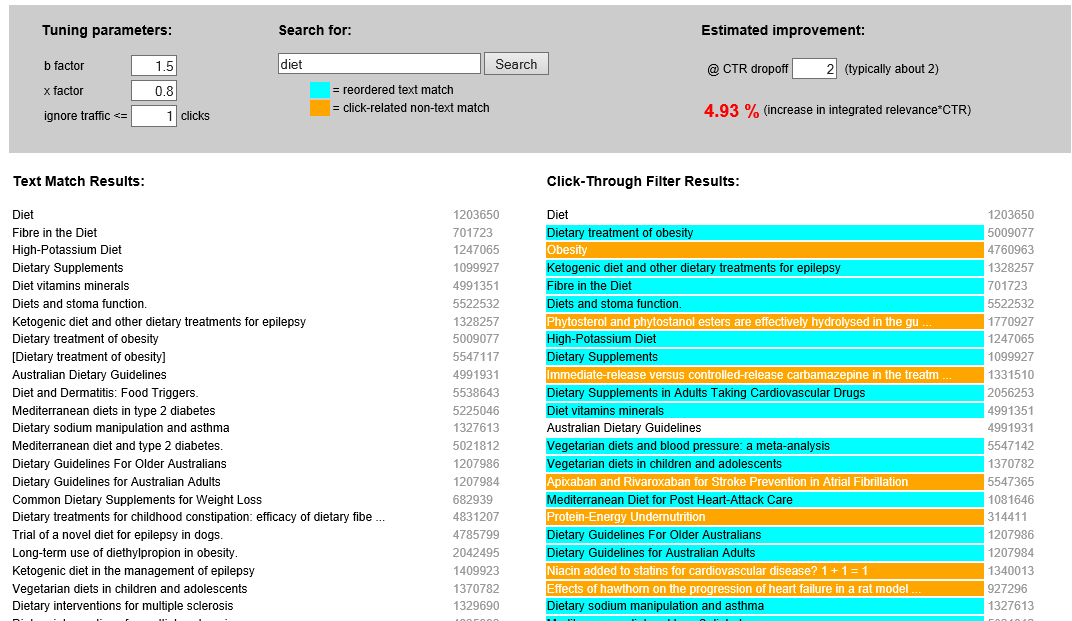
  • The image below is one trial, simply to illustrate a point.  The results are not based on the full Trip index, just a very small sample.
  • The search is using a very simple text matching for title words only.  So, as you will see in the image below all the articles in the left-hand column have the search term – diet – in the title.

So, what’s going on?

The left hand side are the results in this mock-up search.  However, those on the right-hand side have been reordered using simple clickstream data.  Those articles that are surrounded by the light blue colour have been boosted (so appear higher) due to lots of people clicking on them.  Those results surrounded by orange are arguably more interesting – as they don’t include the search term in the title!

What this signifies is that users of Trip, while searching the actual Trip, have clicked on the orange articles in the same search session as one of the articles on the left-hand side.  So, it’s telling us that the orange articles are related to the normal results – and being inserted into the results – even though they were not matched in our search test by having the word diet in the title.

Trying to describe this in the blog is slightly difficult as I’m not sure if I’ve explained it particularly well.  I suppose there are two take homes:

  • Clickstream data, even using a small sample, can undercover some really useful articles that a standard keyword search might miss.
  • I am very excited by this, so have faith in that!

    People who looked at this article, also looked at…

    In my previous post Ok, I admit it, I’m stuck (a title people seem to really like) I highlighted the difficulty in finding meaning in our clickstream data (the data generated by users interacting with the site).  One thing that I had thought about and a couple of people have subsequently raised is an Amazon style ‘People who looked at this article, also looked at this one..’, a feature I find really interesting and frequently useful.

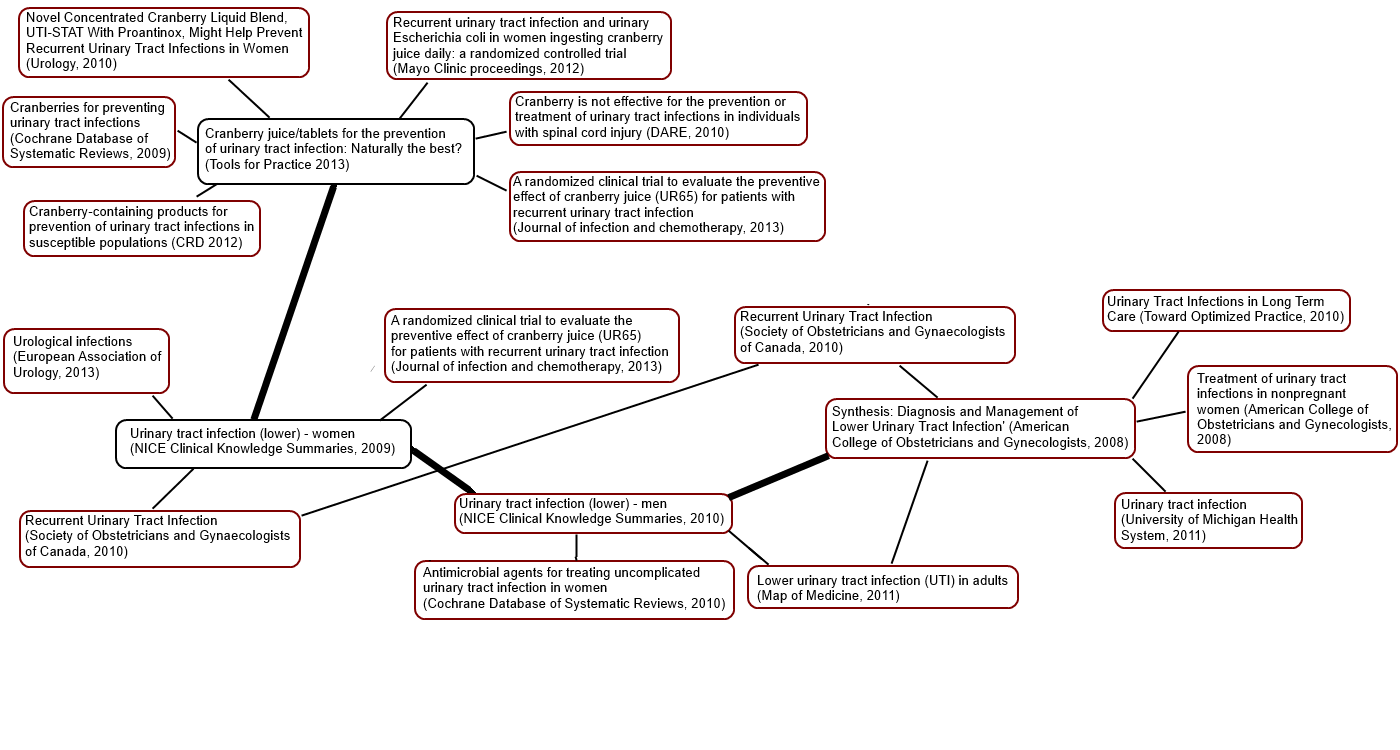
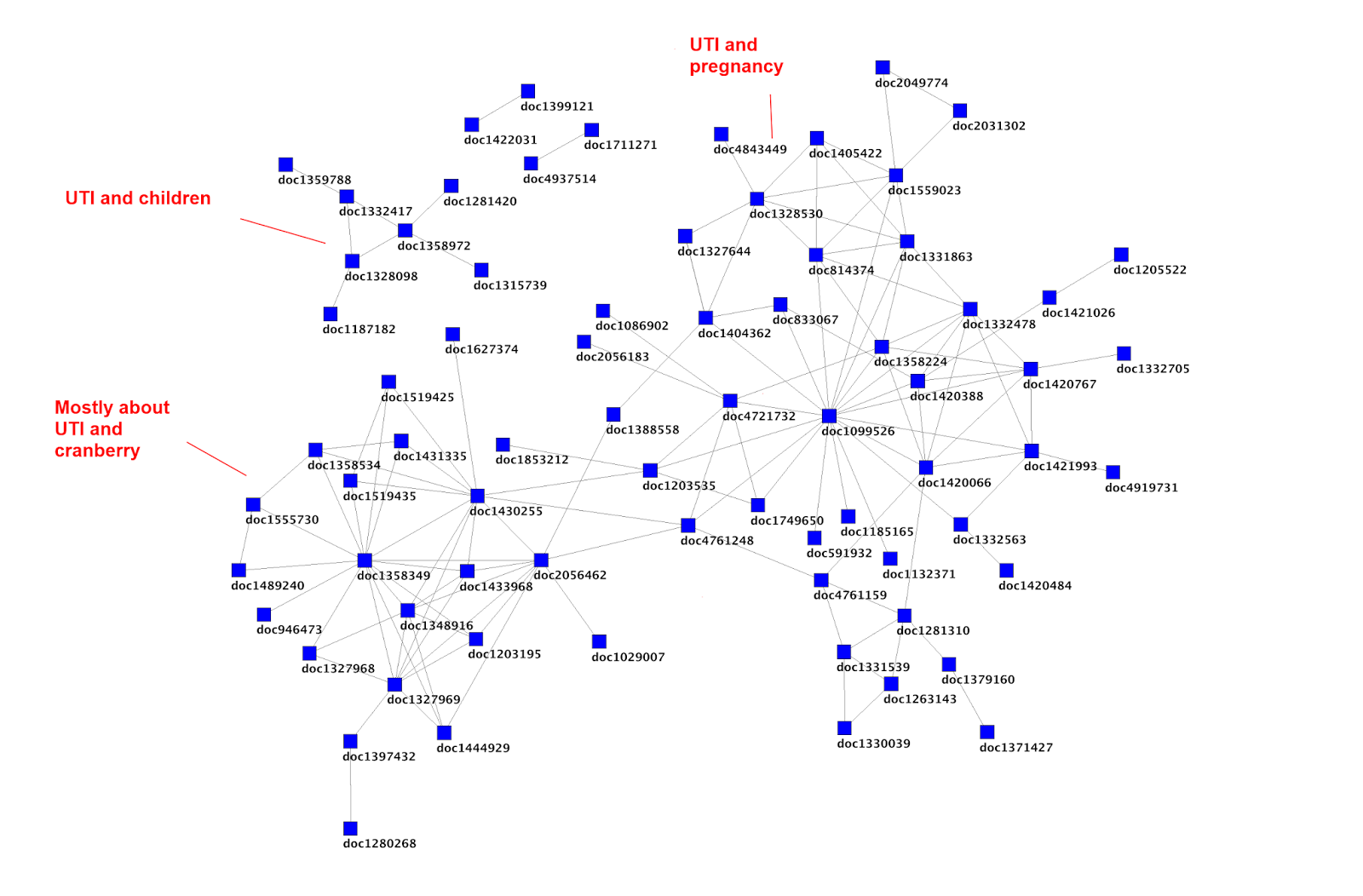
    So, taking some earlier work on mapping UTI data  I started doing further analysis but it was based on this graph.

    I started with an article that looked in an interesting place and picked document 2056462 (Cranberry juice/tablets for the prevention of urinary tract infection: Naturally the best? from the publication Tools for Practice 2013) and then followed the links from there.  Some have since been removed or updated.  But, we can say that ‘People who looked at Cranberry juice/tablets for the prevention of urinary tract infection: Naturally the best? also looked at…

    • Novel Concentrated Cranberry Liquid Blend, UTI-STAT With Proantinox, Might Help Prevent Recurrent Urinary Tract Infections in Women (Urology, 2010)
    • Recurrent urinary tract infection and urinary Escherichia coli in women ingesting cranberry juice daily: a randomized controlled trial (Mayo Clinic proceedings, 2012)
    • Cranberry is not effective for the prevention or treatment of urinary tract infections in individuals with spinal cord injury (DARE, 2010)
    • Cranberries for preventing urinary tract infections (Cochrane Database of Systematic Reviews, 2009)
    • Cranberry-containing products for prevention of urinary tract infections in susceptible populations (CRD 2012)
    • A randomized clinical trial to evaluate the preventive effect of cranberry juice (UR65) for patients with recurrent urinary tract infection (Journal of infection and chemotherapy, 2013)
    • Urinary tract infection (lower) – women (NICE Clinical Knowledge Summaries, 2009)

    I then, as a way of snowballing, took the last article in the list and did a similar thing, which results in ‘People that looked at Urinary tract infection (lower) – women also looked at…

    • Cranberry juice/tablets for the prevention of urinary tract infection: Naturally the best? (Tools for Practice 2013)
    • Urological infections (European Association of Urology, 2013)
    • Recurrent Urinary Tract Infection (Society of Obstetricians and Gynaecologists of Canada, 2010)
    • A randomized clinical trial to evaluate the preventive effect of cranberry juice (UR65) for patients with recurrent urinary tract infection (Journal of infection and chemotherapy, 2013)
    • Urinary tract infection (lower) – men (NICE Clinical Knowledge Summaries, 2010)

    Anyway, I hope it’s clear what’s going on!  On one level it all seems good and interesting in that all the articles seem relevant.  But does it add anything that the initial search wouldn’t have found?  To help I’ve gone through the top list and shown where each of the results appears in the search results (coincidentally the Tools for Practice article came 5th in the results list for a search of urinary tract infection and cranberry):

    • Novel Concentrated Cranberry Liquid Blend, UTI-STAT With Proantinox, Might Help Prevent Recurrent Urinary Tract Infections in Women (Urology, 2010) = Result #38
    • Recurrent urinary tract infection and urinary Escherichia coli in women ingesting cranberry juice daily: a randomized controlled trial (Mayo Clinic proceedings, 2012) = Result #18
    • Cranberry is not effective for the prevention or treatment of urinary tract infections in individuals with spinal cord injury (DARE, 2010) = Result #7
    • Cranberries for preventing urinary tract infections (Cochrane Database of Systematic Reviews, 2009) = Result #14
    • Cranberry-containing products for prevention of urinary tract infections in susceptible populations (CRD 2012) = Result #2
    • A randomized clinical trial to evaluate the preventive effect of cranberry juice (UR65) for patients with recurrent urinary tract infection (Journal of infection and chemotherapy, 2013) = Result #13
    • Urinary tract infection (lower) – women (NICE Clinical Knowledge Summaries, 2009) = Result #54

    To me these results are interesting!  The clear ‘outliers’ are the top and bottom results which appeared in result number 38 and 54 respectively.  This is important as it means that they are much less likely to be seen – especially the latter one which would be on the third page of results.

    Is this useful?

    It will highlight different articles than found from browsing the search results, but is there a cost?  Will users look less at our algorithmic results (the normal results) and rely on these ‘human’ results?  If so, is that good or bad?  I actually think it’ll encourage people to explore more and spend longer on the site – so I don’t think it’ll have a negative consequence.

    This is really interesting!

    I’m really tempted to open a can of worms by asking if there is any coherence/rationality as to how the linked articles list is generated.  However, as the above list is based on only a sample of data it’d be wrong to place too much weight on things.  Also, even if it is random, so what!?

    Finally, I’ve even graphed this out (in not too an appealing way):

    2014, looking back with pride

    At the end of 2013 I did a review of the year and now, in early 2015, I thought I’d repeat the exercise for 2014!

    First, the stats:

    • We had over 3,600,000 page views.
    • We are up to registered user number 140,000.  However, the standard view is to discount the number by 10-20% for users who no longer use the account and/or spam accounts.  So, we probably have 115-125,000 registered users.
    • The average duration on the site continues to increase 5.08 minutes compared with 4.11 in 2013. This is mirrored in the number of pages per session, increasing from 3.26 to 3.89
    • The bounce rate (people who just visit one page and then leave without engaging) has decreased by 20%

    The above represents an ongoing trend which is seeing less unique users but the ‘quality’ is higher in that the users are more engaged and making better use of the site.  It is this engagement that is so satisfying, much more important than some – ego boosting – headline of number of unique visitors (although 3.6 million page views is quite impressive)!

    Financial insecurity has been a recurring theme for Trip and I’m really pleased as I think we’re fine for now and this is based on two facts:

    • We’ve secured a couple of grants recently which help in any number of ways.
    • We’ve finally arrived at a business model (freemium) which we will roll out in March (I hope).  I’m optimistic as we’ll be offering a great premium offering and hopefully a number of users and institutions will sign-up.

    At the end of 2013 I reported on the disappointment of missing out on an honorary professorship but I was very pleased to be given an honorary fellowship at the Centre for Evidence-Based Medicine (CEBM) at Oxford University.  The CEBM runs the wonderful Evidence Live series of conferences and I’ll be involved again in the session ‘EBM into Practice: Future of evidence synthesis: a new paradigm’ which will be alongside Carl Heneghan, Martin Burton and Tom Jefferson.

    Other bits and bobs from the year:

    • One of the grants was from the EU Horizon 2020 funding and will see me getting involved in lots of interesting research relating to multi-lingual search as well as a big chunk of machine reading and learning, including an overhaul and enhancement to our rapid review system.
    • My role in Public Health Wales (PHW) seems to be working itself out as I was given the role of lead for knowledge mobilisation (a term I dislike) and I’ve just finished a draft strategy on making PHW more ‘evidence-based’.  I believe my role will then move into delivering on the strategy – which should be a nice challenge.
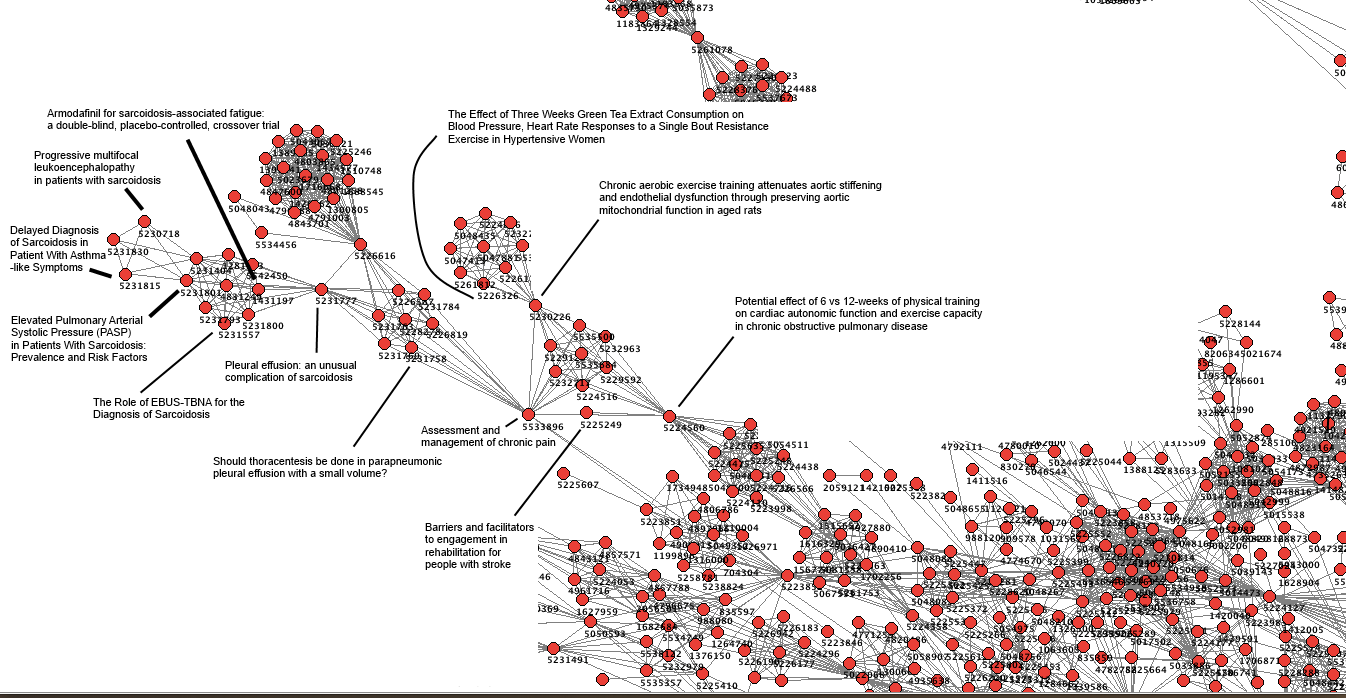
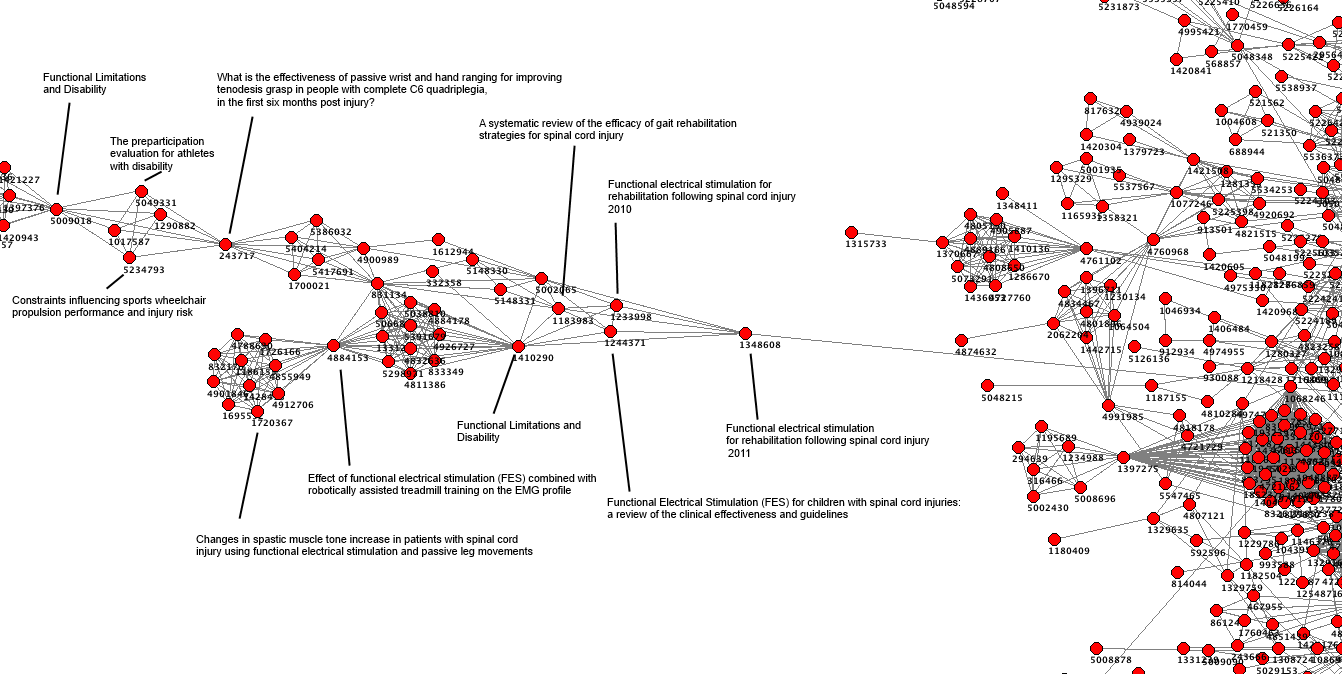
    • I’ve continued to conduct work in the social networks of articles with the huge support of the wonderful Valdis Krebs.  As a little treat I’ve added two images of further analysis below – happy to share more if anyone is interested!

    Other than the above there have been so many other things but many are important to me but probably less so to others.

    There is also another, really major, project I’m starting to explore but for various reasons I can’t share now.  But it builds on the answer engine concept but there is the potential for Trip to work with a huge commercial partner.

    Finally, a very large thank you to:

    • The users, without you Trip would be nothing!
    • Those users that completed the various surveys.
    • The members of the Trip advisory board for being very generous with your time and your collective knowledge/wisdom.
    • The many incredible people who I have interacted with – I really am lucky. 

    2014 has been great and I hope – given the reduced financial stress – 2015 will be even better.

    A critique of the Cochrane Collaboration

    What follows is a summary of a longer paper on some of the problems that the Cochrane Collaboration face.  It is based on the presentation I gave at Evidence Live 2013 entitled ‘Anarchism, Punk and EBM’. 

    But to begin with I want to make it clear that I am fully supportive of systematic reviews and the reasons for doing them.  I also want to make it clear that this is not a criticism of the many thousands of volunteers who give their time freely to improve global healthcare.  I am in awe of their efforts.  My criticism is based on the fact that I feel that the current methods are unsustainable. 

    Relevancy to clinical practice.

    I have run a number of clinical question answering and between them have answered over 10,000 clinical questions.  It is very rare for a single systematic review to answer a question.  In an analysis of 358 dermatology questions only three could be answered by a single systematic review, so less than 1%.  Although we have only formally analysed dermatology there is little sense that many other areas do noticeably better, but there are some e.g. respiratory (but that would still answer fewer than 5% of the respiratory questions. In answering clinical questions I wish we had more systematic reviews that were useful for my work.  Should systematic reviews answer real questions?

    Methodology

    On average a Cochrane systematic review takes 23 months from protocol to publication [1] and hundreds if not thousands of hours [2]. This causes problems with both production and subsequent updating of reviews.  Clearly, with a finite resource the longer a systematic review takes to produce the fewer you can do.

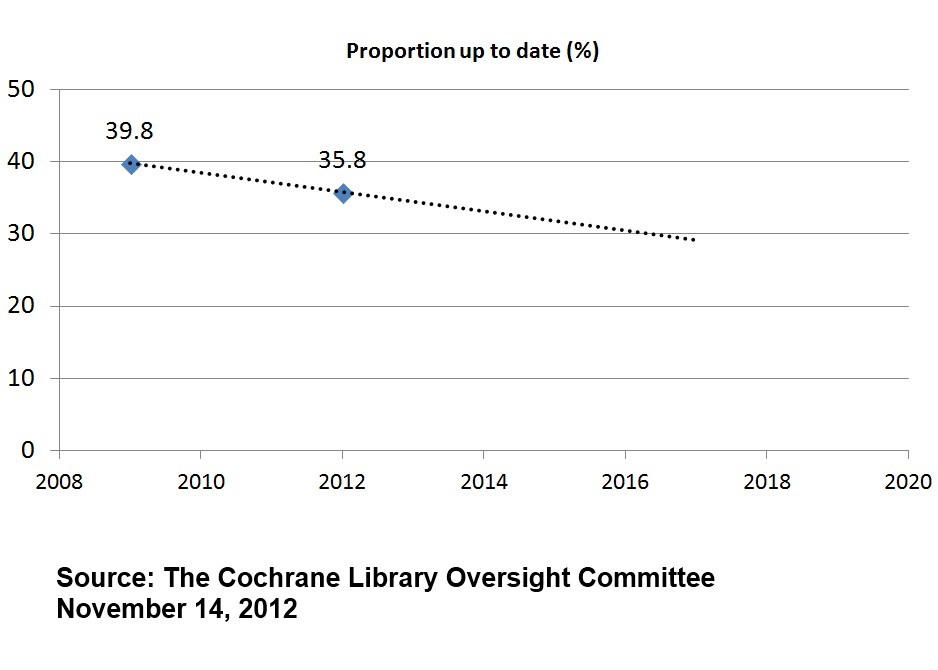
    In 2009 only 39.8% of their systematic reviews were up to date (using Cochrane’s own definition of being updated within the past two years) while by 2012 it had dropped further to 35.8% [1]

    These figures are slightly mis-leading as the number of systematic reviews has increased in that time.  In 2009 there were 3,958 active reviews and in 2012 that figure had risen to 4,905.  So, in 2009, of the 3,958 reviews, only 1,575 were up to date.  In 2012, of the 4,905 reviews, only 1,756 were up to date – an increase in up to date reviews of just 181 in three years.  Putting this another way, in 2009 there were 2,383 out of date systematic reviews and in 2012 this had risen to 3,149.
    These figures are terrible and are made worse by the relatively recent increase in funding and spending Cochrane has enjoyed [3].
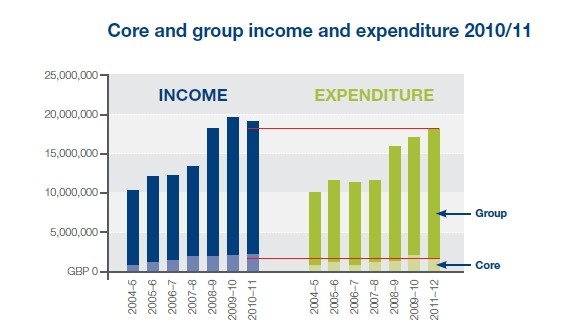
    In the last seven years of financial figures the Cochrane Collaboration has spent in excess of £100 million and over the twenty years it has existed this is likely to be over £150 million – over a quarter of a billion US Dollars.  It is probably redundant to point out that this is a vast sum. [UPDATE: it has been pointed out that £150 million is actually not that much and could be seen as a pittance – I guess it depends on perspective].

    As well as significant financial support Cochrane has the selfless support of 28,000 volunteers. Yet, the number of active systematic reviews is still modest.  This indicates that the current system is unsustainable and not fit for purpose.  The methodology, while reducing some bias, has resulted in a huge cost increase, not just financial but also opportunity cost. Ironically, the case of Tamiflu highlights that the methodology is flawed.

    Tamiflu

    I do not wish to repeat the Tamiflu story here, for those interested there are numerous opportunities to find out more [4, 5].  In the latter reference, Tom Jefferson states:

    “…I personally believe and my colleagues believe with me that Cochrane Reviews based on publications should really be a thing of the past…”

    This is based on the fact that, when preparing the first Cochrane systematic review on neuraminidase inhibitors for preventing and treating influenza in healthy adults and children Tom and his team only relied on published journal articles [6].  This was subsequently found to miss large amounts of data, most of which was made available for the regulatory agencies e.g. EMA, FDA.  The updated, 2012, review [7] was a huge undertaking, even by Cochrane standards, but it was the only way Tom and his team felt they could obtain accurate estimations of the effect of neuraminidase inhibitors. 

    But Tom is not alone in concerns about methodology, concerns with relying on aggregated trial data were made by Jack Cuzick, at Evidence Live 2013.  He made a general call for reviews to be based on individual patient data (IPD).

    Both Tom and Jack feel that the current Cochrane methodology is not capable of making an accurate assessment of an interventions ‘worth’, albeit for different reasons.  The seriousness of this challenge should not be underestimated, it attacks at the very heart of the Cochrane Collaboration. 

    Is there any hope?

    In recent years there have been a number of articles that have suggested, to differing degrees, that doing things more quickly can give you the same or similar results to the Cochrane methodology.  I will highlight three:

    1)    Can we rely on the best trial? A comparison of individual trials and systematic reviews [8].  In this paper the authors (including me) explored a random sample of Cochrane systematic reviews to see how often the largest randomised trial was in agreement with the subsequent meta-analysis.  This occurred in 81% of the meta-analyses examined and if the largest RCT was positive and significant it was around 95%.  In other words, using the largest RCT can give a broad hint as to the likely result of a subsequent meta-analysis.

    2)    McMaster Premium LiteratUre Service (PLUS) performed well for identifying new studies for updated Cochrane reviews [9]. In this study the authors compared the performance of McMaster Premium LiteratUre Service (PLUS) and Clinical Queries (CQs) to that of the Cochrane Controlled Trials Register, MEDLINE, and EMBASE for locating studies added during an update of reviews. They concluded that PLUS included less than a quarter of the new studies in Cochrane updates, but most reviews appeared unaffected by the omission of these studies.  In other words, you do not necessarily need to get all articles to arrive at an accurate effect size (compared to the Cochrane systematic review).

    3)    A pragmatic strategy for the review of clinical evidence [10].  In this paper the authors compared a research strategy based on the review of a selected number of core journals, with that derived by an SR in estimating the efficacy of treatments.  The authors concluded “We verified in a sample of SRs that the conclusion of a research strategy based on a pre-defined set of general and specialist medical journals is able to replicate almost all the clinical recommendations of a formal SR.”. Essentially, the same message as 2) above. 

    The future

    It is a very easy concept, the greater the cost (finance, time etc) of a systematic review the fewer systematic reviews within a fixed budget can be undertaken and kept updated.  Therefore, a major focus for Cochrane should be on reducing the cost per review.  Cochrane is full of incredibly talented people who appear to focus predominantly on reducing bias and random error.  This, to me, is a clear example of the laws of diminishing returns.  I would set the major challenge, for the next five years of Cochrane, to be – how to do a systematic review in a month (or less).

    This side-steps the issue of regulatory data and/or IPD!

    I see a future for Cochrane as having two types of systematic review: rapid systematic reviews undertaken in a significantly reduced timeframe, and a more costly systematic review that includes regulatory data and/or IPD.  If Cochrane can reduce the cost of a systematic review to around 10% of what it is now it means they can do ten times as many.  Or Cochrane might choose to do fewer than ten times as many rapid systematic reviews and leave any remaining resource to do the more costly systematic reviews.  The issues becomes (i) when can Cochrane ‘get away’ with a low-cost systematic review and (ii) when a high-cost review warranted.  These are questions requiring a research base to answer the questions, as well as being a question of values.

    The argument has been made to me that there is a negative cost of doing a low-cost systematic review that might generate the ‘wrong’ answer.  While I appreciate this could be a scenario I would reply that while you’re busy doing one systematic review ‘correctly’ you are neglecting 5-10 rapid systematic reviews that might generate significantly higher benefits.  But, the lack of an evidence base is hampering our ability to address these questions.  This favours the status quo, which could actually be doing more harm than good.

    Finally, I can’t help feeling the current direction of travel by Cochrane is taking us down a conceptual cul-de-sac [11]:

    “Researchers in dominant paradigms tend to be very keen on procedure. They set up committees to define and police the rules of their paradigm, awarding grants and accolades to those who follow those rules. This entirely circular exercise works very well just after the establishment of a new paradigm, since building systematically on what has gone before is an efficient and effective route to scientific progress. But once new discoveries have stretched the paradigm to its limits, these same rules and procedures become counterproductive and constraining. That’s what I mean by conceptual cul-de-sacs.”

    Bottom line: Systematic reviews are vitally important in practicing evidence-based healthcare.  Given that there is a finite funding ‘envelope’ it is imperative to maximise the number of systematic reviews that can be undertaken and to maximise relevancy to clinical practice.  This means significantly reducing the cost per review and improving the prioritisation process.

    NOTE (04/09/2015): Since writing this article I have written a number of follow-up articles:

    References

    1. The Cochrane Oversight Committee. Measuring the performance of The Cochrane Library. 2012
    2. Allen IE, Olkin I. Estimating time to conduct a meta-analysis from number of citations retrieved. JAMA. 1999 Aug 18;282(7):634-5.
    3. Cochrane Collaboration Annual Report & Financial Statements 2010/11
    4. Payne D. Tamiflu: the battle for secret drug data. BMJ 2012;345:e7303
    5. HAI Europe – Dr. Tom Jefferson on lack of access to Tamiflu clinical trials
    6. Jefferson TO, Demicheli V, Di Pietrantonj C, Jones M, Rivetti D. Neuraminidase inhibitors for preventing and treating influenza in healthy adults. Cochrane Database Syst Rev. 2006 Jul 19;(3):CD001265
    7. Jefferson T, Jones MA, Doshi P, Del Mar CB, Heneghan CJ, Hama R, Thompson MJ. Neuraminidase inhibitors for preventing and treating influenza in healthy adults and children. Cochrane Database Syst Rev. 2012 Jan 18;1:CD008965. doi: 10.1002/14651858.CD008965.pub3
    8. Glasziou PP, Shepperd S, Brassey J. Can we rely on the best trial? A comparison of individual trials and systematic reviews. BMC Med Res Methodol. 2010 Mar 18;10:23. doi: 10.1186/1471-2288-10-23
    9. Hemens BJ, Haynes RB. McMaster Premium LiteratUre Service (PLUS) performed well for identifying new studies for updated Cochrane reviews. J Clin Epidemiol. 2012 Jan;65(1):62-72.e1
    10. Sagliocca L, De Masi S, Ferrigno L, Mele A, Traversa G. A pragmatic strategy for the review of clinical evidence. J Eval Clin Pract. 2013 Jan 15. doi: 10.1111/jep.1202
    11. Greenhalgh T. Why do we always end up here? Evidence-based medicine’s conceptual cul-de-sacs and some off-road alternative routes. J Prim Health Care. 2012 Jun 1;4(2):92-7.J Prim Health Care. 2012 Jun 1;4(2):92-7.
    NHS Choices

    The NHS Choices website has launched, it’s a patient-focused site “that aims to put you at the centre of your healthcare.” It looks nice and has some interesting areas that help users to find suitable health services. It also gives you an online health check. Apparently I have no risks for cardiovascular diseases. There is also as extensive list of patient information leaflets, which I may have to add to TRIP (after checking they are not copies of those on NHS Direct).

    My main interest is in search, so that’s what I’ve spent most time on. A search for prostate cancer was interesting. The ‘hottest’ part of the results page was a set of options showing me what my GP was reading (and similar options). Lower down you actually get to the results, which seem appropriate. It seems strange that, as a user, the main results are not displayed in the most obvious part of the page. However, given the prominence of the link, I imagine an awful lot of people will be interested in what their GP was reading. The 2 results are below

    • Clinical Knowledge Summaries: Clinical topics full list Breast cancer — suspected … GI (lower) cancer — suspected … Prostate — benign hyperplasia
    • Clinical Knowledge Summaries: Clinical knowledge DH referral advice for suspect cancer

    As a patient I would find that list slightly alarming! So, he’s looking at breast cancer, GI cancer, BPH – surely he should be looking at information relevant to my condition!

    Apparently, my GP is reading the following in relation to my search of hypertension:

    • Diabetes — hypertension
    • Diabetes — hypertension … Hypertension … Hypertension in pregnancy
    • Alcohol — problem drinking
    • Alcohol — problem drinking

    This site has obviously had large sums of money spent on it (I hear £3.5 million), it just seems a shame that it is let down by the poor implementation of search….

    Joy Division Oven Gloves

    A new feature – inappropriate titles for blog posts!

    I was going to call this post ‘stuff’ but felt that was pretty dismal/boring.

    Anyway, onto the post. Three things to report:

    1) Today’s Google blog linked to something called a binary clock. I was intrigued and visited the Think Geek online store and discovered what it was (click here). I want one!

    2) I came across this wonderful looking “HEALTH 2.0: USER-GENERATED HEALTHCARE“. I’d love to go but not sure I can justify the time and costs for a single day…

    3) The next upgrade for TRIP is taking shape. Yes, we’re still waiting to release the latest upgrade (hopefully next week – I’ve heard that before) but we like to think ahead. The main features will be linked in with the gwagle experiment (see previous post). The main planned features will be user-added content, enhanced My-TRIP, content tagging (with associated tag clouds). We may even add a scoring mechanism whereby users can give a score (based on something nebulous such as ‘clinical usefulness’. It may not sound much but it will represent a significant move in TRIP’s development.

    As for the title of the blog post, see this YouTube clip. I was at that concert and the clip doesn’t do the song justice!

    Pipes

    Yahoo Pipes have been around for a while now. Unfortuantely, I’ve not had the time or inclination to dig around and see what they can do. I’ve now started using them and think they are potentially very powerful. I’m sure, at present, I’m using them crudely. In fact, I’ve so far, simply merged two separate RSS feeds – but it’s a start.

    Take this old (2004) ATTRACT answer on exercise and depression. If you view that you’ll see that it has a warning “NOTE: The following question is over two years old. We do not routinely update our answers. Therefore, significant new research may now be available.”

    I’ve always wondered about auto-updating of answered. Therefore, I created two separate searches in PubMed (with exercise and depression both as [majr] mesh headings), one for RCTs and one for systematic reviews (via clinical queries) and restricted the date to those articles published after the ATTRACT answer. I then exported the results as an RSS feed and joined them together in Yahoo Pipes. You can see the results here.

    If this output was then tagged to the bottom of all appropriate Q&A answers they would, in effect, auto-update.

    TRIP in the FT

    Spotted by Sir Iain Chalmers, who generously sent me a copy. It was included in the article Under pressure.

    Blog at WordPress.com.

    Up ↑