ATTRACT was a clinical Q&A system that began in Gwent, Wales, in 1997. Members of the primary care team could submit questions by post, email, phone – or even fax – and we would provide an evidence-based answer. It was the inspiration behind the creation of Trip, designed to speed up the question-answering process. ATTRACT expanded from Gwent to cover all of Wales, and a few years later, I led the national Q&A service for England through the NeLH/NLH, alongside a number of other initiatives. Altogether, these services have answered over 10,000 questions – but ATTRACT remains closest to my heart. My first professional love, perhaps?
Now that we’ve successfully tested our automated Q&A system, we’re working hard to launch it as an open beta in the near future. One outstanding task is the site design – and while revisiting old ideas, I came across an image of the homepage from 2005:
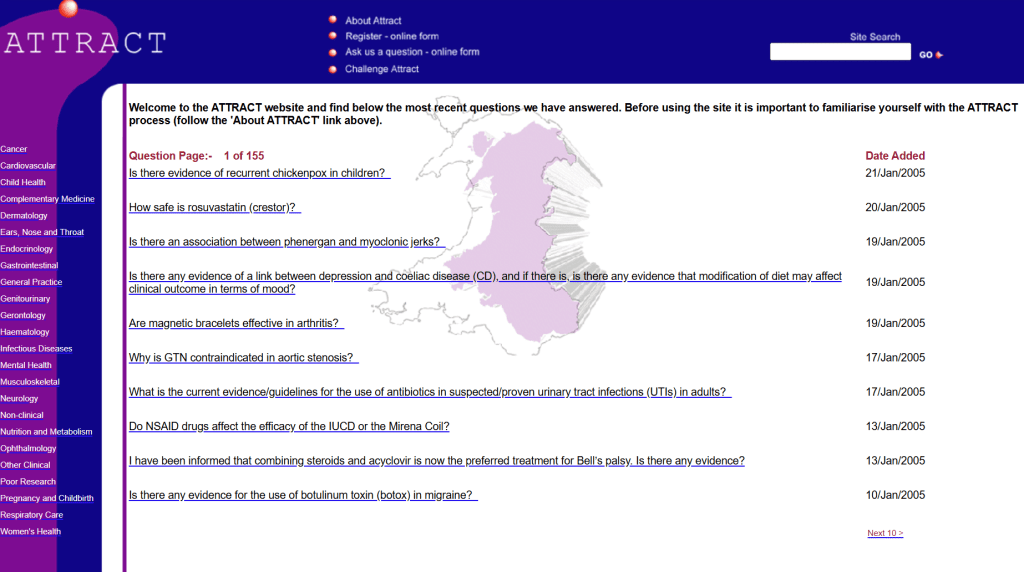
And here is what an old answer looked like:
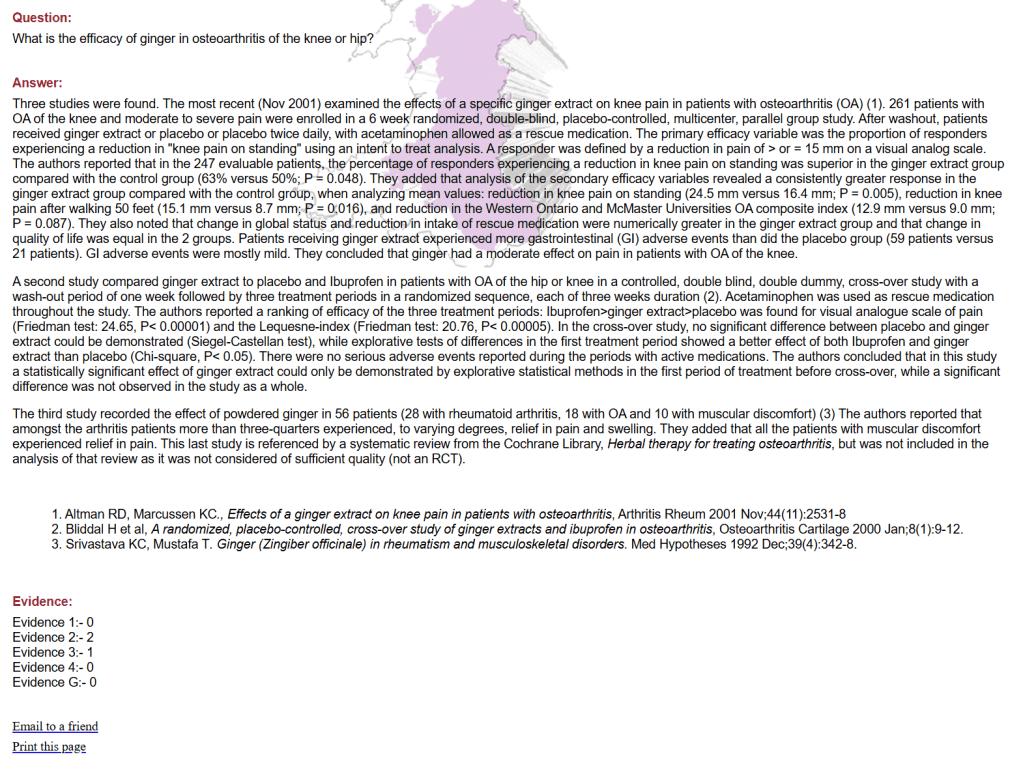
We actually wrote up an evaluation and had it published in the BMJ in 2001: Just in time information for clinicians: a questionnaire evaluation of the ATTRACT project
Given my experience in answering clinical questions the ability to automatically answer clinical questions is still staggering to me – and I’ve been working on this project for over a year. Before, in the ATTRACT days, a question would take 3-6 hours to answer and now they take 20-30 seconds. In fact I took the above question What is the efficacy of ginger in osteoarthritis of the knee or hip? and tried it in our system. it took 24 seconds to generate the answer (which can be viewed below). As I say staggering.
One final thought, what do we call the Q&A service. Do we call it Trip Answers, Trip Q&A, Ask Trip? These all indicate what the service is about – so that’s a positive for them. However, a more evocative (possibly even romantic) name would be ATTRACT. And, many will not know this, ATTRACT was an acronym for Ask Trip To Rapidly Alleviate Confused Thoughts – so still perfectly relevant!
Answer to the Q What is the efficacy of ginger in osteoarthritis of the knee or hip? [Note: this is before the improvements from the beta testing have been instigated, so future answers will be even better]
Clinical Bottom Line
Ginger supplements may provide symptomatic relief in knee osteoarthritis due to their anti-inflammatory properties, but the evidence is mixed. It should be considered as an adjunct to primary treatments, with attention to individual responses and study quality variability.
Answer
Evidence from Systematic Reviews and Meta-analyses
- Knee Osteoarthritis
- A systematic review and meta-analysis (32214292) focused on evaluating ginger’s efficacy in knee osteoarthritis. While oral ginger did not show significant evidence to improve pain relief and function compared to placebo, topical ginger also did not provide statistically significant improvements in pain or knee function compared to standard treatments.
- Mixed Findings on Efficacy
- Another systematic review reviewing ginger in osteoarthritis, including studies on both knee and hip joints, reported mixed findings with some studies showing ginger may not be superior in improving pain when compared to ibuprofen and noted that evidence supporting ginger for changes in disability and functional capacity is weak (27819836).
Randomized Controlled Trials (RCTs)
- Phase I Clinical Trial
- A study evaluating a ginger-honey mixture, “G-Rup® syrup,” showed significant improvements in joint stiffness, pain, and functional scores in knee osteoarthritis patients (13070751). This suggests potential symptomatic benefits of a ginger-honey mixture in knee osteoarthritis.
- Add-on Effect with Diclofenac
- In a double-blind placebo-controlled trial involving ginger and diclofenac for knee osteoarthritis, ginger in conjunction with diclofenac demonstrated superior improvements compared to either treatment alone (24617168).
- Steamed Ginger Extract
- An RCT examining steamed ginger extract found significant improvements in pain and functional indices in patients with mild knee osteoarthritis, indicating its potential utility as a functional food in OA management (39212491).
Mechanism of Action and Safety Profile
- Anti-inflammatory Properties
- Ginger’s active compounds, such as gingerol and shogaol, possess anti-inflammatory properties that can reduce levels of pro-inflammatory cytokines (TNF-α, IL-1β) and inflammatory markers like CRP in knee osteoarthritis patients ([BI]).
- Safety and Tolerability
- Across various studies, ginger was generally well-tolerated with occasional mild gastrointestinal side effects compared to NSAIDs like ibuprofen, making it a safer alternative for long-term use (27819836).
Conclusion: Evidence on the efficacy of ginger in knee or hip osteoarthritis is mixed, with some RCTs demonstrating significant symptomatic benefits, particularly in knee osteoarthritis. However, the quality and consistency of evidence vary. While not a first-line treatment, ginger’s anti-inflammatory properties suggest it may be a valuable adjunctive therapy, especially given its favorable safety profile compared to NSAIDs.


 Trip Database Blog
April 28, 2025 at 2:52 pm
Hi Jon,Wow! That’s brilliant… talk about a revolution… and we thought Dave Sackett and his ward-rounds with a trolley with a computer
LikeLike