Search

Trip Database Blog

Liberating the literature

Month

January 2026

What 10,000 Clinical Questions Tell Us About Evidence, Practice, and Uncertainty

Just over six months after launch, AskTrip answered its 10,000th clinical question. Beyond being a milestone, this created a rare opportunity: to step back and look at what clinicians actually ask when given the freedom to pose questions in natural language – and what kind of evidence is available to answer them.

This post shares some of the most interesting patterns we found when analysing those first 10,000 questions, focusing on three things:

  • What types of questions clinicians ask
  • How those question types relate to the strength of available evidence
  • How questions differ across professional groups

What emerges is a picture of modern clinical uncertainty – and where evidence serves clinicians well, and where it doesn’t.


1. Most clinical questions are about “what should I do?”

By a long way, the most common questions asked on AskTrip are about treatment and management.

Roughly one third to one half of all questions fall into this category. These include questions about:

  • Drug choice and dosing
  • First-line and second-line treatments
  • Managing patients with specific comorbidities
  • Whether an intervention is appropriate in a particular context

Diagnostic questions are much less common, typically under 10% of all questions. Prognosis questions (life expectancy, disease course, outcomes) are rarer still.

This suggests that AskTrip is primarily being used at the point of action, when a clinician is deciding what to do next, rather than earlier in the diagnostic process or later when thinking about long-term outcomes.


2. Treatment questions tend to have the strongest evidence

One striking finding is how closely question type aligns with evidence strength.

Treatment and management questions are far more likely to be answered using high-quality evidence – such as clinical guidelines, systematic reviews, or large trials. A substantial proportion of these answers receive a High evidence rating.

This makes sense. Many treatments for common conditions are well studied, frequently updated, and synthesised into guidelines. When clinicians ask “What’s the recommended treatment for X?”, there is often a clear evidence trail to follow.

In contrast, questions about:

  • Etiology and risk factors
  • Rare or unusual clinical scenarios
  • Health system issues and care delivery
  • Complex patients with multiple conditions

are much more likely to be answered with moderate or limited evidence.

These are the areas where research is sparse, indirect, or ethically difficult to conduct – and AskTrip’s answers reflect that reality.

Importantly, this isn’t a weakness of the system. It’s a reflection of the evidence landscape clinicians work within every day.


3. “Thin evidence” clusters in predictable places

When we looked more closely at questions rated as having limited evidence, clear patterns emerged.

Thin evidence tends to cluster around:

  • Complex decision-making, such as balancing risks after serious adverse events
  • Patients with multiple comorbidities, often excluded from trials
  • Rare conditions, where large studies don’t exist
  • Care delivery and system questions, which sit outside traditional disease-focused research

These are the situations clinicians typically struggle with most, not because they are uncommon, but because they don’t fit neatly into trial designs.

In other words, the hardest clinical questions are often the ones least well served by research, even though they matter deeply to patients and clinicians alike.

Seeing these gaps at scale helps move the conversation away from “why don’t we have an answer?” toward “why is this so hard to study – and what should we do about it?”


4. Different professionals ask different kinds of questions

AskTrip is used by a wide range of healthcare professionals, and their question patterns differ in telling ways.

Doctors ask the majority of questions, and their focus is overwhelmingly on treatment decisions. Diagnostic questions appear, but less often. Prognosis questions are rare.

Pharmacists ask fewer questions overall, but theirs are the most tightly focused. The vast majority are about medications – dosing, interactions, safety, and comparative effectiveness. Diagnostic and prognostic questions are almost absent.

Nurses ask fewer “classic” clinical questions and more queries that sit outside neat categories —- for example:

  • Practical aspects of care
  • Clinical measurements and interpretation
  • Protocols, safeguarding, and service delivery

As a result, a higher proportion of nursing questions fall into “other” categories and are more likely to involve moderate or limited evidence.

Information specialists and librarians ask a distinct set of questions on AskTrip. Their queries often focus less on a single clinical decision and more on understanding the shape and strength of the evidence – for example, whether high-quality studies or guidelines exist on a topic, or where evidence is thin or conflicting. In this sense, AskTrip appears to function as a rapid evidence-triage tool, helping information specialists quickly gauge what is known before undertaking deeper searches, synthesis work, or supporting clinicians’ decision-making.

This isn’t accidental. It reflects professional roles and responsibilities. Each group uses AskTrip to fill different kinds of gaps – and that diversity of use is one of the platform’s strengths.


5. What this tells us about evidence-based medicine

Looking across 10,000 questions, a few broader lessons stand out.

First, evidence-based medicine is working well where research, guidelines, and synthesis are mature – particularly for treatment decisions in common conditions.

Second, uncertainty hasn’t gone away. It has simply moved into more complex, contextual, and system-level spaces where traditional research struggles.

Third, clinicians are not just asking “What does the evidence say?” – they are asking:

  • “Does evidence exist for this situation?”
  • “How confident should I be?”
  • “What do we do when evidence is thin?”

Finally, surfacing where evidence is limited is not a failure. It’s a necessary step toward more honest decision-making – and toward identifying priorities for future research.


Closing thought

AskTrip was built to lower the barriers to high-quality evidence. But these 10,000 questions show something equally important: they map the boundaries of our knowledge.

They show us where evidence is strong, where it’s weak, and where clinicians are navigating uncertainty every day.

That, in itself, is evidence worth paying attention to.

Evidence lozenges now in AskTrip

A user asked if we could bring Trip’s evidence lozenges into AskTrip references, so evidence levels are easier to spot at a glance. You asked, we delivered.

AskTrip hits 10,000 questions

Just over six months ago, we quietly launched AskTrip with a simple aim: to help clinicians get clearer, evidence-based answers to real clinical questions. Yesterday, AskTrip answered its 10,000th question – a milestone that genuinely makes us pause. The 10,000th Q&A was What are the legal obligations of healthcare institutions when allegations of abuse arise concerning safeguarding vulnerable individuals? Not a typical clinical question but it still a small moment that represents thousands of clinical uncertainties explored, clarified, and shared.

For me personally, this marks a much longer journey. Trip originally began with ATTRACT, a manual Q&A service started in Gwent, Wales in 1997 alongside Chris (my business partner at Trip), with the simple aim of helping clinicians get evidence-based answers to real clinical questions. AskTrip feels like a natural continuation of that mission: lowering the barriers to high-quality evidence and making it easier to disseminate trustworthy answers at scale.

We’re already looking ahead. The next 2–3 months will bring significant changes and improvements as AskTrip enters its next phase. But before ploughing on, it feels right to pause, reflect, and briefly bask in this milestone. Ten thousand questions answered – and many more to come.

Bookmarks and AskTrip

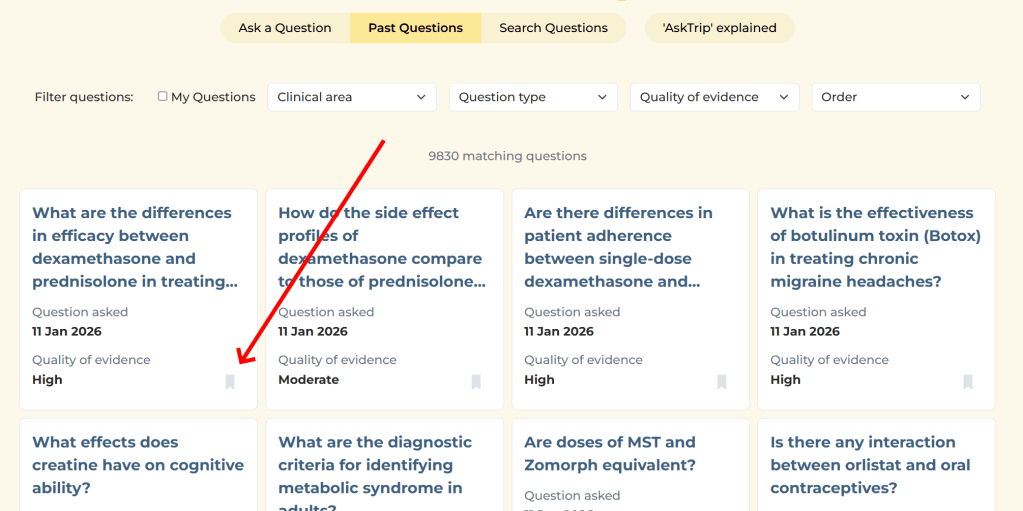
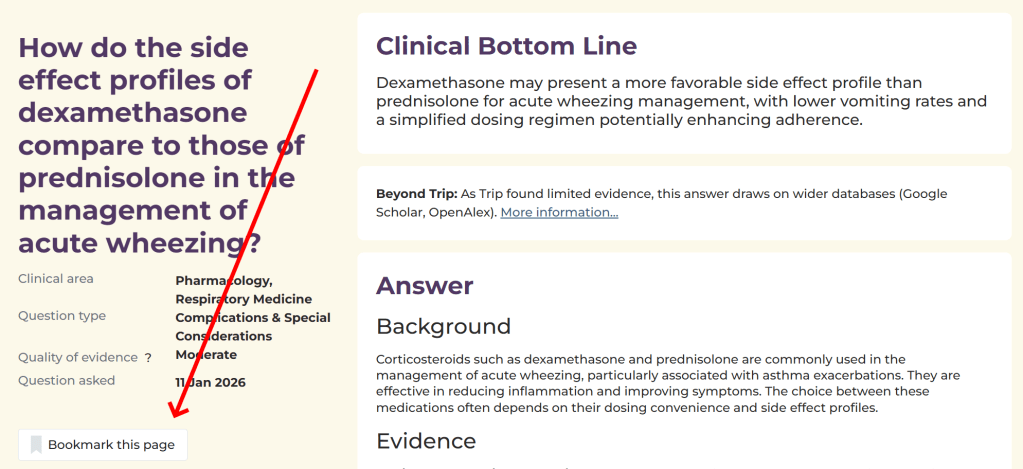
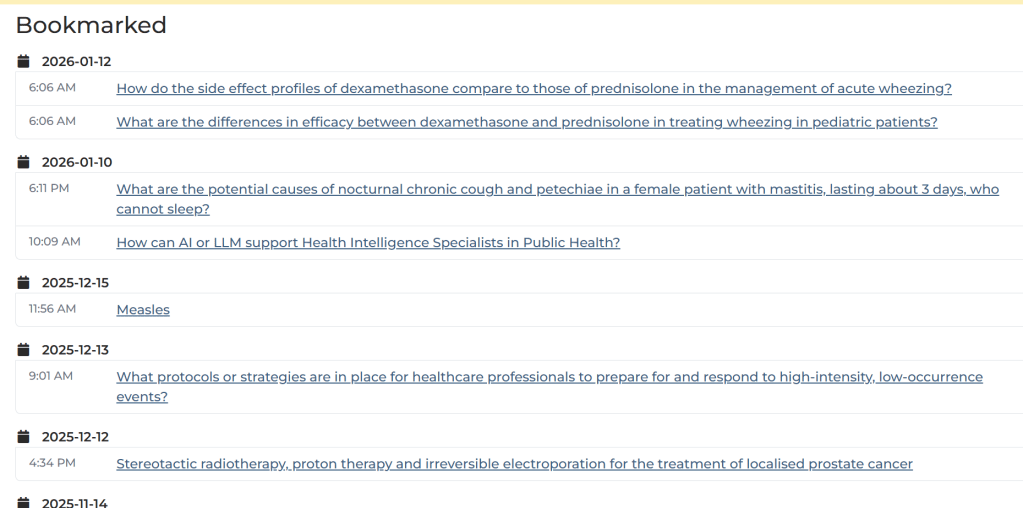
At the end of last year we rolled out a fresh new look to our bookmarks and search history in Trip. We have followed on with this by extending the bookmarking to AskTrip.

You can see the bookmark icons on the results pages for search and also, as shown below, Past Questions. The red arrow indicating the icon:

And, on individual answers:

And, to view them, I go to Bookmarked (via My Account) and you see this:

Simple and powerful.

Trip in 2025: Scaling Evidence, Supporting Care

This year-in-review reflects on what Trip achieved during 2025 and looks ahead to our plans for 2026. A major milestone this year was the launch of AskTrip, which has rapidly become a core part of Trip’s mission to support clinical decision-making. Alongside continued development of the main Trip platform, 2025 was a year of meaningful progress in how clinicians and information specialists access, explore, and use trustworthy evidence.

Trip

1) Impact

Over the past year, Trip experienced substantial growth, with a 60% increase in unique users and a 43% year-on-year rise in page views generated by clinicians and information specialists worldwide.

When viewed alongside our previously published impact evaluations – which showed that 40.77% of searches led directly to improvements in patient care – these usage figures suggest that Trip continues to play a meaningful and growing role in clinical decision-making and patient care globally.
(See: The impact of Trip parts 1 and 2)


2) New features

Systematic Review and RCT scores launched
We introduced scores for systematic reviews and randomised controlled trials, accompanied by a published critique of their strengths and limitations. This reflects Trip’s ongoing commitment to transparency, methodological rigour, and responsible use of evidence indicators.

Improved mobile interface
A redesigned mobile experience now makes Trip much easier to use on the go, supporting faster access to evidence at the point of care.

Expanded journal coverage
We added new journals to Trip, broadening coverage and strengthening the depth and breadth of evidence available to users.

Linking trials across the evidence ecosystem
Randomised Controlled Trials are now directly linked to their trial registrations and to relevant systematic reviews, allowing users to verify trial details easily and see how individual studies fit into the wider evidence base.


3) Blog activity and readership

Our blog activity increased markedly in 2025, with 91 posts published, compared with 34 in 2024, a 168% increase, driven in large part by the growing number of AskTrip-related posts.

This increase in output was matched by strong audience growth. The blog attracted 40,000 views from 23,700 visitors in 2025, representing a 44% increase in views (from 27,700) and a 57% increase in visitors (from 15,100) compared with 2024. Together, these figures point to both sustained publishing momentum and a steadily expanding readership for Trip’s writing on evidence, search, and clinical decision-making.


AskTrip

AskTrip launched on 25 June 2025, and it quickly became clear that it was meeting a real need. As we approach 10,000 clinical Q&As (a milestone we expect to reach by mid-January) AskTrip has significantly strengthened one of Trip’s core purposes: connecting clinical decision-makers with the best available evidence.

Since launch, we have learned a great deal and made numerous improvements to the service, with further substantial enhancements already planned for early 2026.

The AskTrip sub-site has been viewed nearly 100,000 times by almost 20,000 unique users, demonstrating that this growing repository of clinical questions is not only heavily used, but also valued as a distinctive resource in its own right.

Stepping back, it is hard not to feel a sense of excitement about what this represents. Trip was originally created in 1997 to support the ATTRACT clinical Q&A service, helping answer questions manually using the best available evidence at the time. Nearly three decades later, returning so strongly to clinical Q&A – now at scale, powered by a vastly richer evidence base and modern technology – feels like coming full circle. It is a powerful reminder of why Trip exists: to help clinicians ask better questions, find better answers, and ultimately improve patient care worldwide.


Looking ahead to 2026

Looking ahead, we already have a full and ambitious programme of work planned for 2026. A major focus will be on improving search, including the use of document chunking and a hybrid lexical–vector search approach. These techniques will enhance both core Trip search results and AskTrip answers by improving relevance, recall, and precision.

For the main Trip platform, we plan to significantly expand the number of indexed clinical guidelines and to explore indexing full-text journal articles, moving beyond abstracts to provide deeper access to the underlying evidence.

AskTrip will continue to evolve rapidly in early 2026, with several major enhancements already in progress:

  • Longer, more detailed answers
    Feedback from our user survey showed that around one third of users want deeper, more comprehensive responses. We are developing a system that allows AskTrip to deliver this when needed.
  • Support for follow-up questions
    Clinical questions rarely end with a single answer. We are adding functionality that allows users to ask follow-up questions or seek clarification, helping them continue their knowledge journey without starting from scratch.
  • Enhanced Beyond Trip searching using PubMed Central
    We plan to incorporate Google’s BigQuery vector search of PubMed Central into Beyond Trip. While this content overlaps with OpenAlex and Google Scholar, vector search will surface new, semantically relevant articles and improve how external evidence is incorporated into AskTrip answers.

Looking further ahead, there remain areas where we know we can do better, particularly for certain types of clinical questions. These include country-specific questions, where the academic literature does not always align neatly with national practice or policy, and recency-focused questions such as “What is the latest evidence for…?”, which place additional demands on how evidence is identified and prioritised. We have clear ideas about how to address these challenges, and they will become a focus once the current development programme is complete.


Trip delivered an extraordinary amount in 2025 – made all the more remarkable by the size of our team. What we have achieved this year is a testament not to scale, but to focus, commitment, and a shared belief in the value of trustworthy clinical evidence.

Huge applause goes to Phil, Abrar, AD, and Chris for their outstanding work throughout 2025. None are employees of Trip; all are contractors working part-time – and in some cases very part-time – making their collective contribution even more impressive. Their expertise, care, and persistence underpin much of what Trip and AskTrip have become.

We are also deeply grateful to our users and user group members, whose feedback, questions, and challenges continue to shape everything we do. Trip has always been built with its users, not just for them.

Finally, we have never been the loudest voice in healthcare – but we are quietly committed to helping clinicians make better decisions, every single day.

Blog at WordPress.com.

Up ↑