Search

Trip Database Blog

Liberating the literature

Author

jrbtrip

Excelencia clinica

Excelencia clinica (ec.net) was launched in December 2008 as a collaboration between TRIP, the Spanish Ministry of Health and the Iberoamerican Cochrane Center.  ec.net was a bilingual (Spanish:English) clinical search engine modelled on the TRIP Database.

Our contract to work on ec.net finished yesterday and the work is now being carried out in-house.  It has been a great experience working with the Iberoamerican Cochrane Center (our main point of contact) and it has been a pleasure seeing the site grow and to develop. 

We wish them well for the future and hope the growth of ec.net continues.

Medical Images on TRIP

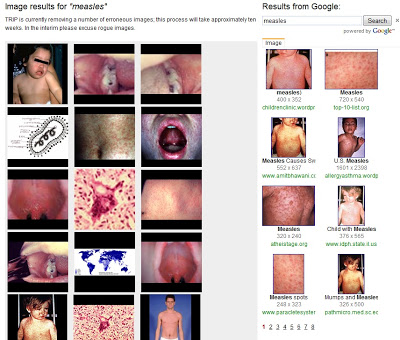
Our latest medical image update has occured and we’ve now got 113,876 images in our index.

For those of you who’ve not used our medical image search before we return the four top medical images for a given search term on the main results page. We then allow users to ‘See more images’ and as you’ll see from the image below we automatically import Google images to enhance our own offering. Altogether our medical images are starting to look pretty solid.

New server

Wow, I’m impressed!

Last week I posted that we’re moving servers and TRIP is now on there. For a few days it’ll redirect to www.tripdatabase.co.uk but that’s only while we muck around with some DNS issues.

Why am I impressed?

It is super, super quick – amazingly so.

I’m very, very happy.

Moving servers

Just a quick note that we’re in the process of moving servers. We’ve been using the same servers for a number of years and one in particular is getting ancient and needs replacing. So, instead of buying new servers we’ve decided to move to the industry leader – Rackspace.

Our sites will be sitting on a brand new, high specification server. We’ll also get better backup and support and most importantly we won’t get charged extra if we’re well used (we currently get penalised if we exceed a particular bandwidth figure).

The transfer is currently happening with TRIP Answers sitting on the new server and the main TRIP Database should follow as soon as the whole database (90 Gb) has transferred over. Once on the new servers we’ll need to alter something called the DNS (the internet’s address book) and then everything will be fine and much faster. In the interim you’ll note that certain addresses re-direct to temporary addresses on the new server (for instance www.tripanswers.org points to http://tripanswers.tripdatabase.co.uk/). This should be no reason for concern.

TRIP in the future

It’s been a while since I last posted, it’s been a busy reflective time at TRIP. We’ve been preoccupied with our new project called TILT as well as looking at our business model. At the same time we’re questioning the ‘worth’ of search (which overlaps with our TILT work).

Looking at the business model is difficult at the best of times and this is especially difficult when the people at TRIP are not natural business people. We’re good at innovating and developing products, but turning these into commercial products has always proved difficult. At the heart of this is how to make ‘search’ profitable. In the mainstream world of Google there is the advertising model which works wonderfully for them. However, our efforts at TRIP to use such a model have never really delivered, even with our hundreds of thousands of searches per month.

We’ve been in a few discussions with bigger companies recently (and these are ongoing) looking at working more closely with them to benefit from the better business brains. It’s very early stages but we’re hoping that more formal arrangements will be forthcoming, giving TRIP a firm foundation to carry on and develop. One of these developments is to move on from the current state of search.

I’ve posted a few times on the limitations of search but will briefly recap here. Imagine if search engines had not been developed and you got 10,000 clinicians in a room and asked them what product would they like to see if they had a clinical question. I would be surprised if a single one would say they wanted to see a screen of 10-20 results which may contain the answer to their question – based on searching with 1-3 search terms related to their clinical question. Yet, this is the current situation. While TRIP is a great search engine, search is limited.

The next stage of TRIP is to try and move on from the above paradigm and TILT is our approach. Without giving too much away, TILT seeks to extract clinically useful content from a wide range of sources. So, you may have a research article which contains multiple nuggets of evidence/knowledge. Why leave them hidden in the document? So, much of TILT is about deconstructing evidence into constituent parts. However, there is another very important layer above that. The layer is how to decide what nuggets are clinicially useful/relevant.

We’re mid-way through piloting our approach and we’re very close to being able to deliver on the above. How our approach is initially received and adopted will decide it’s success and having decent partners to help market and approach TILT will be invaluable. We’re also looking to content providers to work with us and we’re currently in discussions with a few groups we’d like to have on-board at launch.

After over ten years working in search and information support for clinicians I’m getting really excited as TILT has the potential to move significantly closer to where we need to be in helping clinicians practice better healthcare.
An evaluation of TRIP (sort of)

I’ve just seen this rather nice paper about TRIP. The article is from an Italian publication, so all I can go on is the abstract. As such I’m not sure how they searched TRIP and what other databases were involved. Irrespective of that it’s quite pleasing!

Bibliographic research of efficiency tests: analysis of the validity of the meta-database
Galbiati G, Casati M.
Prof Inferm. 2010 Jan-Mar;63(1):3-8.

Aims: The use of a meta-database as a first approach to bibliographic research can be just as efficient asinterrogating single data-bases of the litature. The advantages and drawbacks of the two strategies are compared .
Method: A comparison of the results obtained using an identical interrogation made using the TRIP meta-database and different single databases (15 of guide-lines, 4 of systematic reviews, 3 prevalently consisting of primary studies) made it possible to analyse these methods as well as to study 4 meta-databases and identify the most efficient one.
Results: Using the same MeSH terms in both strategies, the following results were obtained: 204 publicationsusing TRIP and 475 using different databases. Evaluation demonstrated the pertinence of 142 (69,6%) of the 204 found using TRIP compared to 185 (38,9%) of those elicited by single data-bases.
Conclusions: The TRIP meta-database yields a lower number of documents but with a higher degree of pertinency, meaning that the researcher employs less time finding pertinent documents. With respect to the traditional approach, beginning research by testing the efficiency of the TRIP meta-database proved advantageous.

Facebook Questions

I have a real passion for getting answers to people.

I have a passion for search, but search is of limited value in answering questions. The typical search engine returns 10-20 results which the algorithm believes will answer your question(s). Imagine if search engines didn’t exist and you got 100 doctors in a room and asked them what features would they like to see in a system to answer their questions. Do you think any would say ‘give me 10-20 results to articles which may answer my question’ – but here we are.

Anyway, all that preamble is due to news that Facebook is working on Facebook Questions, see this TechCrunch article for more info – this’ll be interesting.

Monthly update

I’ve just finished the monthly update to TRIP with 668 new articles added manually and 2,500+ automatically.

When reviewing the manual uploads I often come across themes and this month the stand out, for me, was wound care. We’ve answered lots of questions on wounds over the years and the lack of evidence if obvious. So, three new reviews are very welcome:

1) Water for wound cleansing (Cochrane)

Conclusion: There is no evidence that using tap water to cleanse acute wounds in adults increases infection and some evidence that it reduces it. However there is not strong evidence that cleansing wounds per se increases healing or reduces infection. In the absence of potable tap water, boiled and cooled water as well as distilled water can be used as wound cleansing agents.

2) Wound cleansing for pressure ulcers (Cochrane)

Conclusion: We identified three small studies addressing cleansing of pressure ulcers. One noted a statistically significant improvement in pressure ulcer healing for wounds cleansed with saline spray containing Aloe vera, silver chloride and decyl glucoside (Vulnopur) when compared with isotonic saline solution. Overall, there is no good trial evidence to support use of any particular wound cleansing solution or technique for pressure ulcers.

3) Silver-Releasing Dressings in Treating Chronic Wounds (Swedish Technology Council)

Main conclusion: The scientific evidence is insufficient to determine whether silver dressings differ from dressings without silver in terms of effects on the percentage of healed wounds, wound size, pain, quality of life, percentage of infections, and use of antibiotics in treating chronic wounds. The reason is that too few studies of sufficient quality are available. The studies reviewed have not identified serious side effects or complications related to silver dressings, but they were not designed to study this specifically.

TILT

A further update on TILT – it’s generating some very interesting outputs. For those of you unsure of what the TILT project is – it’s an area allowing clinicians to record and share learning. Some examples of the learning we’ve received so far:

  • Ropinirole for Parkinson’s disease can cause ankle swelling as a side effect
  • For every 1% increase in omega-3 intake, HDL levels rose by 2.5 mg/dL
  • DISH is Diffuse Idiopathic Skeletal Hyperostosis and is failry common in men and represents calcification of ligaments tendons etc principally around the Thoracic spine. It has a classical ‘dripping wax’ appearence on plain radiography. There may be an increased risk of diabetes and poss heart disease in patients who have DISH
  • Medial arch pain localised to bone rather than soft tissue may indicate an accessory navicular bone! usually unmasked after a twisting injury
  • Both antiseptic cream and silver nitrate cautery are likely to be effective in preventing recurrent idiopathic epistaxis in children Cautery is indicated when there are obvious telangiectatic blood vessels

Lots of feedback from users, many reporting very positive examples of learning from others and others impatient to see it being taken out of ‘proof of concept’ and some serious development undertaken.

So far very, very interesting

Blog at WordPress.com.

Up ↑