Search

Trip Database Blog

Liberating the literature

Author

jrbtrip

TRIP and the Faculty of Sexual and Reproductive Healthcare

TRIP have been using the publications from the Faculty of Sexual and Reproductive Healthcare for years. We’ve used two principle outputs, their guidance and their clinical Q&As. The latter have been produced by the Clinical Effectiveness Unit (CEU). But, the CEU had a problem.

Basically, there was a large repository of clinical Q&As but members of the Faculty were not finding the search particularly useful. So, instead of looking at previous answers they went straight to the human-powered Q&A service – which wasn’t ideal.

So, we were delighted when they approached us to help improve their search. The new search has just been launched and can be accessed via this link. For specialist information on all things sexual and reproductive health orientated, you’d be hard pressed to find a better resource.

Continuing Professional Development (CPD) on TRIP

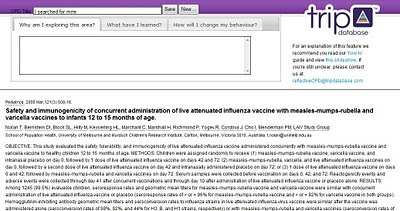
TRIP has been interested in education for a while and the new site saw a new feature added ‘Use as CPD’. This allows a user to view an article in ‘CPD mode’; this results in the article being opened with a top bar with 3 questions:

  • Why am I exploring this area?
  • What have I learned?
  • How will I change my behaviour?

See image below to help understand what we do!

The idea is that health professionals record their reflections on the paper and this is then stored in their educational eportfolio.

As with many innovations things started slowly but I’m now delighted to report that it’s being used heavily and it’s looking great.

What interests me is the middle questions ‘What have I learned’, wouldn’t it be great if this learning could be shared?

TRIP in 2009

Having a blog allows us to communicate new TRIP developments. As such, it also acts as a ‘sort of’ diary. As we’re approaching the end of 2009 I thought that I’d look back over a very significant year.

January – we reported on the early steps of TRIP Answers and also my discovery of Wordle!

February – results of the latest survey of TRIP users & highlighting a massive increase in traffic.

March – Mentioned HIFA for the first time, discussed the 2009 upgrade to TRIP and our trademark of the phrase TRIP.

April – Swine flu resources were mentioned a lot and we also highlighted the end of the NLH.

May – Further posts on new TRIP, highlighting a proposed new logo (which most people hated so we didn’t use) and the adding of the first blog to TRIP – Clinical Correlations.

June – Announcing the TRIP Advisory Board, discussed my partial menisectomy!

July – Mention of our idea for identifying evidence for the resource poor world.

August – further discussion of our ‘resource poor’ idea and some sneak previews of the new TRIP (advanced search, medical images etc).

September – Various teasers for the new site, followed by the launch announcement and ending with an apology for the new site dying and being taken down!!!

October – Announcing our tie-in with a electronic health record system, also announcing the securing of funding for our ‘resource poor’ idea and – thankfully – reporting on the stability of the new TRIP.

November – Reporting on our work with the iPhone, announcing a few new planned enhancements to TRIP and a post about the impact of TRIP.

December – Related articles was rolled out and hitting 3,000 registered users.

Aside from the above in 2009 we had nearly 10,000,000 visits to TRIP, we forged lots of new relationships with companies and organisations as well as building on existing ones.

For me 2009 was a transition period for a number of reasons:

  • We established ourselves as a stable company without the largesse of NHS funding (via the significant Q&A contract we had for 4+ years).
  • We moved away from using a large company for our web-developments and started working with Phil and a separate design agency.
  • We spent a large amount of our time developing the site and improving upon it.

And 2010?

  • We’ll be launching our ‘resource poor’ feature on TRIP, this could have significant global benefits.
  • We’ll be rolling out an overhauled TRIP Answers.
  • We’ll be launching our self-test CPD modules – over 6,200 of them.

However, 2010 will be mostly about building on the work of 2009 and hopefully getting out and discussing TRIP with more individuals, organisations etc. Basically, further increasing brand awareness and traffic!
Registered users hit 3,000

We launched in early October and in just over two months we have attracted 3,000 registered users to TRIP via our My-TRIP offering.

The first 1,000 took 15 days, the second 1,000 took 24 days and the third 1,000 took 31 days.

For a full list of the advantages of signing up see our list of key features but they revolve around keeping up to date with the latest evidence, recording your use of TRIP for CPD/CME and proof of learning and access to the TRIP/doc2doc forum. Finally, searching TRIP while registered means we pay a proportion of advertising income to Medecins Sans Frontieres/Doctors without Borders and HIFA2015.

So, if you’re not registered, do it now – it’s a powerful tool and it’s free!

Using related articles

A recent example of a use for related articles was when I was looking for articles on omega-3 fatty acids. I just searched under omega-3 and looked at the returned list. The fourth result was ”Omega-3 fatty acids for bipolar disorder’ which I thought might be interesting, so I hit related articles which returned the following (just showing the top 7):

  • Omega-3 fatty acid treatment and T(2) whole brain relaxation times in bipolar disorder. American Journal of Psychiatry 2004
  • Omega-3 fatty acids for bipolar disorder Cochrane Database of Systematic Reviews 2008
  • Some of our patients have been put on Omacor by a psychiatrist as a mood stabiliser. As this is not listed as an indication in the BNF, I would be grateful for any information about this use of Omacor. TRIP Answers 2005
  • Omega-3 fatty acids and mood disorders. American Journal of Psychiatry 2006
  • Omega-3 fatty acids: evidence basis for treatment and future research in psychiatry. Journal of Clinical Psychiatry 2006
  • A meta-analytic review of double-blind, placebo-controlled trials of antidepressant efficacy of omega-3 fatty acids. Journal of Clinical Psychiatry 2007
  • Cross-national comparisons of seafood consumption and rates of bipolar disorders. American Journal of Psychiatry 2003

So, from having one article on the topic, with the click of a button I have lots – easy!

New features

Sorry, I mentioned it on twitter but didn’t mention it here! Basically, we rolled out some new features earlier this month!

Search history. This is only available if you’re logged in and records each search you make. Most importantly it allows you to undertake complex combination searches. NOTE: This feature is available to the right of the search button.

Search wizard. This is our rather nifty feature that uses a combination of a PICO search and contingency searching to return a small number of results. It works by toggling terms between title only and text anywhere in the article.

Semantic tools. I’ve blogged about this twice (here and here) which is a sign of how much I rate the technology. Basically, it compares documents textually to see if how they compare. Those that are similar – based on word analysis etc are considered related. There are two main ‘outlets’ for the semantic tools:

  • Related articles page. This allows you to add text (e.g. free-text question, passage from a book/article etc) and it will find related articles. This has many possible uses (see the first post mentioned above).
  • Related articles in the search results. All the semantic analysis has been inspired by my love of the ‘related articles’ feature in PubMed which has been really helpful in finding articles on many many occasions. Now, under each search result, in TRIP, is a ‘Related’ link that shows you semantically similar articles. Why is this helpful? Do a search for colon cancer and this returns many different types of articles (diagnosis, screening, treatment etc). You find an article that you like (e.g. screening family members) you press related and the new results will be closely related and highly likely to be on screening family members for colon cancer.

Oh yes, before Xmas we’re hoping to roll out a new design – a slight upgrade to the current site!

Related articles

In our previous post I revealed the release of our related articles functionality.

We have now released a bit of code that allows users to embed related TRIP articles into their own pages. For examples see these two examples Noctural Enuresis and Acne Vulgaris. In both cases the related articles are on the right-hand side of the screen, just below the main TRIP logo.

To be clear, you place the code on your site and it will find TRIP content related to your site and place the 3 top related links onto your site – all automatically!

So, if you embed the code, what’s happening? Essentially, the code alerts TRIP to come and look at the page and find related articles from within TRIP’s content. The top three most related articles are then sent back to the page.

If you want to use the code let me know!

Exporting CPD learning

TRIP has a CPD (Continuing Professional Development) facility which allows clinicians to reflect on articles that they have looked at via TRIP (for further details click here). These reflections are saved on our system and users can recall these at any time.

We have just rolled out an enhanced export facility that gives the user greater flexibility as to what they export (ie only between 2 dates, to not export certain reflections etc). In addition, the recorded learning is not exported as a PDF file. We have updated our slide show to reflect this (click here).

Background Knowledge

Since launch our background knowledge boxes have seen heavy usage. The background knowledge boxes appear at the top of the search results and link to textbook style entries (e.g. eMedicine). The idea is that they help give some contextual links to the main research articles.

One idea we’ve got is to allow users to nominate references/links and, in a way, adopt a keyword. This is still not likely to be properly rolled out, although we did receive a suggestion for the osteoporosis entry and have added a link to the WHO FRAX fracture risk assessment tool. On one level this is a small step, but for me it carries a certain significance around future possibilities!

Blog at WordPress.com.

Up ↑