Search

Trip Database Blog

Liberating the literature

Author

jrbtrip

Related articles on TRIP

I’ve long admired and found useful the related articles feature on PubMed. When you’re carrying out a search on PubMed and think you’ve exhausted all the references, clicking on ‘Related articles’ often finds gems you would have otherwise missed.

After years of envy, we’ve just rolled out a test version and this can be tried by clicking here. There are multiple ways of using the related article feature and the most obvious is to add text into the text box and press search. Once you’ve carried out a search you’ll see that under each record there is this chunk of text ‘Related: Method A Method B’. These are two different methods of finding articles related to that particular article.

We’re looking for novel ways of using the related articles via the text box and here are a few suggestions:

  • Asking free-text questions. For instance typing in “Is calcium useful in preventing falls?” gets pretty good results.
  • Writing an article and need to find a reference to support a particular passage – add the passage to the text box and see related references!
  • Education needs. One tester has highlighted the usefulness of linking in with PUNs and DENs (educational concepts – Patients Unmet Needs and Doctors Educational Needs) which UK doctors are encouraged to consider. Add the PUN or DEN to the text box and see what happens!

Anyway else got any suggestions?
TRIP and doc2doc

TRIP has a track record in helping clinicians find answers to their questions. However, it would be naive to think it answers all the questions all the time! So, trying to be helpful, we’ve linked in with the BMJ’s clinical community doc2doc. We’ve just ‘opened’ it in the last few days and the BMJ even produced a press release.

The whole idea behind this collaboration is that if a user of TRIP doesn’t find what they’re after they can use the doc2doc forum to obtain an answer. This could come from the wider clinical community on doc2doc or even the TRIP team, who’ll regularly monitor the site and use our experience to help answer the question.

A quick update

I’vew just noticed that it’s been nearly three weeks since the last post. I think that’s a sign of how busy things have been! We’re currently working hard on the next update to TRIP. We’ve got a very tight deadline and lots of things happening at once. Also, as some of the upgrades are significant changes they’re requiring significant work.

The main work is around:

  • CPD – we’re finally putting the finishing touches on our self-test CPD feature, with over 6,000 education packs.
  • TRIP Answers – mainly a redesign, improved search and ‘new research’. This latter feature will automatically highlight new research that may be of interest/update an exisiting question. This is being powered by some semantic technology we’re using.
  • Semantic technology features, too complex to state in this brief post, but one for another time. Think ‘Related articles’ in PubMed…

TRIP on the iPhone (and other smart phones)

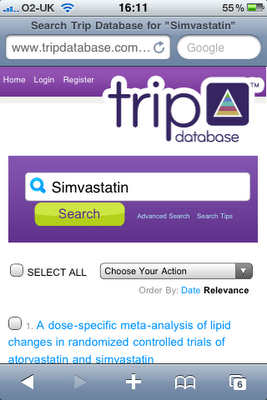
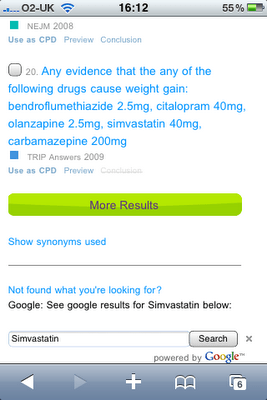
A few tweaks of the CSS on TRIP and it works rather well on the iPhone (and Android phones – thanks @amcunningham). See below for some screen shots. The top image is how the icon looks on the start page of the iPhone, below that is the top of the results page and right at the bottom is the bottom of the results page.

As well as looking great it makes TRIP usable on smartphones which is becoming an increasingly important ‘market’.

NOTE: @amcunningham has commented that the pictures are potentially mis-leading. To be clear, what I’ve described is not an ‘app’ it’s simply our site optimised for web-browsing. The top top image shows a bookmarked TRIP icon that takes you to the homepage.

Pretty, Pretty, Pretty and pretty useful!

A TRIP Down Database Lane: A Talk With Jon Brassey

I felt very privileged to be asked by Hope Leman for an interview. The results can be seen on her blog Significant Science and on AltSearchEngines.

One response I think could have been improved on was what aspect of TRIP am I most proud. I’m happy with what I said, but could have added to it. In the 10+ years of TRIP I estimate we’ve been searched around 50 million times. If only 1% of these had resulted in improved patient care for a single individual, that’s half a million people – that is mind-blowing….

But, how does one measure the impact of TRIP? There are many possible reasons for seaching TRIP and many possible outcomes, here are a few:

A clinician with a clinical query, some potential outcomes:

  • They may not find any suitable documents.
  • They may find some documents and find insufficient evidence to help.
  • They may find some documents that support their current care.
  • They may find some documents that support a change in practice.

A student doing a study, some potential outcomes:

  • Finds no articles, poor outcome.
  • Finds useful articles that help in their studies.

An academic researcher undertaking a review or creating a guideline, some potential outcomes:

  • Finds no articles, poor outcome.
  • Finds articles that help improve the review or guideline.

As mentioned the list is not meant to be exhaustive! However, it should illustrate that people come to TRIP for many reasons and there are many potential outcomes.

A small bit of research we carried out in 2007 (click here to see the full post) showed the following:

  • 13% – find the information they wanted all the time
  • 53% – find the information they wanted most of the time
  • 19% – finds the information about half the time
  • 15% – find the information less than half the time

It was a small sample and invariably biased – so may not help much in deciding the impact of TRIP.

If anyone has any bright ideas, please share them!

Community noticeboard

Another new feature that was released in the latest upgrade was a community noticeboard. This allows for people to send targeted messages to TRIP users. It’s free and easy to set-up. See the slideshow below (best viewed in full screen mode). We envisage it being used to highlight conferences, job and to even ask for help! However, we’re keen to see how people utilise the feature, so feel free to be imaginative!

Can (or should) TRIP be social?

I posted the following comment on twitter:

Is 1,020 people on TRIP the beginning of a useful social network? If so, how to proceed. If not, how big before a crtical mass?

To give some context the 1,020 people refer to those people who have signed up to My-TRIP. I also think using the term social network was wrong, too many associations.

That aside, I had three responses:

@markhawker: Depends what “links” you want to be made? i.e. what connects the nodes?

@CharlieNeck: we shall be the fellowship of the trip

@amcunningham: I think 100 early adopters of new trip may be useful people to know. What are your plans?

My initial post was just me thinking aloud. We’ve got > 2,100 people signed up, all with country identification, all saying what their clinical interests are and also what their profession is. As I see these accounts being set-up (I get an e-mail of each one) I just see lots of connections e.g. country connections, professional connections, speciality connections.

Can these connections be put to good use? Currently, these connections do not formally exist. No-one has requested that TRIP make the connections.

My own view is that users of TRIP are looking for information. If they cannot find the information can they ‘reach out’ via connections to try and obtain this information. Someone with a cardiology question could make a request for information to people with an interest in cardiology. Someone needs a geographically specific question e.g. what’s the best hospital for CABGs might ask cardiology interests in a particular country.

Is the above ambitious, not ambitious?

Might it be useful to offer:

  • People ‘like you’ are currently looking at these articles
  • People ‘like you’ who searched for asthma looked at these articles

I’m not convinced by the ‘like you’ notion or the usefulness of seeing what others are looking at.

I think this post demonstrates the very early stage of thinking on the matter. It might also highlight a lack of ambition. Either way, feel free to help give me a guiding hand!

Using CPD on TRIP

The CPD feature on TRIP is new, so we’ve created a simple walkthrough of how to use it (if the writing is too small, open in ‘full’ mode.

TRIP and Electronic Health Records (EHR)

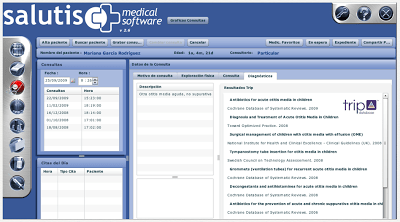
A few months ago TRIP was approached by the manufacturers of a new EHR called Salutis Evidentia. They were keen to integrate their product with the evidence-base of TRIP. The natural way forward was to use our web-services and the results of this collaboration are close to being released. The image below shows you how the beta-version is looking.

What is happening is that when the doctor enters a diagnosis or treatment the system automatically searches TRIP and returns pertinent results. It’s a simple concept which works well and looks great. We think it’s a great feature and we’re excited to see TRIP used in such a way.

If you want further details just let me know via the comments section or e-mail me directly (jon.brassey@tripdatabase.com)

Blog at WordPress.com.

Up ↑