Search

Trip Database Blog

Liberating the literature

Category

Uncategorized

A web-based library consult service for evidence-based medicine

According to the paper in BioMed Central’s ‘Medical Informatics and Decision Making‘ this paper (click here):

“The LCS system is designed to provide full text evidence-based literature with critical appraisal in response to a clinical question asked by a physician who may be at a remote or rural site. “

It appears to be a type of Q&A service. Not sure about the turnaround time they aim to achieve although this is an outcome to be measured. I always wonder what ‘real’ impact using full-text has. On one level it adds to the robustness of the answer. However, the extent of this difference may be clinically insignificant. Also it invariably adds to costs and turnaround time.

Evolution of ‘knowledge’

I had an interesting meeting with the NLH regarding an extension to the Q&A service. One issue that came up was repeat questions and the need to update them. Perhaps the biggest discussion focussed on what to do with the old questions once updated. My view was to leave them on the site as much as a historical record, as a mark of the evolution of ‘knowledge’. A few days later a great example of this: the use of watchful waiting in inguinal hernias.

In the initial answer (click here), which was answered in December 2005, there was a lack of trial data but it was reported that a trial would be reporting shortly. Moving into the present day and our answer (click here) reports on the findings of that trial.

Is that significant? I believe so. Previously the ‘expert’ view was supportive of watchful waiting, now there is trial data to support that view. In the space of 6 months a clinical uncertainty has been reduced.

Yahoo Says Searchers are Better Patients

http://blog.searchenginewatch.com/blog/060623-151210

The future of search is mobile…

Google to focus on London for next phase of growth is the title of an article in The Times.

In Britain there is one mobile phone for every person, while in some parts of Scandinavia mobile ownership is almost double that rate. “Looking at these numbers, it becomes very obvious that in the future people will want to access information on the web with a device they carry with them,”

Yahoo answers

Interesting post Look Out Wikipedia, Here Comes Yahoo Answers! which includes the following passage:

“Aside from traffic, I think the more interesting comparison between Yahoo Answers and Wikipedia is the different approaches. Wikipedia aims to have everyone comprehensively build a corpus of knowledge in an organized fashion. Yes, disorganized in the sense that anyone can change things. But organized in that each topic gets a single page containing the contributions.

Yahoo Answers deals with one-off question answering. There’s a corpus of knowledge growing there, one that’s even organized into categories, but all the answers on a particular topic aren’t neatly put on the same page.

That’s not necessarily a disadvantage. In fact, it may be part of the reason Yahoo Answers is pulling in an audience that might never want to contribute to Wikipedia. Wikipedia, if it were a computer game, would be a strategy game where you take a long view to win a campaign or goal. Yahoo Answers is a first-person shoot-em-up. Questions appear, and as soon as one is shot down with an answer, it’s on to the next one.”

With the ATTRACT website hosting 2200 questions and the NLH Q&A site hosting 3100 that’s a total of around 5,300 questions and answers. Small compared with the 10 million on Yahoo answers. But these are 5,300 ‘good’ answers. The number of repeats questions is rising (probably around 5-6% compared with 2-3% when it was just ATTRACT). What happens when we get to 10,000 answers, 25,000 answers? Will we have answered 50% of likely clinical questions? Will we then have a more useful resource than, say, eMedicine and Uptodate?

An interesting systematic review on the use of PDAs by health care providers. They found:

“The current overall adoption rate for individual professional use ranges between 45% and 85%, indicating high but somewhat variable adoption, primarily among physicians.”

Why do the clinicians use PDAs?

“In terms of patient care, access to drug information was reported in 93% of the surveys reporting clinical PDA use, while 50% reported prescribing, 43% stated accessing patient records, 43% described medical calculator use, and 36% indicated use in reference to laboratory values.”

I’ve blogged before on wi-fi access. It seems to me that fairly soon all PDAs will be seamlessly linked, via wi-fi, to the internet. This will negate the need to store databases actually on the device and allow live searching of up-to-date resources. But the big message, for me, from the systematic review was the broad need for ‘drug support’. Although the paper focussed on PDAs I’m sure a similar trend would be seen by clinicians using a computer-based internet connection.

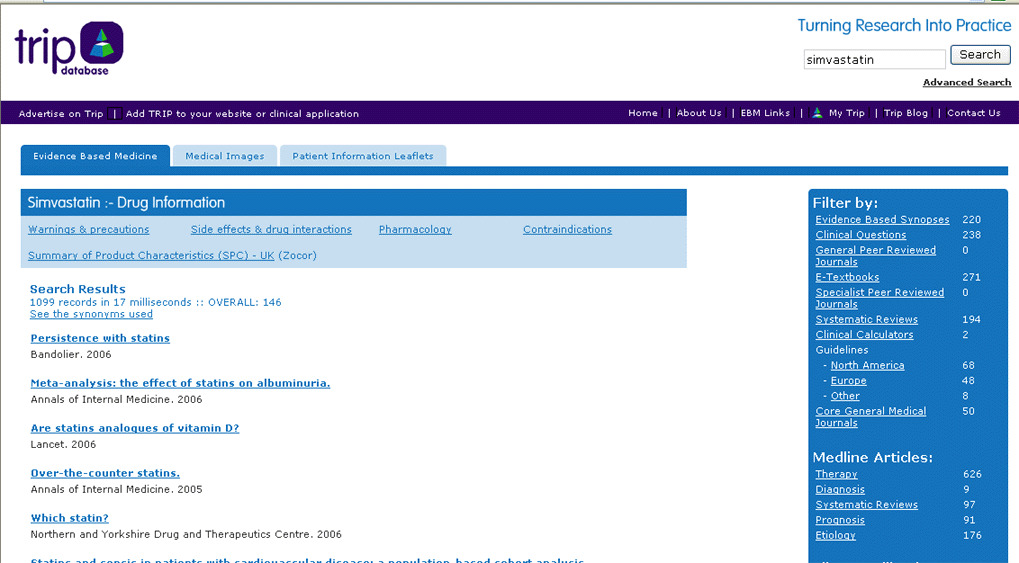
TRIP, while a great source of information for EBM articles it has not focussed on drug support (be it contraindications, interactions, side-effects etc). Two sites that look good are the UK’s Medicines.org SPC site(Summary of Product Characteristics) and the American Rxlist. A bit of thought and I’m sure they’d fit in seamlessly with TRIP.

Record month

May reported the largest number of searches, ever, for TRIP – 573,413

Nice.

Podcasts

Where Dean goes the BMJ follows. Perhaps in a few years TRIP may contain a podcast search.

Dianette

I like to analyse what people look at via TRIP. Given the Q&A services we run (ATTRACT and NLH Q&A service) I decided to see what articles users follow via TRIP – so restricted the analysis to just those two services:

– What is the duration of treatment when adding clopidogrel to routine aspirin short-term post CABG and post coronary artery stenting in IHD.
– Are influenza vaccinations effective in older people?
– *What is the length of time a patient can remain on Dianette provided that there are no contraindications?
– What are the recent guidelines/evidence regarding the treatment of prostate cancer?
– What treatments are available for someone with a ruptured Bakers cyst?
– *What is the reason for stopping dianette a few months after skin condition resolve?
– Can the drug amlodipine cause atrial fibrillation?
– What causes a yellow tongue, and what is the best available treatment?
– *What are the risks of using Dianette as an oral contraceptive, over and above the risks associated with a 3rd generation oral contraceptive pill?
– What skin preparation if any is recommended when taking blood or giving an injection?
– *What therapies are available for women with PCOS with hirsutism other than Dianette?
– *What is the recommended length of time a woman should be on Diannette for acne, should any blds be checked, should there be any break in-between treatments?

What immeadiately struck me was that of the top 12 questions 5 related to Dianette. What does that tell us about Dianette?

Blog at WordPress.com.

Up ↑