Search

Trip Database Blog

Liberating the literature

Category

Uncategorized

Freemium: the next stage

Earlier this week I had the first planning meeting around turning Trip into a freemium service.  Much of the current site will remain free. The premium (paid for) service will have no restrictions and will have some enhancements.

So, here’s what we’re thinking:

Free service

  • no advanced search
  • limited export options
  • no images, videos etc.

Premium service

  • better export facilities
  • improved meta-data
  • advanced search available
  • all content types available
  • no adverts
  • various discounts from evidence-style products
  • ability to add (and share) reflective notes against each article
  • introduce the answer engine

Costings is still fluid.  I intend to have an individual subscription and an institutional one.

Individual – My aim is to suggest a monthly charge of around a cup of Starbucks coffee but people will be at liberty to reduce (or increase) the amount they pay, although there would be a lower limit.

Institutional – Various levels based on the number of individual accounts available.  In addition we intend to introduce some analytics so the institution can see how the service is being used.

It’s still early days and if you have any opinions please let me know.

Freemium

We have recently been in discussion with an organisation about potentially partnering with us.  This would have brought some financial security to the site as well as allowing me to further develop some of the products we’re currently working on.  These technologies being shared with the organisation. While nothing has officially been said I get the impression that it’s not a priority for them – so I need to move on.

I have come to the conclusion that I cannot rely on others to support Trip and therefore we need to strike out on a ‘Plan B’; which is a freemium version of Trip.  In a nutshell most of the current Trip remains free and certain enhancements are made to create a ‘paid for’ premium version.

The insecurity around funding is getting more than tiring – so something has to change.  We’ve got to work out the details (features etc) but my plan is to keep the price low – I quite like the idea of linking it to the local price of a Starbucks cappuccino (or similar).  The point being that if you value Trip you’ll surly pay a monthly fee that is the same as a Starbucks (I’d welcome feedback on this point).

If we can get a regular, secure income we can properly plan for Trip.  We can enhance and roll-out some truly great products.  The vision I have for Trip is really exciting and as such I could have gone and secured venture capital funding.  But that would have changed the nature of Trip, something I’m not particularly keen on – for obvious reasons.

Evidence based medicine: a movement in crisis?

In January this year I was a participant at a small gathering of EBMers in Oxford, exploring the notion of RealEBM.  It was jointly organised by Trish Greenhalgh and the Centre for Evidence Based Medicine.  The participant list was Trisha Greenhalgh, Jeremy Howick, Neal Maskrey, Druin Burch, Martin Burton, Hasok Chang, Paul Glasziou, Iona Heath, Carl Heneghan, Michael P Kelly, Richard Lehman, Huw Llewelyn, Margaret McCartney, Ruairidh Milne, Des Spence and myself.  Someone – certainly not me – called it the Evidence Based Medicine Renaissance Group.

A paper has been prepared and was recently published in the BMJ Evidence based medicine: a movement in crisis?

The preamble is:

Trisha Greenhalgh and colleagues argue that, although evidence based medicine has had many benefits, it has also had some negative unintended consequences.They offer a preliminary agenda for the movement’s renaissance, refocusing on providing useable evidence that can be combined with context and professional expertise so that individual patients get optimal treatment.

And the conclusion:

Much progress has been made and lives have been saved through the systematic collation, synthesis, and application of high quality empirical evidence. However, evidence based medicine has not resolved the problems it set out to address (especially evidence biases and the hidden hand of vested interests), which have become subtler and harder to detect. Furthermore, contemporary healthcare’s complex economic, political, technological and commercial context has tended to steer the evidence based agenda towards populations, statistics, risk, and spurious certainty. Despite lip service to shared decision making, patients can be left confused and even tyrannised when their clinical management is inappropriately driven by algorithmic protocols, top-down directives and population targets.

Such problems have led some to argue for the rejection of evidence based medicine as a failed model. Instead we argue for a return to the movement’s founding principles—to individualise evidence and share decisions through meaningful conversations in the context of a humanistic and professional clinician-patient relationship (box 2). To deliver this agenda, evidence based medicine’s many stakeholders—patients, clinicians, educators, producers and publishers of evidence, policy makers, research funders, and researchers from a range of academic disciplines—must work together. Many of the ideas in this paper are not new, and a number of cross sector campaigns with similar goals have already begun (box 3). We hope that our call for a campaign for real evidence based medicine will open up debate and invite readers to contribute (for example, by posting rapid responses on bmj.com).
I hope you’re interested and if you need an electronic copy, just drop me a line.

Stars, favourites and saving

This is another ‘how to’ post – explaining how to use a particular bit of functionality on Trip.  Other posts in this series include the recent Colours and Trip

Many other websites allow users to favourite (or save) things of interest.  In Google Mail they allow you to favourite an email and in Twitter you can favourite a tweet; in both systems they use a star.

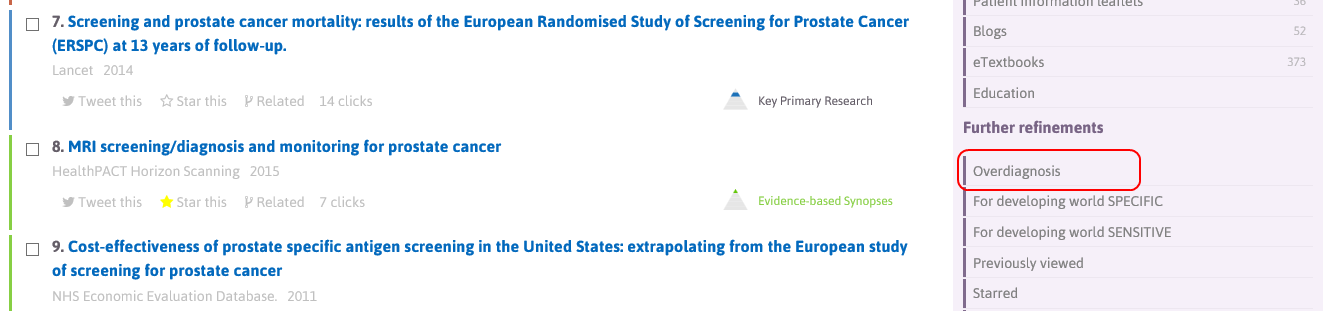
In Trip we’ve recognised the need for users to save favourite/interesting articles and we have adopted the same approach as Google and Twitter with the star system.  Below are images highlighting the main features of the ‘star’ system:

  • The top image shows you the simple way to save articles
  • The middle image shows how you can browse the starred/saved articles
  • The bottom image shows how you can find articles, after a search.  This last technique might be useful if you want to actually search for an article (as opposed to browsing).  However, it might be that you’re carrying out a broad search and you may want to know if any previous articles you’ve read (and possibly appraised) match your particular search.

Full-text on Trip

Last year we released our full-text link out feature.  It’s a simple concept, instead of linking from Trip to the article abstract on PubMed we link directly to the full-text article that your institution has subscribed to.

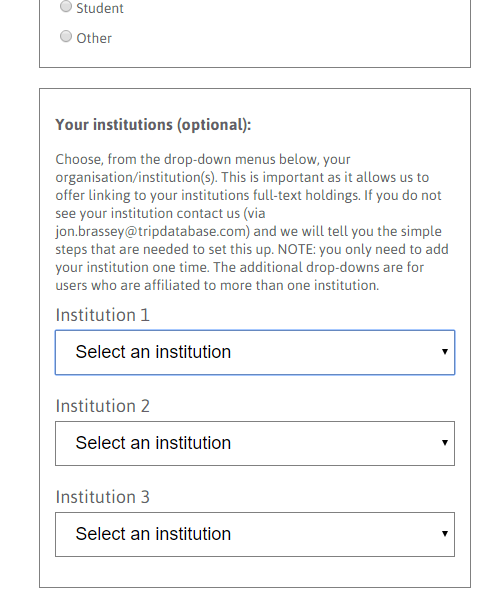
It’s free and really simple to set-up.  All we need is your institutions link-resolver/base URL.  Knowledge of this is likely to be the preserve of library-folk, so all you need to do is contact the library and ask if they have one. Send it to me (jon.brassey@tripdatabase.com) and we can set you up.  You then need to edit your profile on Trip (easy to do) to let us know you belong to the institution, and when you search you’ll see a link to full-text under each primary research article.

So, if you want to make easy access to full-text, contact your library today and join over 330 organisations around the world:

Evidence-based tweeting

Or possibly more appropriately, evidence-based dissemination of research evidence.

For a while now we have been tweeting new research added to Trip in 8 topic areas, those being:

For each account, we send a topic specific tweet with the title and the corresponding URL of an article recently added to Trip. They have been really successful with over 2,500 followers since the start of the year (with little publicity) and tens of thousands of clicks (on links to the articles).  

In the last month we’ve been monitoring the activity quite closely to better understand usage.  We have typically been tweeting articles throughout the day at fairly even time intervals and seeing how many clicks we’re getting.  Doing so has allowed us to graph the most popular time for people clicking on links, which we have graphed below (click on graph to expand).  The data is based on hour time-periods when we have received more than ten clicks in that hour.

So, there’s a clear pattern with the evening (UK time) being the most popular. 

We have used this information to see if we can better focus the tweets we send to coincide with the greater likelihood of being clicked on.  So, this means the following:

  • Weekdays – a tweet between 9-10am then some tweets after 6pm, with a concentration between 8-11pm.
  • Weekends – a tweet around 11am then some tweets after 3pm, with a concentration between 9-11pm.

We’ve uploaded the tweets for the next 6 days and I will report back to see if this ‘evidence-based’ targeted tweeting makes any difference!

Synonyms

We have a manual system for handling synonyms in our search.  This means that if someone searches for IBS we automatically search for irritable bowel syndrome.  I’m currently undertaking a review of these synonyms, a long-winded and problematic process – but well worth doing.  However, I’m stuck and would like people’s views (email me via jon.brassey@tripdatabase.com).  Currently, we have three separate ‘collections’ of synonyms:

paediatric, paediatrics, pediatric, pediatrics, infant, children, infants, infancy, child, childhood, kid, kids, preschoolers, childrens, children’s

infant, babies, baby, child

newborn, neonatal, neonate, neonates, newborns, neonatology

There is clear overlap.  But there is a precise answer and a pragmatic one.  In other words, you need to put yourself in the shoes of a searcher.  So, if they search for children and cough is it reasonable to drop in the synonym paediatric ie also search for paediatric and cough?  I think it is.

But, and this gets a bit harder – where is the overlap between newborn with infant and with children?

The easiest solution is to lump the top two ‘collections’ together and leave the third ‘as is’. 

But I’d welcome opinions!

Trip and CPD/CME

I’ve posted before about Trip’s educational merits.  But, in a nutshell, using Trip to help answer clinical questions is undoubtedly educational.

Many health professionals around the globe are required to demonstrate that they are keeping up to date with the latest evidence and the requirements vary widely from country to country.  Trip is very keen to help support this and to date we have two main ways:

  • The timeline, this records all activity on Trip (search terms used, articles viewed) and can be exported for inclusion in educational portfolios
  • Reflective toolbar.  This is little used but allows a user to open a document and answer reflective questions about it.  This is recorded and is exportable.

But, we want to improve our educational support but require help from our users – hence this post.  It has been prompted by me seeing, for a UK-based educational activity, a company offering 1 CPD credit.  The notion is that if an activity takes an hour they get 1 CPD credit.

Might such an approach be useful in Trip?

For every article read do we assign a CPD credit?  Do we also allow, via the timeline, the ability to reflect on an article to gain extra CPD credit?  So, you might read an article and gain 0.5 CPD credits and if you then record your reflections it goes up to 1 CPD.

So, if the above impacts on your professional life please let me know what you think (via jon.brassey@tripdatabase.com).  If we get it right it’ll be a huge benefit.

Colours and Trip

I have recently received an email from a librarian in Sweden asking about the use of colours in Trip.  Hopefully this post will answer her questions and also prove useful to others.

A small bit of background first: when someone is presented with a list of results the mind attempts to make rapid sense of them; to better understand them.  The mind uses heuristics to minimise the cognitive load, the lighter the load the better for the user.

It is for that reason I introduced a colour coding system in Trip.  While everyone might know that Cochrane, NICE and AHRQ are likely to be higher quality (using secondary review methods) what about other, smaller, lesser known publishers that we include in Trip?  For instance, a user might not have heard of BestBETs and therefore – falsely – relegate the ‘worth’ of that article.  Similarly, many users might feel that preeminent journals such as NEJM and The Lancet must be high-quality.  However, within Trip we only count these as medium quality as they have only gone through peer-review (itself a highly flawed quality control system).

In other words there is a hierarchy, based on likely quality of article/publisher, within Trip.  Quality is perhaps an over-simplification, it’s more robustness and transparency of method (but the two are closely linked).  This hierarchy features heavily in our search algorithm (the technique we use to decide on the order of articles on the results page), which favours higher-quality, secondary review type evidence

In Trip we use the colour system to reflect the quality hierarchy.

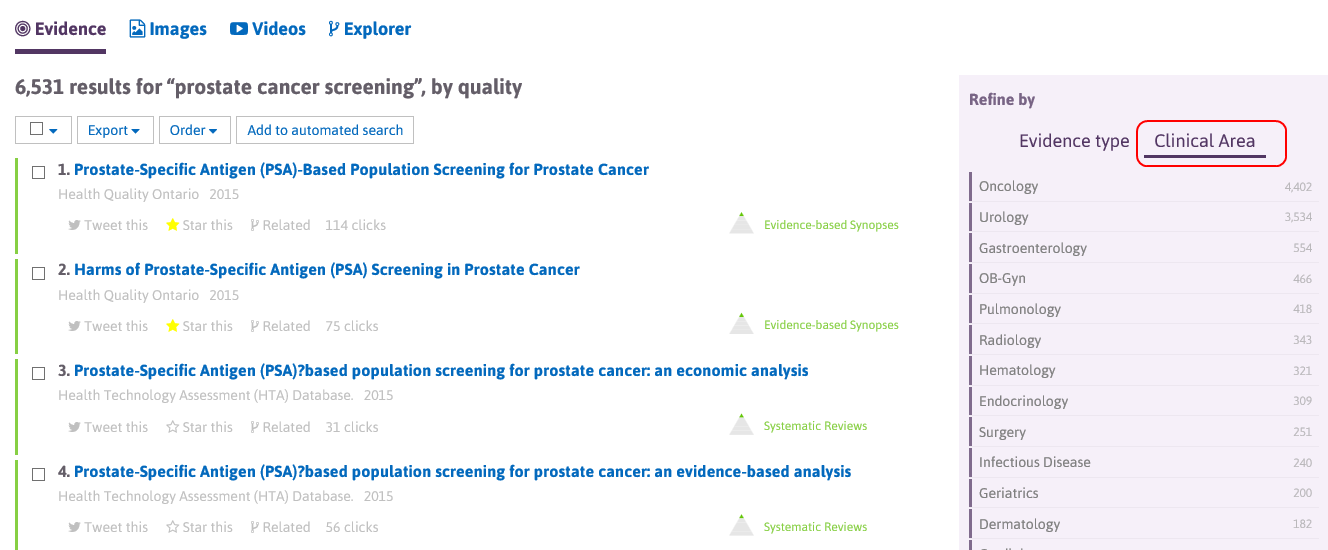
In the image above (click to enlarge) you can see two areas where we use colour:

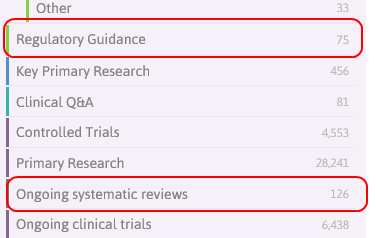
  • On the right-hand side, associated with the refine/filtering system. As you can see next to Evidence-based Synopses, Systematic reviews there are green ‘flashes’ and as you move down the quality hierarchy the colours change.  At the bottom we have the yellow for eTextbooks.
  • On the left-hand side, associated with each result is a colour flash.  In the top result, it’s an AHRQ publication, which has a green flash – indicating that it’s likely to be high quality.  Under that are articles from the journals Breast cancer and Anticancer research, both of which are primary research journals.  They have orange flashes as they are controlled trials.

So, the two sides of colours are linked and should help users quickly locate the content that best suits their needs.

Blog at WordPress.com.

Up ↑