Search

Trip Database Blog

Liberating the literature

Category

Uncategorized

The future of TRIP

For those of you who follow TRIP you’ll know that I frequently reveal our lack of money.  It’s something I’ve got used to and learnt to live with.  I like to think of myself as an innovator and product developer, as opposed to a businessman.  I’m not great at the latter, I don’t like asking for money!  However, we’ve survived for over ten years and are still financially viable (I was going to say strong, but that’d be a slight exaggeration)!  What we’ve achieved with a small budget has been spectacular and part of me thinks that being kept hungry keeps the pressure on me to innovate.

But, I do occasionally fret over the lack of business development. I do wonder what we could do with a decent budget.  I do have a realistic set of ideas/innovations that would make TRIP significantly better.  I do think I could make TRIP the Google for medicine – the first port of call when clinicians have knowledge needs.

So, when I was approached 4-6 weeks ago by someone interested in helping TRIP on the business side, I was excited (and apprehensive).  We had some great chats and interesting exchanges of emails.  I’m thinking the approach may well have stalled but I’m not dispondent and that’s for the following reasons:

  • I learnt an awful lot during the due diligence process.  I received numerous pieces of advice – all free – around various aspects of business, including corporate structure.  I’ve come out of this stronger and more confident than before. 
  • As a result of one thread of advice I’ve been introduced to a venture capital firm.  This relationship isn’t necessarily about raising finance, it’s more about exploring options and business models.

With the new version of TRIP due before the end of the month and all this excitement around business development I can’t help but be excited about the future.  I doubt I’ll ever be a businessman but as long as I keep enjoying my business that’s fine by me 🙂
TILT and learning points

TILT is our shared learning experiment which allows for clinicians to record and share learning they may have experienced.  We’ve now had over 850 TILTs so it’s getting a useful resource.

Reading today’s BMJ there’s an article on postural hypotension which has a great section called ‘Learning points’.  These are not new but it occurred to me how close TILT is to the concept of learning points.  In other words, what is the take home message from the article.  It’s different from simply the conclusion as it’s more nuanced.  So, two TILTs I added (out of a total of four) are:

Whenever I make connections between concepts (in this case TILT and learning points) it makes me contemplate things.  Is TILT too niche?  Should we automatically grab all learning points from BMJ articles?  Why not try and create a database of everything we know – so TILTs, learning points and conclusions.

These issues and othes like it represent challenges, real and important.  This is why I love doing what I do.

TRIP’s use in SRs

TRIP is frequently mentioned in systematic reviews as one of the sources searched for relevant studies.  In fact the mentions seems to be accelerating and below are 5 recent examples:

I can’t help feeling we’re doing something right!

20,000 registered users

Quite a milestone, over the weekend we hit 20,000 registered users.

We’re currently adding 1,000 new registered users every 3-4 weeks (this has been consistent over many months).  We’re really pleased with this. However, it does put the onus on TRIP to create an even better product/experience for registrants.

Blitter – update

We’ve had lots of feedback on Blitter, mostly positive but some less so (but constructive).

As such we’ve re-designed it, to emphasise our view that it’s principally a search tool (as opposed to a news service).

Give it a whirl and let me know what you think.

http://blitter.tripdatabase.com/

New TRIP product

This isn’t really a proper TRIP product, more an experimental one! 

http://blitter.tripdatabase.com/

The idea behind Blitter is that it only includes content that an independent clinician has deemed interesting/newsworthy enough to comment about. Most clinical search tools grab all the content from a particular publisher – irrespective of the clinical usefulness of the output. So, we see Blitter as being a bottom up approach to content identification – possibly making it more useful.

In addition we have classified each contributor by their clinical interest allowing users to filter results based on the speciality of the contributor – this is possibly an important development. Why? Take the search term pain, an oncologist searching for pain would typically want significantly different results compared to a rheumatologist or a generalist. Currently TRIP and all other clinical search tools show the same results – meaning lots of ‘noise’. So, allowing users to restrict the results based on speciality should make the results more meaningful.

What’s happening?

While I’ve not written a blog article for over a month it does not mean we’ve been doing  nothing – far from it we’re busy busy!  Below are a few examples

  • We’re currently working on a major upgrade to TRIP which I hope will be out before the end of June.
  • We’re also working on a social media search tool we’re calling evidently. We’ve identified a number of bloggers and tweeters who regularly post about clinical issues and we’re grabbing their outputs.  Why?  It’s an experiment but we think that if these coal face clinicians make the effort to blog/tweet about an article they’ve read, it suggests it’s newsworthy.  So why not aggregate that and have a searchable database of noteworthy articles?
  • We’ve started talking with 3rd parties about potential investments in TRIP
  • We’ve added a whole bunch of new content as well as correcting a load of faulty guideline links!

In addition we’ve just had our 19,000 registered users.

There’s more I want to say about all the above, but too busy to be coherent!

The cost of search (3)

A further update on the cost of search via another Freedom of Information request to NHS Evidence.

In the previous analysis (click here) I highlighted their budget was over £24 million, of which over £10 million was on content (e.g. Cochrane, BNF) and a further £2 million was on the specialist libraries (which have now ceased to exist). Therefore, removing the cost of the specialist libraries and content (a total of £12,675,971) leaves their core budget of £11.8 million (I’ve rounded up).

The FoI request highlighted that actually only 384,661 searches are carried out via the NHS Evidence site per month (or, if multiplied by 12 it gives an approximate annual search total of 4.62 million searches (I’ve rounded up). I’ve excluded both the CKS and specialist library search figures (as I have their costs as they are no longer procured).

Therefore, a cost of £11.8 million yields 4.62 million searches = £2.55 per search.

The TRIP costs have not altered and remain at 0.43 pence per search.

So, each search of NHS Evidence appears to be 593 times more expensive than TRIP.

New email format

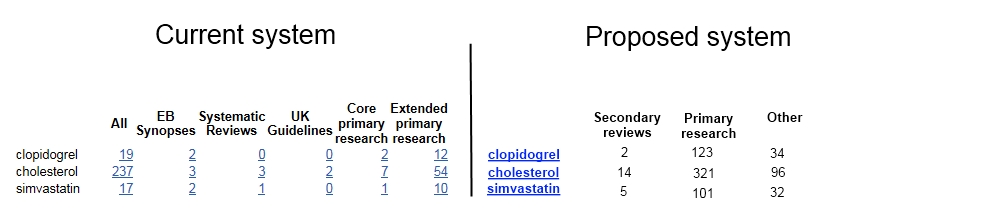
A while ago we asked TRIP users what they thought of the monthly TRIP emails and we got a broadly positive response.  However, we’ve tried to listen to some of the constructive comments and have created a ‘mock-up’ of what a new email system might look like (click on image to make bigger).

What we’ve done is simplify the columns (as we’re introducing new categories in the near future – namely social media) so increasing the number of columns would look even messier!  To see what’s new you’d click on – say – cholesterol – and that would take you to the TRIP results page with ALL the new content for cholesterol.  Users can then click on any category they like to see the relevant articles.

Please let me know what you think – leave a comment or email me: jon.brassey@tripdatabase.com

Blog at WordPress.com.

Up ↑