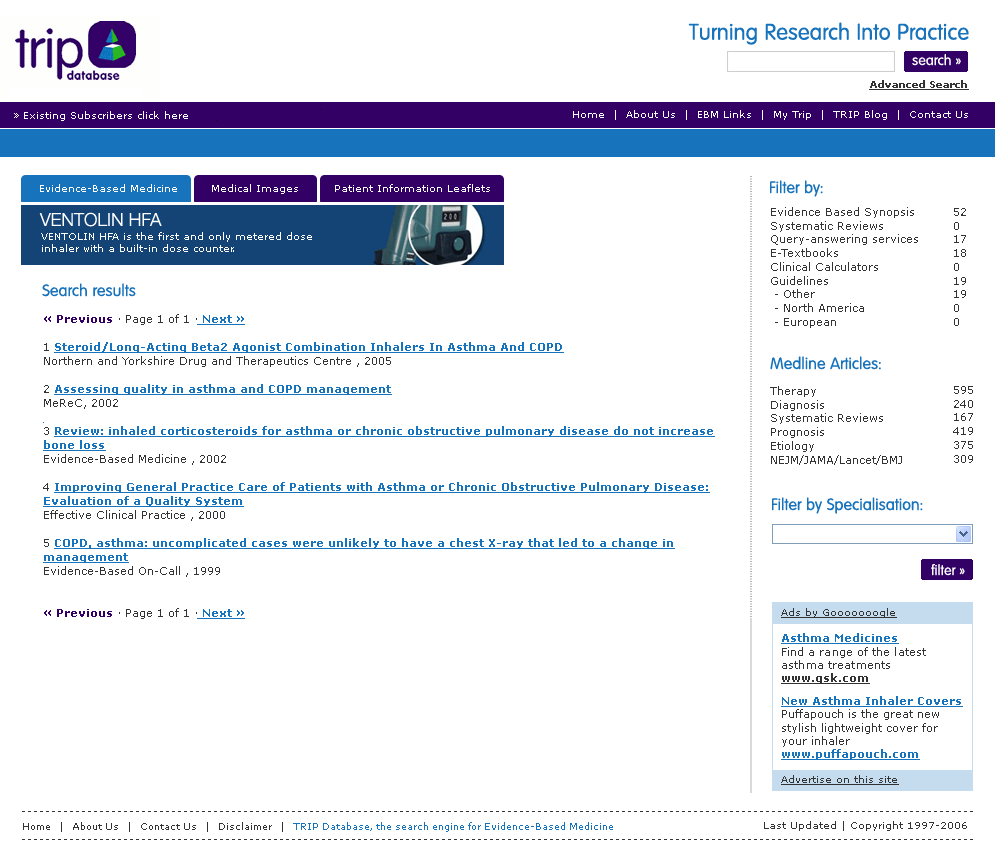
I had an interesting chat with Ben from the NHS eLibraries blog. He suggested trying to tie-in with Google, as part of their Google Health ‘initiative’. One option in Google Health is ‘For health professionals’ – TRIP could form the backbone of a new tab ‘Evidence-based medicine’.
We frequently get very positive praise via our Q&A feedback mechanism. Every now and then we get comments which stand out (for one reason or another):
“Very impressed, very useful. I was however, quite alarmed at some of the other questions posted i.e people asking for guidance on issues which you would have hoped as health professionals they would be extremely familiar with, I suppose you could see that as a good thing, as if this service didn’t exist, presumably they would stay uninformed and at least they are asking questions which will improve their practice.”
In a trial of 8 ‘proper’ clinical questions we rated which search located results best:
Current live system – 1
New test system – 4
No difference – 3
I think the first round goes to the new test system.
Not 100% sure why the authors chose to ignore convention and remove the space between ‘clinical’ and ‘questions’. I’m sure it seemed a good idea at the time!
However, that doesn’t detract from the site (http://clinques.nlm.nih.gov/JitSearch.html) which is a collection on 4,500+ clinical questions. No answers, just the questions. Not sure why I like it so much. It’ll be useful in testing the new search algorithm!
When testing a search appliance it seems sensible to try ‘real’ searches. We’ve received a question about SLE (Systemic Lupus Erythematosus) and statins – should all patients with SLE receive statins.
I entered the search ‘sle AND statins’ and the first result was what I was looking for. On the current ‘live’ system the same search would return one result. However, the user would be required to click on the ‘Clinical Questions’ link. It’s only one click but the new search is showing great promise..
At last, the final installments of the potential new TRIP algorithm have been delivered! We’ve got 35 volunteers testing it alongside a number of staff…
The testing of the new search algorithm is having implications far beyond those expected. The current system of ‘title’ and ‘title and text’ distinction allows for a very accurate location of material. However, the use of these features can be cumbersome. The abolition of ‘title’/’title and text’ distinction creates a compromise.
Perhaps the solution is to adopt the new algorithm, which will give us a great new challenge of always trying to improve it. We could then create an advanced search page for our ‘advanced’ users who take advantage of more of the current search features. The advanced search could look like the Google advanced search with fields for ‘title’ words and ‘title and text’ words….
But, going back to the title of this post, what is TRIP for? Our general view is that its a tool to allow clinicians to rapidly identify high-quality research evidence with which to base a clinical decision on. But that’s our view, our users might have different ideas.
Before going free-access in September we’re experimenting with a new search algorithm, which was delivered 2 days ago. We’ve got around 25 volunteers to play with it to see how they think it works. It’s difficult for me to be objective but my initial trials are promising. A few weird results, but hopefully these are small issues relative to the improvements.
It’s made me appreciate the ‘work in progress’ all search systems must have in order to improve. I feel we’re at the start of a very long journey – exciting times.
Been doing some work around google health and yesterday I searched for ‘tonsillitis’ and got the image on the left, this didn’t work in Canada! Just did a search for ‘prostate cancer’ and got the second image – note the refine function. Interestingly, or perhaps disappointingly, it didn’t give the same results with ‘prostatic carcinoma’ – perhaps synonyms will be plugged later.
Although is this google health? Wouldn’t that be stand alone like google finance – something like http://health.google.com?
One of the refine functions is ‘For health-professionals’ which when clicked gives the following search syntax ‘more:for_health_professionals’. Alas, for tonsillitis the first page of results are for patient information sites! For prostate cancer it did slightly better – but not hugely!


Recent Comments