Artificial intelligence offers many ways to improve access to research evidence. The challenge is not generating ideas, it is deciding which problems are most worth solving.
At Trip, we are considering two quite different developments. One would use AI to help people build better searches and identify the most relevant results. The other would monitor guidelines, reviews and clinical topics for important new evidence.
Both could be useful. We are unlikely to develop both at the same time, so we would like your help deciding where to focus.
Option one: AI-supported search
Traditional search remains central to Trip. It keeps the underlying evidence visible and allows users to explore the results for themselves.
But searching can be difficult. People may not know the best terminology, useful synonyms can be missed, and the most relevant result does not always appear near the top.
AI could help by:
suggesting alternative or missing search terms;
turning a natural-language question into a stronger search;
identifying synonyms and related clinical concepts;
reranking results by likely relevance;
suggesting ways to broaden or narrow a search.
The aim would not be to replace search with a generated answer. It would be to make finding the evidence quicker and easier.
This may be most useful if you struggle with choosing search terms, refining queries or finding the best evidence among noisy results.
Option two: Evidence Watch
Evidence does not stand still.
A guideline or systematic review may be reliable when published, but new trials appear, safety concerns emerge, and papers may later be corrected or retracted.
Evidence Watch would allow users to monitor an important topic, guideline, review or recommendation for developments such as:
new trials or systematic reviews;
findings that challenge an existing conclusion;
important safety evidence;
corrections or retractions.
It would not decide that guidance should change. It would act as a safety net, flagging new evidence that may deserve human review.
This may be most useful if you need to keep searches up to date, monitor existing guidance or avoid repeatedly running the same searches.
Which problem causes you more difficulty?
We are not asking which idea sounds more exciting. We want to know which problem has the greater impact on your work.
Would you benefit more from help finding the right evidence today or from knowing when the evidence changes tomorrow?
Please vote in the poll below:
Please also leave a comment telling us what you would need the chosen service to do well.
Your feedback will help us decide what Trip builds next.
We’ve always tried to keep Trip as open and easy to use as possible. But Trip’s content collection and search results reflect years of indexing, classification and curation, and they are increasingly being targeted by large-scale automated extraction, bots and scrapers systematically working through our results to collect records and source links in bulk, rather than people using Trip to answer genuine clinical or research questions.
To protect that work, and to keep Trip fast and reliable for everyone else, we’ll shortly be introducing one change: opening a source document will require either signing in or being recognised through an institutional IP address. Creating a free account takes less than a minute.
Requiring authentication at this final step will also help us identify unusual patterns of activity and investigate potentially abusive use of Trip.
Searching will remain fully open, with no sign-in required, and results will continue to show the title, year and publisher so that relevance and provenance can be judged at a glance. Authentication will only be needed at the final step, when opening the source document.
We know that any additional step should be introduced reluctantly and only where necessary. We believe this is a proportionate way to protect Trip’s infrastructure, the curation behind the service, and the experience of the clinicians and researchers who rely on it every day.
At Trip, we’ve spent thirty years watching people search for clinical evidence. AskTrip lets us watch something we could never really see before: what people ask next.
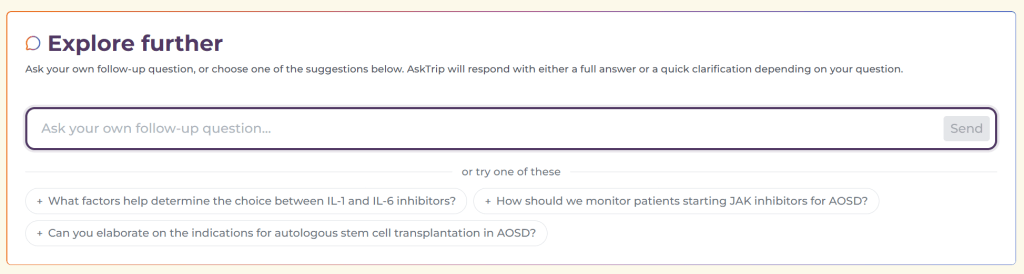
When someone reads an answer and then comes back with a second question – a refinement – they are telling us how their thinking has moved. This has been made much easier, for the user, via our Explore further feature which was released during our recent major upgrade:
We pulled together a set of these refinement pairs and looked not mainly at their topics, but at their direction of travel. In less than a week, users generated more than 50 such refinements – enough to start seeing patterns in how questions evolve. Two patterns dominate.
Pattern one: from knowledge to action
The most common move is from understanding something to doing something about it. The opening question asks what a thing is, what causes it, or whether it works. The follow-up asks what to do, how to monitor it, or what to choose.
A nurse asks about the perceptions and contributing factors behind medication administration errors, then asks which training programmes actually reduce them. Someone asks what Bartter’s and Gitelman’s syndromes are, then asks about long-term management. A question about whether cladribine retreatment is safe in multiple sclerosis is followed by one about the monitoring protocols to use during it. A question about the weekend effect on organ procurement becomes a question about interventions that reduce weekend discard rates.
The follow-up rarely becomes more theoretical. Once the descriptive need is met, the pull is usually towards clinical application, the last mile of turning evidence into a decision. This maps neatly onto a common gap in evidence tools: they often answer the descriptive question better than the applied one.
Pattern two: from general to specific
The second common move is to sharpen a broad question by adding a constraint – a population, a comorbidity, a comparator, a subtype, or a more specific outcome.
“What is the best treatment for hypertension?” becomes “What is the best treatment for hypertension in patients with chronic kidney disease stage 4?” A broad question about dietary changes for weight loss narrows to whole-food plant-based versus omnivore diets, or to the effect of meal timing. A question about formula changes and infant growth narrows to prebiotics in sick preterm infants. A question about chair alarms for falls narrows to self-releasing chair-alarm belts specifically.
This is essentially the user reshaping a broad query into something closer to a well-formed PICO after seeing the first answer. Occasionally the narrowing is methodological rather than clinical: one user narrowed by evidence tier, asking which quality-of-life measures are highlighted specifically in systematic reviews.
Answer-induced follow-ups
Some refinements look different. Rather than simply narrowing a question the user already had, they pursue a concept that the first answer would plausibly have surfaced. We cannot prove that the concept was not already in the user’s mind without the answer text and a behaviour trace, but the pattern is suggestive.
A comparison of ivermectin versus permethrin for head lice is followed by a question about the prevalence of permethrin resistance – likely one reason the comparison matters. A question about folic acid flour fortification is followed by one about B12-deficiency risk groups, the classic masking harm. A question about whether LLM chatbots in the electronic medical record help clinicians pivots to how clinicians can improve their trust in the outputs.
These matter because they are the organic version of what a “suggest a follow-up” feature is trying to support. They show which answer-embedded concepts users spontaneously find worth chasing. That gives us a direct empirical rationale for building this support, rather than guessing at it.
Two things worth separating out
A related subset probes the evidence itself rather than the clinical content. Users ask whether there have been trials beyond the recommended stroke treatment windows; whether there is any direct evidence on cognitive recovery in brain injury with pre-existing ADHD; whether vitamin D injections deliver clinically relevant benefits; or, in one case, for supporting quotations on the timing of intravenous iron.
That last example is a request for provenance: a user wanting to see the source text, not just a synthesised answer. It is a small group here, but it speaks directly to the need for a show-your-working transparency layer.
Finally, a handful of questions are not clinical in the usual sense. They are about research methodology: predictors of PRISMA 2020 reporting completeness and the effect of AMSTAR 2; quality-of-life measures across reviews; how to structure a conference case presentation. These seem to come from an evidence-synthesis audience rather than from the clinician-facing applied questions. Their refinements deepen the methods question rather than moving towards clinical application. They should probably be analysed as a separate segment; mixing them with applied clinical queries risks blurring both signals.
Why this matters
The refinement pairs may be more informative than the initial questions alone because they capture the natural history of an information need. Initial questions tend to start broad, what something is, whether it works, what the evidence says. Refinements then move in two dominant directions: from knowledge to action, and from general to specific. A smaller but important subset appears answer-induced, where the first answer surfaces a concept the user then pursues.
That has a practical consequence. A follow-up is not necessarily a sign that the first answer failed. Often the answer has done its job: it has acted as a scaffold that helps the user find the sharper question they could not quite articulate at the start.
Refinements are therefore a useful signal not just for what users ask, but for how their uncertainty evolves after they receive an evidence summary. That is the behaviour we want to design around.



Recent Comments