Search

Trip Database Blog

Liberating the literature

Author

jrbtrip

The latest evidence in TRIP

Below is a copy of an email I sent to one of the design teams we use, I’m hoping it’s self-explanatory.  Feel free to comment on the idea and possible approach.

In TRIP we add around 4-5,000 new articles per month and currently this gets added to the index. In a way this hides it. I feel we could make it much more visible and accessible.


I’m increasingly aware that to search you need to know what you’re looking for ie a known unknown. I want to create a space where people can browse for content without really knowing what they’re looking for, so more like unknown unknowns.

A few points:

  • I’d like users to be able to select the time period (from 1 month to 12 months) perhaps some sort of visual system e.g. slider.
  • I’d like them to be able to select the grade of evidence (we have the slider in the results filter, which could be used/aopted).
  • I’d like to create some specialist areas e.g. view all the latest cardiology articles.
  • But I’d also like them to be able to search e.g. show latest articles on cholesterol
  • But I’d also like them to start with ALL latest evidence and burrow.

I’d hate for it to be a simple list – so boring. I want it to be immersive, I want them to enjoy exploring the data. I’d like it to be visual. I quite like the idea of using a word cloud to help navigate. But is that good? Old fashioned?

I’m still at very early stages of my thoughts and am quite keen to have some input from a design perspective.


Do you fancy doing a little bit of work on this? I’m not expecting proper designs, perhaps some outlines? I’m not saying this should be design led but I think it could help guide my thoughts on how/if it develops.

Welcome to 2011 and a request for new content ideas!

I hope everyone had a good new year.

In 2010 we added a number of blogs to TRIP, for instance:

We’re fairly selective about which blogs to include and have identified a few more to add in the near future.  However, we’re hoping to hear from users of TRIP with suggestions of any blogs to include.  A few – loose – criteria:

  • High quality
  • Content is clinically focused and clinically usable
  • Aimed at health professionals

Let me know if you can think of any.

Also, we’re always looking out for high-quality content.  So, any non-blog sites you find useful, that fit the criteria above, then feel free to let me know.

TRIP in 2010

It’s a bit of a tradition to do some sort of review of the year.  This year I’m combining this with my love of the data visualisation site Wordle.  Wordle takes blocks of text and displays them in a manner that allows you to instantly see which words are used more frequently that others. The more often a word is mentioned the bigger the word is displayed.  I’m hoping this makes sense!

For the review of 2010, I’ve taken the titles of all the documents manually uploaded to TRIP during the year and given it to Wordle to display, the results are below.  The graph should expand when it’s clicked, but if not the full word cloud can be viewed here.

Wordle: TRIP 2010

RIS and Background Knowledge Boxes

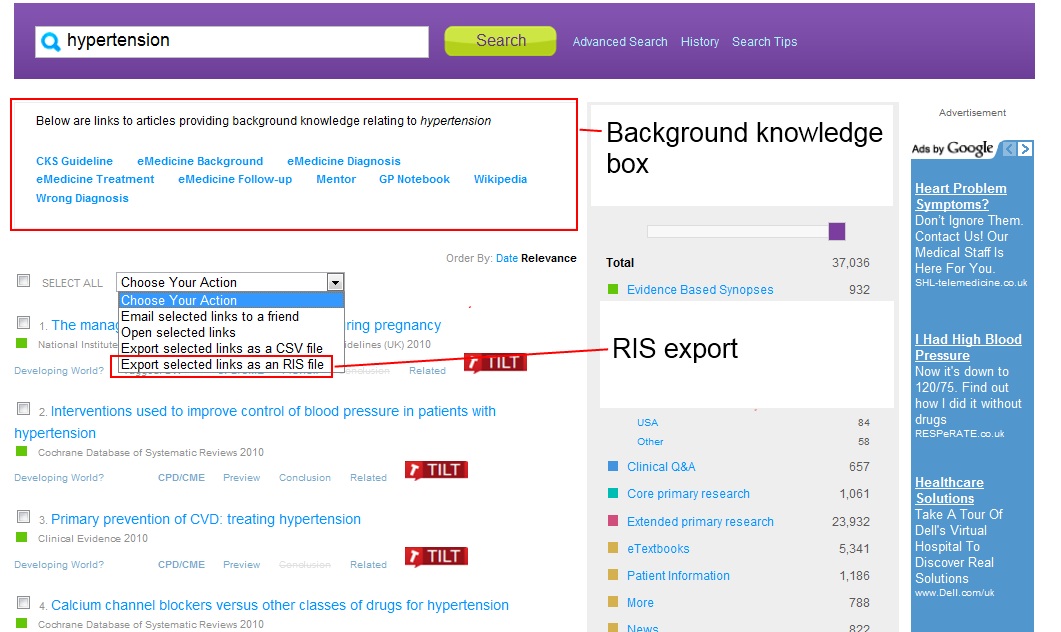
RIS is the file format for reference management software and we’ve been asked on a number of occasions if TRIP can support this format.  In other words, allow users to select search results in TRIP and export them – via RIS – into their reference management software package.  We’re delighted to say this has now been released and users can select it via the drop-down menu at the top of the search results (see image below – click to make bigger).  NOTE: TRIP does not have access to all meta-data so the export will be for partial results only.

Another bit of work we’ve been doing is looking to 2011 (see previous post).  I’m very keen to redesign the results page to make the results more useful.  One feature that we’ve spent a lot of time creating has been the background knowledge boxes (these appear at the top of many of the search results that link to eTextbooks linked to the search terms – see image above).  However, we’ve started to look at how popular this feature is and yesterday it was used 30 times.  This seems relatively little, so perhaps we need to consider if such a modestly useful feature deserves such prominence. 

It’s always the battle, balancing the demands on precious screen space between results and ‘added value’ features. 

Feel free to comment on any of the above topics…

The next upgrade to TRIP

Now TILT is out and seeming to be operating well it’s time to turn our attention to the next upgrade to TRIP.  So far we’ve got a number of suggestions, including:

  • Better support for languages other than English.
  • RIS export (we actually hope to get this out before the main update).
  • Linking in to content on the BNF.
  • Better differentiation of content types (e.g. evidence, images, patient information).
  • Introduction of new content types.
  • Integration with TILT.

There are others but the above are some of the the main ones. 

I’m guessing that if you’re reading this then you’re likely to be a regular user of TRIP.  How can we make it better?  What new features would you like to see?  Any gripes that annoy you about TRIP?

Analysing TRIP searches: COPD

We’ve been doing some analysis looking at what users are looking for when they search TRIP.  Below are two visual representations of this, using COPD as an example.

The top image shows all the additional search terms used when people have searched for COPD.  In other words, if someone searched for ‘COPD and exacerbations’ we have analysed the auxiliary terms, in this example it’s exacerbations. NOTE: Click on image to make bigger.

Wordle: COPD - search terms

This second image uses a similar process to highlight the documents users actually went on to visit. 

Wordle: TRIP COPD

Help support TRIP

I’m guessing, if you’re reading this that you like TRIP and feel what we do is important.

If that is correct can you please read our request for donations.

Thank you in advance.

jon

Adding a TILT button to other sites

You can see in the top right of this blog a TILT button, if you press it it opens up TILT with the URL embedded – making it very easy to TILT about a particular page.  We’ve added it to the actual blog, but there’s no reason it couldn’t be added against every article that appears on a website.

Either way, it’s very easy!  Simply paste the following code into your site and you’re TILT enabled…

http://tilt.tripdatabase.com/scripts/refer.js

The impact of TRIP: Part 2

Earlier this month we posted results of our survey of users which revealed that 40.77% of searches improve patient care.  For the full methodology read the post – click here.

Since it’s start in 1997/8 TRIP has been searched over 51 million times.

So, 40.77% of 51 million =  20,793,000 times TRIP has helped improve patient care.

Is the answer 20,793,000?  Probably not!

But there are good reasons why this figure is too high and reasons why it is too low!

Reasons why the figure is too high

  • Methodology weak: relatively small sample size, self-selecting participants (?more likely to be favourable to TRIP), non-validated questionnaire.
  • TRIP has improved. The figure of 40.77% assumes that TRIP has always been as good as it is now while it’s likely to have been relatively poor to start with.  However, to be fair to TRIP it has been consistently good for a number of years and the bulk of our searches have been in these latter years.

Reasons why the figure is too low

  • TRIP has actually been searched more than 51 million times.  The 51 million refers to people coming to the http://www.tripdatabase.com/ site.  We allow 3rd party sites to search TRIP and return results in their sites.  We have a number of these for examples in clinical portal sites, EMRs etc.  Also, we do various other automated information support systems (such as displaying related articles against 3rd party clinical articles).
  • It assumes that the information gained via TRIP is only used once.  If each clinician searches TRIP based on a patient-query I imagine the knowledge gained is used in dealing with subsequent patients.

Irrespective of an accurate figure, I doubt anyone can question that TRIP has had a significant impact!

Blog at WordPress.com.

Up ↑