Search

Trip Database Blog

Liberating the literature

Author

jrbtrip

Advanced search

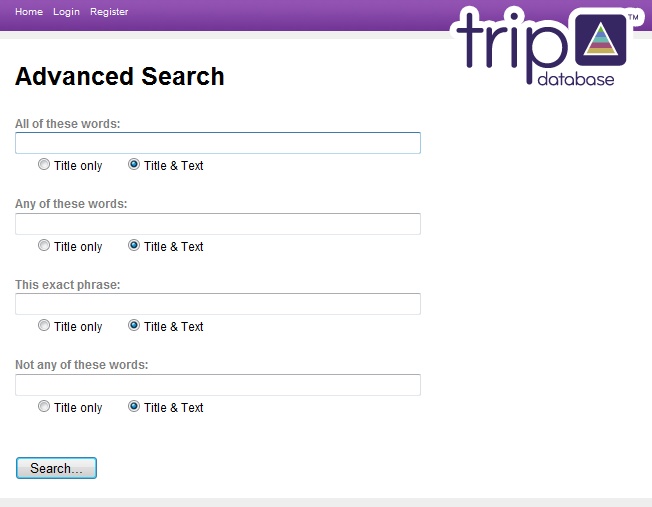
The advanced search on TRIP has been a problem for years. We’ve spent many hours fixing it, only for it to develop further problems. In our current overhaul we’ve taken a fresh look at the advanced search and significantly changed the way it works. For a sneak preview see below (click on image to make it bigger) – you’ll also see our new logo!

RXVantage Taps Into Massive Pharma Sales/Marketing Budgets

Nothing to do with TRIP, but an interesting article on the use of technology in medicine:

RXVantage is “Open Table for doctors” – it’s web based scheduling software that doctors and pharma/medical device companies use to calendar those visits, manage appointments, etc. It’s free for all parties to use, and premium features are available to the marketers if they choose.

Click here for the full article.

The new site

The site is getting very close to being finished and we’re entering a rigorous testing phase

Internal Testing
I had my initial look at the work on Tuesday and the points raised have now been addressed, so we have a few days of additional internal testing.

Independent Usability Testing
Early next week we will be carrying out some independent usability testing using Minervation. This involves a number of volunteers looking at the new site and being asked to perform a number of tasks. The volunteers will be videoed while performing the tasks and this will be analysed (alongside a post-test questionnaire) to highlight possible weaknesses in the design.

TRIP Advisory Board testing
Once alterations have been made based on the above steps we’ll throw the site open to the members of the TRIP Advisory Board. This should last two weeks, giving longer-term usage feedback.

The above represents the most robust testing that we’ve ever undertaken. It should be worth it and we should be able to launch early September.

FSRH Clinical Enquiries

While researching a question on oral contraceptives and low BMI I came across a significant number of links to the FSRH clinical enquiries that were leading to ‘file not found’. Due to their set-up they delete files from their servers after about 3 years old. TRIP does not access the files dynamically so ‘dead’ links aren’t removed and people get poor results. Therefore, I’ve manually updated the records, removing 500 (around 30%) of the records.

The issue of longevity of Q&As is problematic and there are no obvious right answers. On TRIP Answers we leave all our answers on the web, but mark when the record is over two years old. We also allow users to comment if they feel something is out of date (or if new research appears) – and this will be further enhanced in the near future. Finally, we will be rolling-out a semi-automatic system to keep records up to date towards the end of the year.

I strongly believe that Q&As (arising from genuine clinical situations) are the most powerful form of evidence. They are nuggets of evidence that clinicians can directly apply to their practice. So, I hate to lose Q&As – they’re too useful. Be transparent, warn people when they’re ‘old’ and let the user always be sceptical.
Another blog for TRIP

I’ve just added the 3rd blog to TRIP – this time it’s the National Prescribing Centre’s blog. The blog focuses on pharmaceutical issues and publishes 6-7 articles per month. This is an excellant edition to the evidence base of TRIP.

Patient Information

TRIP has typically concentrated on research evidence. However, we have recognised the usefullness of patient information leaflets and have included a variety of leaflets from around the globe. The slight problem is that, as they were only available via a separate tab, few people were aware they existed. Therefore, in the new site they’ll be blended in with the main results (although they can easily be excluded from the search or the search limited to just patient information leaflets.

In preparation we have just uploaded to excellent collections of patient information leaflets (and deleted some out of date records). The new collections are:

My-TRIP Users – important notice

The new version of TRIP will now be released at the start of September and this will include a significantly enhanced My-TRIP.

Unfortunately, as we’re using new technology the two versions are not compatible. Therefore, if users of My-TRIP have information they want to save, they should save it between now and the end of August.

We’re sorry for any problems this may cause, but this inconvenience will be worth it for the boost in functionality.

Monthly update

We have just added July’s monthly update of 807 new records, which includes the 3rd edition of Cochrane. In addition to this manual upload our automated systems will be grabbing additional content from the likes of guidelines.gov and PubMed.

This new content should be searchable in the next 1-3 days.

Using TRIP to help identify content suitable for resource poor nations

I’ve been talking with HIFA2015 which is a campaign group hoping to improve access (for patients and health professionals) to health information in developing nations. I commented that, given most of the content of TRIP is aimed at richer nations, it makes it more difficult for users from poorer nations to identify material appropriate for their context.

I’ve thought of a rather simple solution – allow users of TRIP to identify such content. Basically, someone does a search and in the results they see a resource suitable for poorer nations – they click a button next to the record and this is tagged as being suitable for resource poor nations. When someone does a search they could press a button and then restrict the results to ‘resource poor’. To start with this wouldn’t be particularly useful – but with 25,000+ visits a day I’m sure it’d work quite well within a short space of time.

There are quality issues that need working through, and we’re working on these. But I’m hoping this might be a reasonably efficient mechanism to solve a difficult problem.

Blog at WordPress.com.

Up ↑