Based on PubMed Central (PMC), the U.S. National Institutes of Health (NIH) free digital archive of biomedical and life sciences journal literature, UK PubMed Central (UKPMC) provides a stable, permanent, and free-to-access online digital archive of full-text, peer-reviewed research publications.
Ben Toth writes about web 2.0 for e-health insider.
As Gwagle will incorporate tagging this article was of great interest to us:
Patterns and Inconsistencies in Collaborative Tagging Systems: An Examination of Tagging Practices
Jello Biafra talks about net neutrality on YouTube!
For more information on net neutrality see this wikipedia article.
We’ve just received a nice e-mail from the University of Turin; highlighting the embedded TRIP search box (click here to view).
Website owners can easily embed a TRIP search box via our Add Trip To Your Site page.
A number of key developments to look out for in 2007.
1) Gwagle. Still not ready to release too many details. However, work has started – earlier than anticipated.
2) Socrates. Socrates has gone through a number of name-changes. First there was ‘WEME’ (where evidence meets experience), this changed to Socrates. Things went a bit quiet as the new project (Gwagle) was born. However, Gwagle was initially called Socrates as I thought the initial Socrates wouldn’t happen. Confused? Anyway, Socrates still might not happen but we’re feeling more confident. Basically, Socrates will attempt to harness the collective experience of health professionals. The ‘evidence’ is fine, but can be abstract and not always applicable to practice. According to Clinical Evidence, in their chapter on mild-to-moderate depression, CBT, TCAs and SSRIs are all ‘beneficial’. By placing them all in the same ‘evidence’ bracket it suggests a type of equivalence. However, in the real world what do the doctors find best? Socrates will give them the space to record their views. So, Socrates will happen, when we get some money.
3) NLH Q&A Service. We are currently reviewing our work to date with a view to re-vamping the whole service. New ideas include better search, better re-use of questions, better production of resources to better answer questions, better signposting of existing resources. Better move on……
4) TRIP search. I’m desperate to improve the search. When we launched we were pretty pleased with the search. Now, with 4 months experience we feel time to improve things. For many searches they’ll be no noticable change but for others they’ll be significant change. I’m very excited about the Digg idea, posted the other day. But that should be coupled with a modification to the text relevancy score. Currently, there are 3 main scores – text, year, publication. So, sometimes, an article might have very low text relevancy, but score very high for year and publication. As such it’ll appear quite high up – even though it’s not hugely relevant. We’re working on the best solution to this – but the problems identified and we’ve got some money to improve.
This leaves the issue of raising money:
1) Improved use of Google ads – placing them at the top of the results page. Should significantly improve income – but we’re wanting to use that space to advertise Gwagle and Socrates….
2) I notice wikipedia has an online ‘begging bowl’. So far they’ve raised (from this round) $840,000. Obviously, they are much bigger than TRIP. But might we use a similar system to raise $25,000 – who knows. If we state what improvements the money would be used for, it might make people more likely to donate. We currently get 70-80,000 searches per week, so I’m guessing we have around 100,000 users. if 5% donate $5 – we’re there. What do people think?
3) Any other suggestions…….
Have a happy 2007.
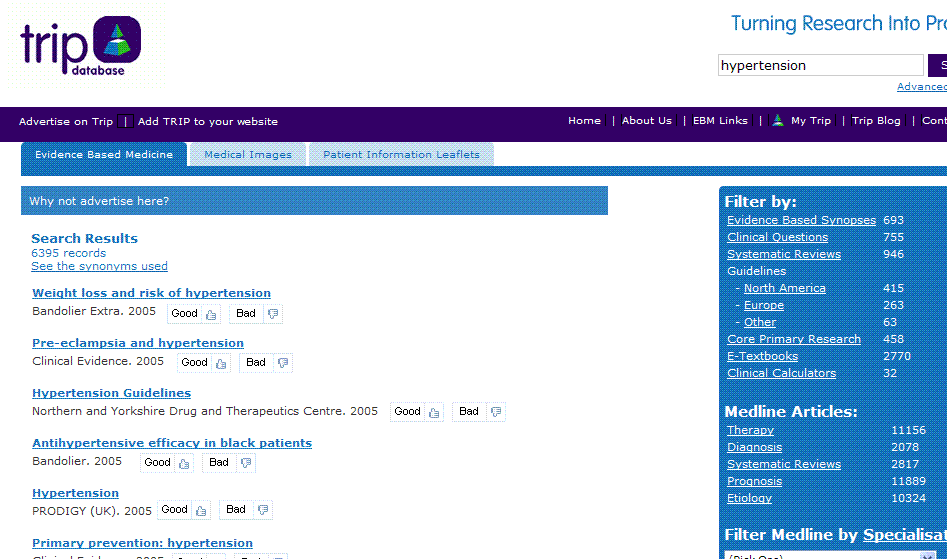
Nice idea. Could this principle apply to TRIP? Could you allow users to decide if a result is good or bad? Could they vote ‘Digg’ style to say if that result was good or not? A ‘thumbs down’ means that result scores less well next time, a ‘thumbs up’ scores higher and no score means the same score next time.
I’ve mocked up what a ‘TRIP meets Digg’ might look like.
Another clinical wiki – Wiki surgery
Below is the cummulative zeitgeist for the four months since we’ve moved to free access. In that time we have been searched 806,715 times.
- 448 views. Growth reference charts for the UK. Royal College of Paediatrics and Child Health.
- 257 views. Guidelines for the administration of blood components. Australian & New Zealand Society of Blood Transfusion.
- 251 views. Buprenorphine transdermal patches (Norspan) for chronic severe pain. National Prescribing Service.
- 242 views. Nutrition support in adults. NICE.
- 233 views. Asthma. PRODIGY.
- 228 views. Management of patients with dementia. SIGN.
- 222 views. Guidelines for Blood Grouping & Antibody Screening in the Antenatal & Perinatal Setting. Australian & New Zealand Society of Blood Transfusion.
- 216 views. Guidelines for the management of enteral tube feeding in adults. CREST.
- 205 views. Failure to thrive. Ganfyd.
- 201 views. Lower back pain. PRODIGY.
An interesting and mixed list. More comment of the above over the next week or so.


Recent Comments