Search

Trip Database Blog

Liberating the literature

Author

jrbtrip

New site

It should be tomorrow (18th Sept) morning when the new site goes live. It took a little longer to transfer from the development server to the live server (where it is now). So, the stability testing will not finish until after the network people have gone home, but I’m hoping they’ll be in nice and early!

If you like the current TRIP, this should be the last few hours before it goes forever…..

Don’t worry, the new site is significantly better 🙂

New site imminent

We’re currently transferring over the new site to our ‘live’ servers. Once this has been completed and various checks made we can go live. It may be today or tomorrow morning (assuming nothing major happens).

If the site goes live tomorrow it’ll conincide with a meeting to discuss another significant round of upgrades to the site (for launch in November/December). Things really are moving fast and don’t look like slowing down in the slightest!

New logo

Ahead of tomorrow’s launch (fingers crossed) we’re revealing our new logo.

You’ll note that we’ve kept the pyramid motif but have modified it. The colours in the pyramid correspond with those in the ‘evidence slider‘ with the highest quality evidence represented by green, which is at the top of the pyramid. We’ve embraced colours in TRIP as it’s a quick and easy way to recognise the corresponding level of evidence of a particular result. You’ll also note that we’ve incorporated the trademark symbol (TM) into the logo (a legal requirement) as we have the trademark for TRIP.

What to expect next week

After yesterday’s teaser of the ‘evidence slider’ today is another glimpse into the new TRIP.

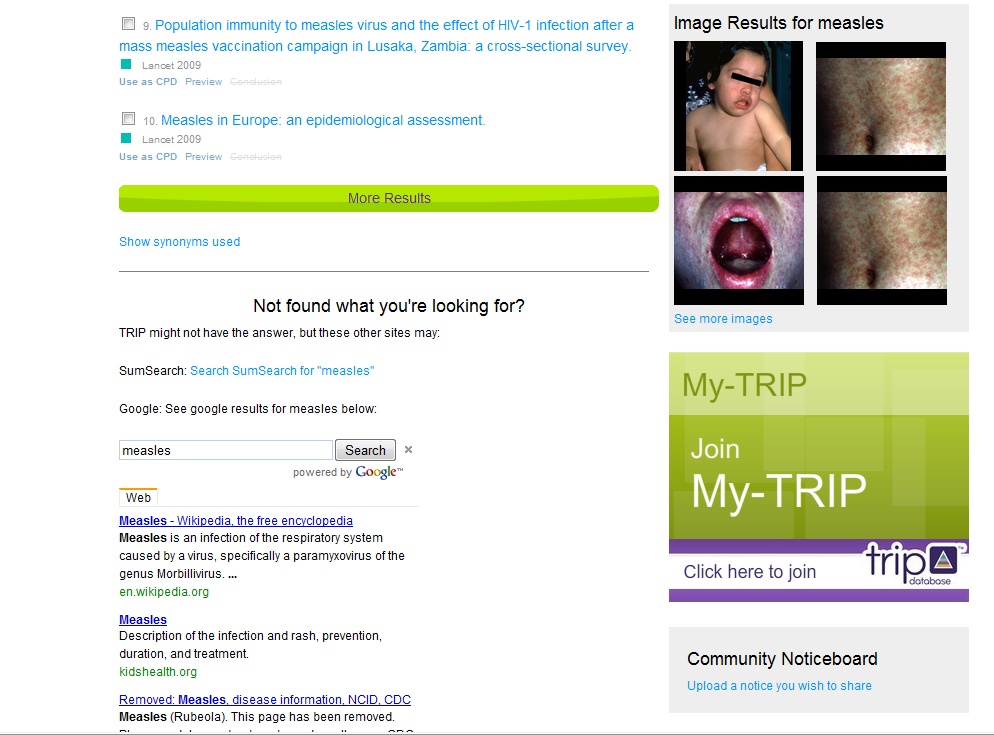
S0, what does the above all mean? Basically, the above image is taken from the foot of the results page on TRIP and the key elements are:

  • ‘Not found what you’re looking for?’ – it has always bothered me that TRIP doesn’t answer all the questions all the time, so what do you do then? We’ve teamed up with SumSearch in a reciprocal agreement that allows users to seamlessly search each others sites. You search on prostate cancer in TRIP and the link to SumSearch is dynamically generated to search SumSearch for prostate cancer. You’ll also see that we’re pulling through the top results from Google, which in user testing was seen very positively.
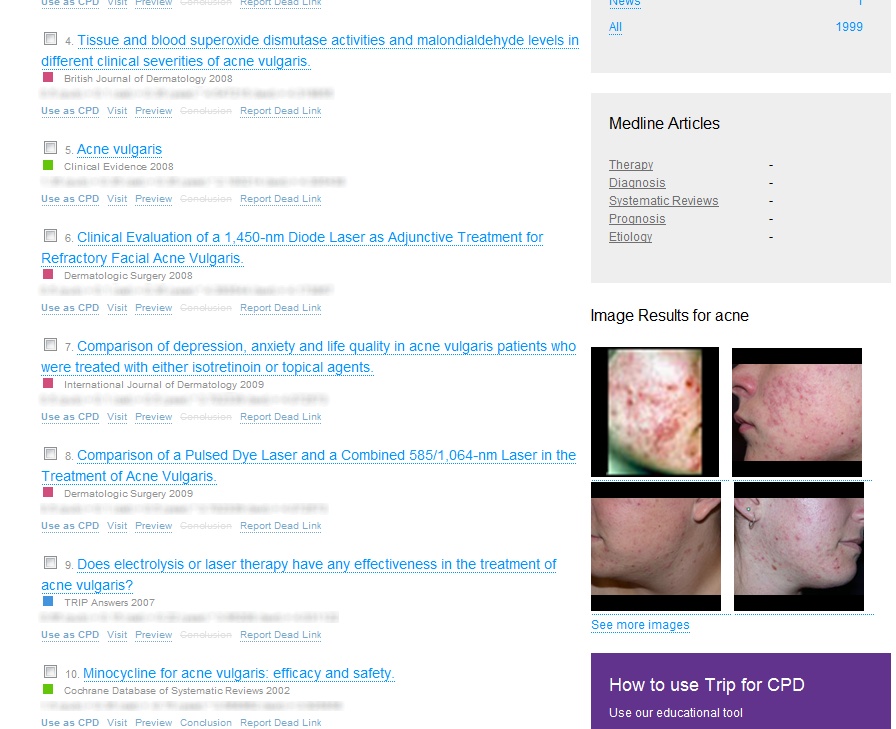
  • Medical images. As mentioned previously on this blog we’ve significantly increased the number of medical images available to our system. In previous surveys users have indicated that they’re not aware we actual search medical images. To help combat that, we’re displaying medical images in the main results page.
  • Community noticeboard. Do you have a message you want to share with others? This free service will allow targetted messages to be displayed to users of TRIP. Want to highlight a conference, job, recruit patients? Why not use this feature.

There’s so much more to show as well – this really is the largest ever set of enhancements to TRIP.

The new TRIP

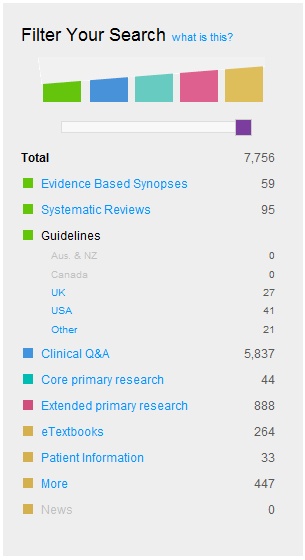
The new version of TRIP is very close to launch. Unless we have any major problems highlighted it’ll go live early next week. One of the major new enhancements will be the introduction of a ‘quality slider’. I first raised this problem/solution in 2007 (see this article). It’s amazing that the concept has come back and works very well when in operation:

We have now colour coded all records in TRIP based on the concept of the hierarchy of evidence. When someone carries out a search of TRIP they’ll have all the results presented. But, they may decide to only include the highest quality evidence, in which case they simply move the slider to the left and all the lower quality evidence is removed.

The future of Q&A

TechCrunch is a technology blog and is respected enough to gain access to te biggest tech players in the world. In this interview with the CEO of Google (Eric Schmidt) they ask about the future of search:

“So I don’t know how to characterize the next 10 years except to say that we’ll get to the point – the long-term goal is to be able to give you one answer, which is exactly the right answer over time. Okay, you know, the question I’ll ask today, how many Americans have – what percentage of Americans have passports?…The Google’s answer was a site, which was somebody who had attempted to answer that question and had multiple answers. It’s quite interesting actually to read…So you go to a very good definitive site. And what I’d like to do is to get to the point where we could read his site and then summarize what it says, and answer the question…Along with the citation and so forth and so on.”

It’s a challenge to do that for fact based questions (such as ‘How many Americans have passports?’) but could they really tackle clinical questions? These sorts of questions are so much harder as there is often not an answer – more the odd bit of research that helps a doctor form an opinion. Perhaps in twenty years time they’ll get close!

Click here for the full article.

Medical Images: Update

Just over a week ago I posted that we’ve managed to grab over 90,000 medical images. That figure has now risen to 284,398. The figure shouldn’t go any higher but will certainly get lower. Our system which grabs the images is fairly sophisticated but it still grabs any image on a page (based on certain parameters). As a result a chunk of those 284,398 images will be ‘junk’. The only way to weed out this junk is for them to be manually reviewed and inappropriate images exluded. If this is completed before the launch (sometime in the next 10-14 days) it’ll be a miracle, but even if it’s not completed by then it’ll gradually improve over time. Even if we end up with ONLY 100,000 images it’ll still be an amazing collection.

Using crowdsourcing to identify content suitable for resource poor settings

6 weeks ago I posted an article about using TRIP to identify content suitable for resource poor settings click here.

Since then I’ve been busy discussing the idea with a significant number of people including Richard Smith (Director of Ovations and ex-editor of the BMJ), David Lipman (Director of the NCBI and responsible for PubMed) and representatives from WHO. I’ve worked up the idea some more – with the help of those I’ve discussed the idea with – and am currently seeking funding. The idea, as it stands, is as follows:

Problem: A clear problem for resource poor settings is identifying high quality evidence upon which to base clinical decisions. Within TRIP, content suitable for these environments, is frequently ‘hidden’ by the volume of material aimed at resource rich environments, making the identification of appropriate evidence difficult. This problem is not restricted to TRIP: there is no way in Medline (or other databases) to select material suitable for resource poor settings.

Proposal: We propose that users of TRIP would be allowed to ‘tag’ (by pressing a single button) an article if it is suitable for resource poor settings. A user coming to TRIP could then carry out a search and decide if they want to restrict the results to just those tagged as being suitable for resource poor settings.

Quality is an important issue, therefore, we propose a quality system whereby an article would be considered ‘pending’ until it has been selected at least two further times. If a user restricts any subsequent search a pending article would be clearly marked as such.

Medical Images on TRIP

We’ve had medical images on TRIP for many years now. They’ve not worked particularly well and, in a recent survey, we found most people were unaware we had a searchable collection of images. So, in the soon to be released upgrade, we’ve made some significant changes:

  • Thumbnails improved. Previously we re-sized all the images ‘on the fly’ which caused all sorts of rendering problems, they tended to look awful. We’re now grabbing the content from the web, re-sizing at our leisure which allows us to significantly enhance the thumbnail quality.
  • Quantity. Due to our spidering tool improvements we’ve gone from around 40-50,000 images to over 90,000 with a hope to take the figure to over 100,000 before the end of the year. In addition we’ll also auto-search google images and add those to the main medical image results display.
  • Display. We’ll start showing 4 thumbnail images on the main results page of TRIP, see below for how it’ll look.

Blog at WordPress.com.

Up ↑