Search

Trip Database Blog

Liberating the literature

Author

jrbtrip

TRIPanswers

With a huge amount of relief the site is very nearly ready to go live. We may be able to sneak it out tomorrow, if not it’ll be Monday/Tuesday next week. As I look at the site there are 4,325 Q&As, all tagged and quality scored.

We’ve already secured the agreement of a number of collaborating organisation to publish their Q&As on the site, the list is as follows:

  • ATTRACT (Wales)
  • FSRH (UK)
  • Clinical Cases and Images (USA)
  • RCOG clinical queries (UK)
  • TRIP
  • Univadis (UK)
  • Norwegian Electronic Health Library (Norway)
  • Ma’aneh Larofeh – Clalit Health Services (Israel)
  • Evidence Direct, Melbourne (Australia)

The international flavour is particularly exciting and I’m looking forward to these questions being available.

Watch this space…

Orientating yourself on TRIPanswers

This is a really brief introduction to recently launched TRIPanswers. The aim is to orientate you around the site so you can use it more efficiently. For further information view the ‘About’ section (link from the top of the page). So, a few points about TRIPanswers:

  • It’s a collection of clinical Q&As from around the World
  • Each question has been tagged (tags are roughly the same as keywords). They help describe the question and are useful in browsing and refining searching
  • Tags are displayed in tag clouds. These are collections of tags and the more prominent the tag, the more times the tag has been used
  • If you click on a tag it restricts the Q&As to those with that particular tag. NOTE: A Q&A is typically tagged with multiple tags
  • Search is an alternate to browsing via tags. One way is to search using your broad topic area (e.g. myocardial infarction) and then click on a tag (in the tag cloud) that matches your interest e.g. clopidogrel
  • Check out the Tag Cloud of Clinical Uncertainty
  • Still confused? Let me know via the form at the bottom of the Interact page.

Below are images (click on image to make bigger) of the key features of the homepage and an individual question.

Homepage

Answer page

This weekend I’ll be reading…

User experiences of evidence-based online resources for health professionals: User testing of The Cochrane Library

Semantic analysis

For years I’ve been a huge fan of the related articles feature in PubMed and recently have been investigating the underlying mechanism (semantic analysis). As a result of this, TRIP is starting to investigate using semantic analysis in a variety of ways. Our first trial has shown the promise of this technology.

Below are two screen shots (click on these to see a larger image). The big text box is the input box (where text is added) the list below that are the results obtained from TRIP. In the first example there is free-text question I added and in the second there is a title from a recent JAMA article.

I’d be keen to hear from readers of this blog if they feel this may be useful and if so how they’d like to see it used.

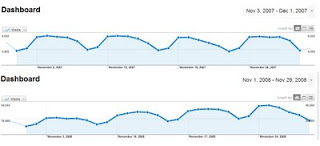
159 637

The above number is the number of extra searches in August compared to July. August is traditionally a slow month, which makes this new record number of searches, all the more remarkable. The actual number of searches for August was 1,369,638

I get so excited by these figures for two reasons:

1) They’re pretty big numbers
2) Think of all that good quality evidence that is being used!

Ubiquity

Wow…

http://vimeo.com/moogaloop.swf?clip_id=1561578&server=vimeo.com&show_title=1&show_byline=1&show_portrait=0&color=&fullscreen=1
Ubiquity for Firefox from Aza Raskin on Vimeo.

Web 2.0 and medicine

For a number of years web 2.0 has been a buzzword. I’ve been caught up in the hype and explored it’s use in a variety of situations, with limited success.

It would appear I’m not alone. In the web 2.0 world that relates to health professionals there appears to be no clear ‘big winners’. Sure, there are lots of examples of ‘web activities’, for instance:

But none of these, as far as I can tell, have made in-roads into mainstream healthcare. As such, I’m starting to have my doubts. Has the hype caused me ignore one of my own rules – DO NOT BE LEAD BY TECHNOLOGY, BE LEAD BY THE USER?

It would appear that I’m not alone in my scepticism and this has just been addressed in the Health Care Blog, with the post ‘Balloon Mania: Happy Birthday Health 2.0‘. I’m not won over by the anecdote used but it does remind me that it’s very early days…

Apture

I saw this feature on the BBC news website and liked it, so I dug around and found out about Apture. In a way this is my trial. it allows you (the website controller) to highlight sections of text and it will pull through appropriate links to content, so some examples:

  • Ligaments
  • Liverpool FC
  • Half Man Half Biscuit
  • Olympic Games

Hopefully, if this works, various embedded link-outs will appears.

Fingers crossed.

TRIPanswers: sneak preview

We’re getting there with TRIPanswers and hope to have something by September, a slight delay, but that seems traditional. I’ve said very little about TRIP answers but will give a bit more detail here and over the next few weeks.

In a nutshell TRIPanswers is a repository of clinical Q&As.

We hope our efforts will see a long-term dream of mine realised – a space on the internet where clinicians/information specialists can freely share their Q&As with others. With that aim in mind we will launch with 8 Q&A services around the globe, all willing to share their Q&As.

At the foot of this post is a screenshot of the homepage (click on image to make it full size) and I’ll highlight a number of the key features:

  • A list of most recently added Q&As.
  • To the left of each Q&A is a multicoloured cube with the letters s, a & c underneath. This represents the quality score that each Q&A receives: s = search, a = appraisal and c = confidence.
  • Tag cloud. Each question is tagged and these aggregate to form a tag cloud. This can work independently, to allow browsing of the repository. However, it can also work with the search, to easily narrow down to the users area of interest.
  • Tag Cloud of Clinical Uncertainty. A personal favourite, this is a sub-section of the site, specifically for questions where the evidence is poor. This links in from my work with DUETs but is different in two main ways. Firstly, it does not restrict entries to therapies. Secondly, the entry point (uncertainty) is more pragmatic. But the aim is pretty much the same – highlight areas where the research evidence is poor.

Another key aim of the site is to encourage interaction and user participation. We have made it easy for users to leave comments on each Q&A and we believe this can only improve the quality of each Q&A.

In summary, I would say that TRIPanswers is a repository of Q&As which aims to interact with users to boost and improve the content still further.

Blog at WordPress.com.

Up ↑