Search

Trip Database Blog

Liberating the literature

Category

Uncategorized

New research: diabetes

I had a great meeting with Carl Heneghan at the Centre for Evidence Based Medicine yesterday.  I went with an agenda which Carl skillfully dispatched and then turned everything on it’s head.  I believe I’ve recovered.

One issue we touched upon was new research and how to keep up to date with the latest evidence. At Trip we aggregate the World’s evidence.  If there’s new high-quality research it should be (and probably is) in Trip.  But Trip is a search engine.

Chris (my partner in Trip) is a GP and he uses Trip to answer clinical questions.  To him this is what he wants Trip to do and he’s very happy with how it works.

Carl, on the other hand, wants to know what’s new and what to take notice of (as well as searching for answers).

So, what can we do to help?  We have our monthly emails, but they’re far from perfect.  There are oftern way too many results (especially in primary research).  So, one potential approach is to just highlight new research from the categories of secondary evidence (systematic reviews, synopses and guidelines) and key primary research (big 5 internal medicine journals plus the output from ‘EvidenceUpdates’). If we take the example of diabetes, below is the complete list (from last month) of articles with diabetes in the title (an important distinction) from the ‘top’ sources:

  • Different intensities of glycaemic control for pregnant women with pre-existing diabetes, Cochrane Database of Systematic Reviews
  • Continuous glucose monitoring systems for type 1 diabetes mellitus, Cochrane Database of Systematic Reviews
  • Momordica charantia for type 2 diabetes mellitus, Cochrane Database of Systematic Reviews
  • Interventions for pregnant women with hyperglycaemia not meeting gestational diabetes and type 2 diabetes diagnostic criteria, Cochrane Database of Systematic Reviews
  • Self-monitoring of blood glucose in patients with type 2 diabetes mellitus who are not using insulin, Cochrane Database of Systematic Reviews
  • Saxagliptin (Onglyza) – type 2 diabetes mellitus, All Wales Medicines Strategy Group
  • Type 2 diabetes: newer medicines and insulin analogues, WeMeReC
  • Exenatide – Type 2 diabetes mellitus, Canadian Agency for Drugs and Technologies in Health – Common Drug Review
  • Reno-protective effects of renin-angiotensin system blockade in type 2 diabetic patients: a systematic review and network meta-analysis, DARE
  • Type 2 diabetes – reducing cardiovascular risk, National Prescribing Service Limited (Australia)
  • Empagliflozin for type 2 diabetes mellitus, Health Technology Assessment (HTA) Database
  • Review finds little evidence for Complementary and Alternative Medicines in diabetes, The Diabetes Elf
  • Review:  insulin pumps may improve quality of life and glycaemic control in adults with type 1 diabetes, The Diabetes Elf
  • Peri-operative diabetes management guidelines, Clinical Practice Guidelines Portal, Australia
  • Linagliptin rejected by the NHS in Wales for use in type 2 diabetes due to lack of evidence of efficacy, The Diabetes Elf
  • Moderate physical activity is associated with lower mortality in people with diabetes, The Diabetes Elf
  • Diabetes accounted for 8.9% of prescribing costs in NHS England in 2011/12, The Diabetes Elf
  • Better evidence needed on the effectiveness of tailored interventions on self-management type 2 diabetes, The Diabetes Elf
  • Review:  more evidence needed for metformin in children with type 2 diabetes, The Diabetes Elf
  • New guidelines for the management of diabetic retinopathy, The Diabetes Elf
  • Review finds weak evidence favouring moderate blood sugar targets in diabetic women during pregnancy, The Diabetes Elf
  • Intensive blood pressure control prevents strokes in diabetic patients with hypertension, The Diabetes Elf
  • Eating disorders are common and problematic in adolescents with type 1 diabetes, The Diabetes Elf
  • Review:  children and adolescents with type 1 diabetes can have the same quality of life as those without it, The Diabetes Elf
  • Welsh NHS recommends saxagliptin as an option in type 2 diabete, The Diabetes Elf
  • Comparison of Two Creatinine-Based Estimating Equations in Predicting All-Cause and Cardiovascular Mortality in Patients With Type 2 Diabetes, Diabetes Care (EvidenceUpdates)
  • Concentration of Cystatin C and Risk of End-Stage Renal Disease in Diabetes, Diabetes Care (EvidenceUpdates)
  • Maternal Efficacy and Safety Outcomes in a Randomized, Controlled Trial Comparing Insulin Detemir With NPH Insulin in 310 Pregnant Women With Type 1 Diabetes, Diabetes Care (EvidenceUpdates)
  • Intervention Costs and Cost-Effectiveness of a Successful Telephonic Intervention to Promote Diabetes Control, Diabetes Care (EvidenceUpdates)
  • Short-term continuous glucose monitoring: effects on glucose and treatment satisfaction in patients with type 1 diabetes mellitus; a randomized controlled trial, Int J Clin Pract (EvidenceUpdates)
  • Diabetic neuropathy: clinical manifestations and current treatments, Lancet Neurol (EvidenceUpdates)
  • Hemoglobin A1c Versus Oral Glucose Tolerance Test in Postpartum Diabetes Screening, Diabetes Care (EvidenceUpdates)
  • Combined intensive blood pressure and glycemic control does not produce an additive benefit on microvascular outcomes in type 2 diabetic patients, Kidney Int (EvidenceUpdates)
  • Curcumin Extract for Prevention of Type 2 Diabetes, Diabetes Care (EvidenceUpdates)
  • The cost-effectiveness of substituting physicians with diabetes nurse specialists: a randomized controlled trial with 2-year follow-up, J Adv Nurs (EvidenceUpdates)
  • Performance of HbA1c as an Early Diagnostic Indicator of Type 1 Diabetes in Children and Youth, Diabetes Care (EvidenceUpdates)

A great collection of evidence.  As I’ve not used it for a while, I used Wordle to create this word cloud (click to make bigger):

But what’s the best way of Trip using this data, not just for diabetes, what about hypertension, acne, hay fever?  We want to find a great way of highlighting new evidence. It needs to look good and make people want to engage with it…!  Carl highlighted what the BMJ are doing with their portals e.g. diabetes portal, not as something to aspire to but an example of one approach.

If you’ve ever seen Flipboard for iPad, I like that approach but no idea if it’d work.  It might be that we use our – soon to be released – timeline.  But if anyone has any ideas – please let me know.

The new TRIP – Find Evidence Fast

We’re getting fairly close to the launch of the new TRIP, hopefully within the next 4 weeks – depending on testing.  We are very busy behind the scenes and there is even more work to come.  We’ve just reviewed the 7th iteration of design.  Each time we get a set of designs we need to review them and comment.  I believe version 8 will be the version we approve.  Once they have been ‘signed-off’ we’ll be busy plugging the new and old functionality into the design and then on to proper testing!

The work on the new site started last year and included a large review of our users (click here for the main results).  Our users have been great since then feeding back on various questions I’ve had.  One user (via our Facebook page) even helped formulate a – sort of – tagline of ‘find evidence fast‘, a very simple yet powerful explanation of what TRIP does.  And I cannot forget the wonderful donations we received that have helped make this all happen! 

In conjunction with user input has been a significant amount of work on my part exploring the literature on information retrieval and search.  So, what can we expect?  In no particular order (and there are more as those listed below):

  • Redesign.  We’ve used a great designer who’s worked wonders. The old site was looking old and had suffered from new design/features simply being bolted on.  While it’s still a search engine it has been completely redesigned – even the logo will change.  IT IS LOVELY.  I appreciate some people will be put off as it’s a huge change, but people will get used to it and love it.
  • PICO search.  As well as the ‘usual’ search we have introduced a PICO search to help users formulate focused searches. 
  • Clear demarcation of content types.  While TRIP is principally about evidence, we also have videos, images etc in our index.  We’ll be making this more explicit and easier to use.
  • Filter move.  Currently the filter by evidence type is on the left-hand side, we’re moving it to the right.  The most important aspect of TRIP are the results, so they should be in the most prominent position!
  • Improved filtering – allowing easier filtering by clinical area, year and even the ability to restrict the results to a single publisher.
  • Cited.  We’re starting to automatically explore citations.  If you find an article you like, we’ll link to other articles in TRIP that have cited it (typically a systematic review or guideline).  This is new and experimental – so expect mixed results!
  • Important papers.  For any search on TRIP we’ll explore the citations found in the results and see which articles appear most frequently – surely a sign of importance to the search terms.
  • Login.  While not compulsory we’re going to encourage people to login.  This serves numerous functions, some obvious now and others for the future.  But, immediately, when you search we’ll also include previous papers you’ve viewed – as we know people often revisit the same papers, this makes it much easier. 
  • Starred.  Like and article or think it’s interesting – well star it and we’ll save it for you in your timeline….
  • Timeline.  This is where we record your activity on TRIP: searches, articles viewed, articles starred, any new content that we think is of interest to you (based on your recorded keywords of interest).  There’s a twist in the timeline that will make it special.  The Timeline might lead to much bigger things.

TRIP was good before, it will now be better and I think we’re getting close to greatness.

New version of TRIP

We’ve been working very hard on the next version of TRIP and we’re getting there!  There are two main components of work, functionality and design.  These are performed by separate people (a techie and a designer) and eventually brought together by the techie.  We’re hoping to go live in the next 4-6 weeks.

We had a first round of designs about 2-3 weeks ago and had the latest version yesterday.  So, it was a hectic day going over them and giving feedback to the designer.  But the design is close to being signed-off.  It’s actually a complete overhaul of the site, including a new logo.  It will look and behave radically differently, it’s a significant step forward for TRIP.

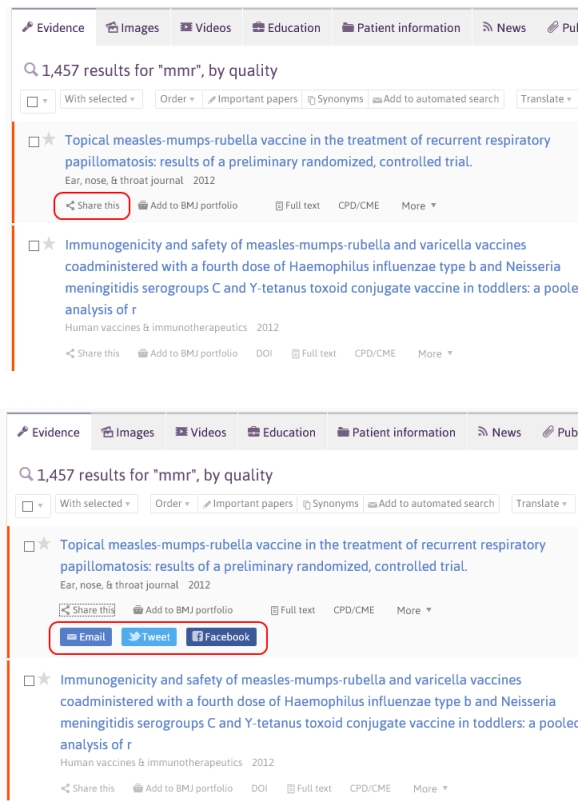
See below a small sneak preview of a component of the results page (click on image to increase the size).  Some hidden for tease value and some hidden as they need altering. I hope you enjoy it 🙂

Clinician similarity

I’m doing some work (well, thinking really) around clinician similarity and information needs.

Basically, if a UK general practitioner does a search for diabetes the intention/information needs are likely to be different than, say, a Brazilian endocrinologist. Yet, TRIP returns the same results.

If we created a similarity score (based on profession, interests and geography) we could we show the results as per normal but also have an area ‘Clinicians like you who searched for diabetes looked at these articles…’. 

We could also introduce something similar at an article level – ‘Clinicians like you who looked at this article also looked at these…’.

In a way, it’s using the experience of previous similar users of TRIP to filter and hopefully improve search results.

What do people think?

Important papers

As part of the new upgrade to the site we’re experimenting with a number of new features. An ‘Important Papers’ feature is a side-effect of one of our efforts, but what’s that?

When you search TRIP our algorithm is designed to show the best, most research, which is great.  However, much of the latest research is built on significant ‘historical’ papers in that field, for the time being we’re calling them ‘Important Papers’ (happy to take suggestions for other names).  These are important papers associated with the main search results.

To illustrate what I’m talking about, take an example search for ‘warfarin anticoagulation’, on the main TRIP the top results can be seen here (the top result being: Comparative Effectiveness of Warfarin and Newer Oral Anticoagulants for the Long-term Prevention and Treatment of Arterial and Venous Thromboembolism (Veterans Affairs Evidence-based Synthesis Program Reports 2012)).  Using our ‘Important Paper’ feature, the top 3 results are:

  • Placebo-controlled, randomised trial of warfarin and aspirin for prevention of thromboembolic complications in chronic atrial fibrillation (Lancet, 1989)
  • Oral Anticoagulants vs Aspirin in Nonvalvular Atrial Fibrillation An Individual Patient Meta-analysis (JAMA, 2002)
  • A risk score for predicting stroke or death in individuals with new-onset atrial fibrillation in the community: the Framingham Heart Study (JAMA, 2003)

We’re using a number of measures to infer importance including citations and social media.

Also, to be clear these results will be presented away from the main results (as a side-feature).

Will this feature be a hit?  I’ve no idea.  The results are certainly interesting and user feedback will decide if it stays.

Networks and TRIP

For a number of years I’ve been pondering the numerous relationships contained within TRIP.  These are numerous and a few examples include:

  • Relationships between articles e.g. via citations, by being in the same publication
  • Relationships between users e.g. linked by clinical interests, by geographic location
  • Relationships between articles and users e.g. looking at the same articles

I can’t help feeling there is value in these links and I do not mean in the financial sense.

Take a really simple example (click on image to enlarge it)

This is an imaginary search undertaken by 5 users and a line signifies which papers they looked at.  We can deduce some things:

  • Papers six and seven weren’t liked.
  • Paper two looks the most popular
  • Users 2 and 3 appear similar/close (both looking at two of the same papers)

Now, if we add an extra level of data:

In this image the rounder reddish boxes signify doctors while the green boxes signify nurses.  Do these inferences seem reasonable?

  • Paper five is really suited to nurses while papers one (to a point), two and three are more ‘doctor’ focused
  • Paper four has mixed interest.

Imagine if you can add extra detail (different types of doctors, different geographic location) and lots of data (something we have lots of in TRIP) you might be able to generate a really powerful system.  Could it inform search results?

What do people think? I’ve really simplified things to make a point and I doubt the data will ever be as clear cut. 

The next upgrade to TRIP

Are you in for a treat?  I’d like to think so.

I had a long but rewarding meeting with Phil (our genius techie) and Reuben (our new and wonderful design guy) to thrash out the final details of the next upgrade to TRIP.  I am so excited by the proposed developments which are:

  • 3 major innovations – for me really really important developments
  • A handful of significant improvements
  • A load of minor improvements
  • A design overhaul

I’m being deliberately vague with the details for now.  But as things develop and designs get drawn, features get available I may well share them here and on Facebook (if you didn’t know we had a Facebook page, click here).

No firm timetable but I’d like to think it’ll be ready in 3 months.

Also, I’ve started planning the next upgrade, the one after this one, but much depends on how the innovations from this one take off.  If you have any suggestions then feel free to let me know.

An explosion of ideas

It’s less than a month ago when I heard the gutting news that a potential purchaser of TRIP had pulled out (with no reason) from purchasing TRIP.

But every cloud has a silver lining.  While waiting for the acquisition issue I’d not given a huge amount of thought to the next updates of TRIP, not since the survey of last year (click here for details).  But not now – WOW – it’s been a great two weeks of reflection.

I’ve met with Phil (our genius techie) to discuss the updates from last year’s survey and they seem all straightforward(ish) to implement.  We had our request for donations (click here, it’s not too late) which has generated a good amount.

I really like being open about what I’ve been thinking recently, but it’s so special (at least I think so) that I need to keep it under wraps.  It’s built on our social learning tool called TILT but goes way beyond it.  One possible offshoot of this idea is to have organisational accounts of TRIP.  This would allow organisations to upload their own documents to TRIP and then these would be searchable via TRIP.  So, the University Hospital of Bristol might create an account and upload documents (local guidelines, protocols, antibiotic resistance data, clinic opening times – whatever they wish).  A local doctor or nurse could link their profile to the University Hospital of Bristol’s profile and when they search they’d see local documents.  In addition to local documents the organisational account might add their link-resolver details – making linking to full-text documents so much easier.

The big issue for me is needing to make it as painless as possible for organisations to upload their documents.  Also, it needs to be easy for individuals to find their institution.  Both shouldn’t be too problematic

So, feel free to comment or add any feature you think would make it even more powerful.

As mentioned this is a relatively small offshoot of a bigger idea which I hope to reveal gradually over the next month or so,

TILT – survey time

Following on from my recent post about TILT (click here) I’ve decided to get the wisdom of the crowd to try and improve things – I really don’t want to give up on the idea.

So, if you can spare five minutes then please take the survey – click here.

Thanks!

Blog at WordPress.com.

Up ↑