Search

Trip Database Blog

Liberating the literature

Author

jrbtrip

KConnect

I’m just back from a meeting of KConnect, an EU funded consortium bringing together academia, SMEs and care providers with a view to improving health care.  This is the 3rd meeting in two months and thankfully this one was in London (the others being in Luxembourg and Vienna).

There was lots of exciting developments and the following apply to Trip:

Answer engine.  The answer engine is a system designed to infer questions from a users search terms and pull through the best answer (as well as the usual search results). We have a proof of concept model, which is great. However, there are a few issues with it.  A few conversations with consortia members and it looks like that will be fixed fairly easily.  With the prototype I estimate we got between 50-60% right and with the new tweaks, when they’re rolled should see that rise to over 80%.

The answer engine relies on being able to match search queries to articles.  That needs us to accurately reduce document titles down to medical concepts.  We should now be able to do this more accurately, more quickly and it’ll give us lots more flexibility with how we display the results.

Search log analysis.  I typically refer to this as clickstream data, but search log analysis appears the favoured term.  A new feature that we’ll be rolling out relates to search refinement and this will manifest itself in two ways:

  • During search.  We currently have a drop-down list of suggestions, supplied via PubMed.  However, it’s very ‘dry’ and never feels particularly ‘human’.  By using real-life data from Trip we’re confident that our system will be more real for our users.
  • Post-search.  Users typically only search using 1-2 terms.  This system can be used to suggest additional terms to bring the user closer to the results they need.

Below is a list of query suggestions based on a search for hypertension:

  • 976 hypertension pulmonary
  • 715 hypertension arterial
  • 694 hypertension treatment
  • 572 hypertension pregnancy
  • 439 hypertension diabetes
  • 401 hypertension stroke
  • 248 hypertension exercise

So, if you’ve search for hypertension we might show the above and say, something like ‘are you interested in hypertension pulmonary, hypertension arterial etc.  A user clicking on a search phrase will see the search automatically undertaken.

This should be rolled out shortly and we’ll test it to ensure it actually improves things!

Algorithm changes. Already planned from my visit to Vienna but further refinement of the specification which will see us trying multiple tweaks – in isolation and in combination – to try to ensure an optimal new search algorithm.

There are a few other bits and bobs that significantly affect Trip’s future development – but these are outside of KConnect and therefore can wait for another post.  But, rest assured, these changes are all ambitious and doable!

Oops, we missed a bit

Large sites, such as Trip, are complex and when you create a new design things can be missed and the following is a case in point.

At the top of the image (above) is the advanced search from the old site and below that is the new site.  Apart from the design there is a bit of functionality missing – the ability to combine search (called ‘recent searches’ at the top).  This allowed users to build up fairly complex searches.

We’re now aware of this and hope to get a fix out early next week!


Quality of content

Picture the scene – you’ve gone to Trip and searched for an article to answer your question.  You find a paper that looks interesting and click on the link – and it leads to a dead link.  I appreciate the frustration – I really do.

Websites change URLs for many reasons such as a new design for the site, withdrawing out of date content.  It’s a constant battle for Trip to keep up to date.  Thankfully we have a new and powerful tool to help with the release of a broken link system.  Here’s what it does:

  • It detects that a user has clicked on a link that has led to a ‘dead’ link.
  • After an hour we try the link again (sometimes sites – temporarily go down) and if the link still doesn’t work we remove it from the index and an email is sent to our content team.
  • They can then understand the reasons for the failure and either put in a new link to that single article or instigate an overhaul of all links for that particular site.

While it is not perfect it’s a significant enhancement to the site.

Linked to the notion of quality we have just introduced a new system to grab guidelines from the American guideline.gov.  This is a great site and our system broke when they changed their URL from guidelines.gov to guideline.gov!  But – from now – the links should work fine.  So, as well as grabbing new guidelines we should automatically remove ‘withdrawn’ guidelines.


NHS England – free access to Trip Pro

Great news if you work for NHS England, you can access Trip Pro for ‘free’.  Health Education England has entered into a trial, till the end of 2016.  This makes Trip Pro free to all NHS staff in England.

If you work for the NHS in England and are not automatically upgraded to Trip Pro (we use your computers IP address) either contact your library or me: jon.brassey@tripdatabase.com


The future of Trip

I’m not sure how many of these ‘the future of Trip’ articles I’ve written over the years, but there have been a few.  I like to set out my current thinking of the direction of Trip with some reflections on the past.

Business model – our move to a freemium business model last year (most of the site free but a ‘pro’ section for those willing to pay for extra content and functionality) has been a great success.  For years we have been concerned about the financial security of Trip and this new approach has allowed us to diversify our income streams and bring the security we craved!

New Design – It’s been out for a few weeks now and I’m loving it and the reaction.  We rolled out a few new features but it was more cleaning up the interface.  It was a major piece of work and it’s great that this particular project has finished.

Answer engine – This has been talked about for years and it’ll finally be here shortly.  It’ll be a learning system to give answers as well as search results.

As all this has been going on as I’ve been reading the very interesting ‘Business for Punks‘ which is an overview of the rise of the Scottish brewery Brewdog.  It’s refreshing and has given me the inspiration to write this post.  One big factor in their success has been the relationship with their customers, in effect, being their brand ambassadors – helping promote the business and the brand.  To a large extent this happens with Trip.  We have lots of fans and a great connection and I can always rely on our registered users to help out when I need advice. But one thing that Brewdog have shown is that you cannot do enough customer/user engagement.  So, I’m hoping to reflect on better ways of making the Trip users feel part of Trip.

But another really powerful message is to properly define what you’re trying to do and really focus on making that magical.  This is something I’ve been pondering for a while and this book helped crystallize my thinking:

What is Trip about?

Trip started as a service to my work answering clinical questions for general practitioners in Gwent, South Wales in 1997.  Q&A is my passion.  When we ask users about Trip we get three main reasons for using the site:

  • Clinicians seeking answers to their clinical questions.
  • Information specialists carrying out literature reviews for systematic reviews, guidelines etc.
  • Academics using the site to plan research.

The focus of Trip developments has always been the top reason (Q&A) but I’ve been keen to support the other two.  I think this will always be the case.  But I do think I may have lost sight of what the Q&A component means.  What do I want the site to do, in relation to Q&A?  A few alternatives:

The best place for health professionals to obtain answers to their clinical questions

or

Clinical question answering heaven

or

The ‘go to’ place for clinical question answering

They all amount, roughly, to the same thing.  The top one answers it best albeit being a bit wordy (but we can work on that).  So, the plans for the next major developments involve supporting clinical question answering!  This requires a number of components:

Answer engine – as mentioned above it’ll be rolled out soon.  It won’t be perfect but it’s a great start and it’s a learning system so it’ll get better with time.

Search algorithm – we’ve followed the same basic algorithm for years, arranging results based on a mixture of word matching (between search term(s) and documents in the Trip index), year of publication and quality of the publisher.  This is fine, to a point, but search has moved on massively and we’ve not moved with the times.  So, we will be looking to overhaul this.  As part of my work in the KConnect I will be working with information retrieval experts to exploit current ‘best practice’.

Belief – Underlying the changing has to be a belief that we can be the best.

Community – Trip needs to state our aim to be the best and to actually be the best. This will rely on our community of users letting us know when we’re great and when we’re less than great. So, our engagement with users needs to be enhanced – from good to great.

So, Trip’s future:

Community and site moving closer together to deliver something magical


Analytics

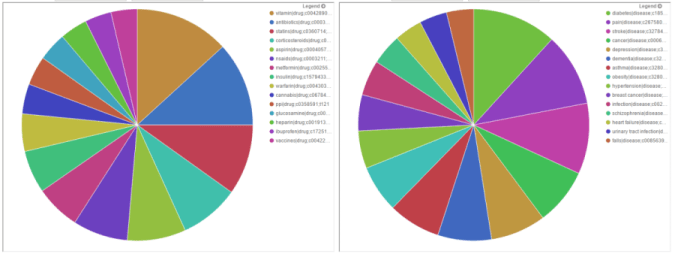
Trip is involved in the extremely interesting KConnect project, via the EU’s Horizon 2020 funding stream.  One output of this has been a nice interface to explore our clickstream data.  Clickstream data being a record of how people interact with the site eg search terms used, articles viewed etc.

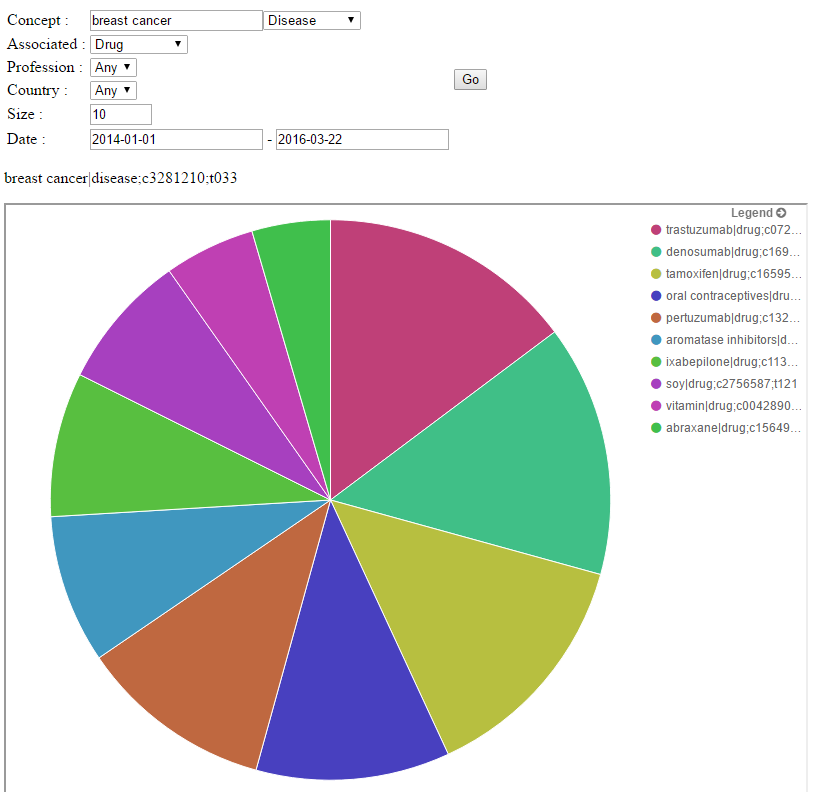
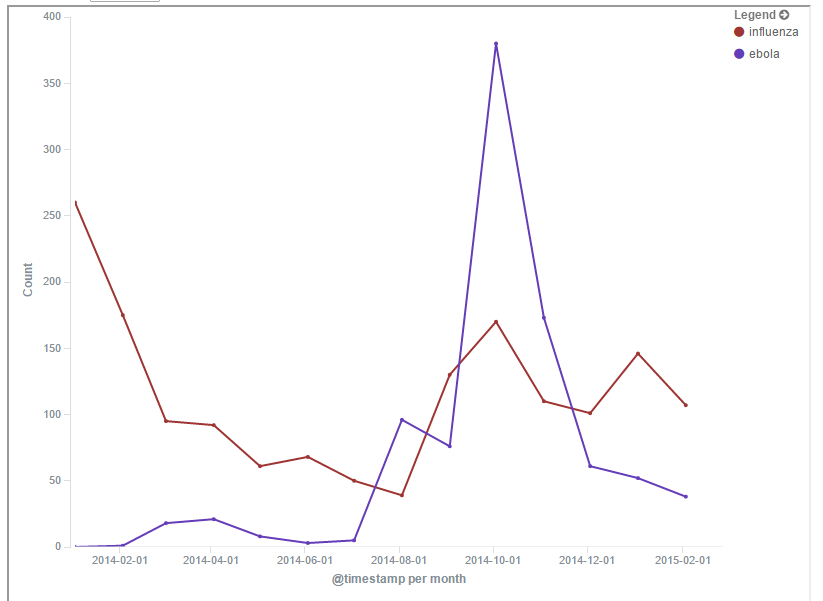
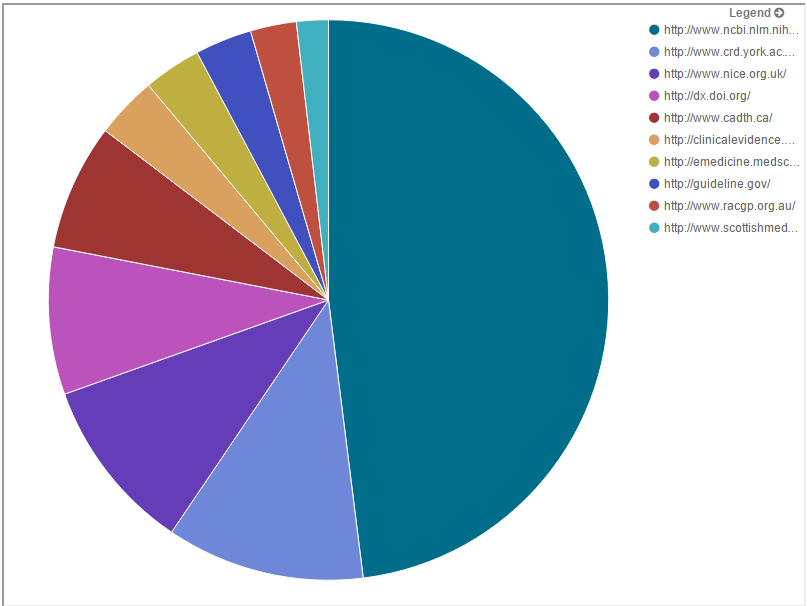
This gives us a glimpse of clinical uncertainties, ‘hot topics’, useful sites etc.  Below are three images to highlight potential uses, but we know there are more.  Imagination is the limitation with this data!

Image One – this is a record of searches for breast cancer and a drug.  So, which drugs are most popular when used in conjunction with the term breast cancer?  In this case, it’s trastuzumab!

Image Two – As we record the date and time of the search we can plot search term popularity.  So, you can clearly see a peak of searching for ebola around October last year.

Image Three – for searches which publications have been most visited?  Top is PubMed, followed by NHS CRD, then NICE.  http://dx.doi…. refers to Cochrane and the final entry to the top five is CADTH.


Institutions and Trip

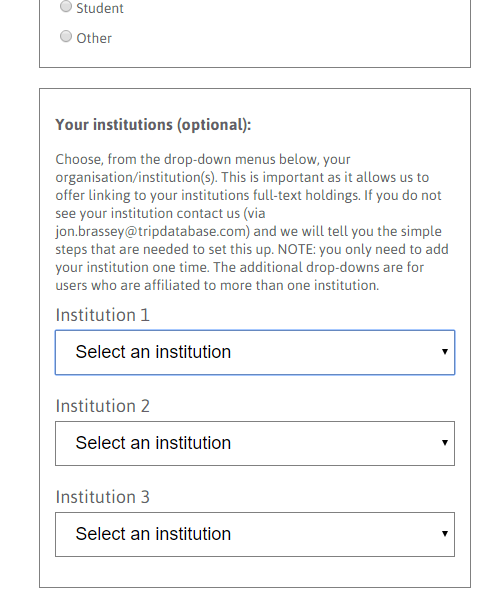
In the registration process there is a section for ‘Institutions’:

This is optional and can be ignored.  But it does serve two purposes, should you not ignore it:

  1. Better links to full-text.  If you are at an institution that subscribes to journals we can use something called a link resolver to link from Trip directly to your institutions full-text (as opposed to the PubMed abstract.  This is a powerful feature but does require a link resolver.  To find out if your institution has one – ask in the library.
  2. Premium membership. If the institution purchases a premium account it can be used to connect users to the premium content/features.

But, to repeat, this can be ignored, it is not essential for your registration.

New site, released today

It’s always an exciting time when we release the new site and this time is no different.  In fact, I tend to get more excited, as the site gets better and better.  So, what’s new?

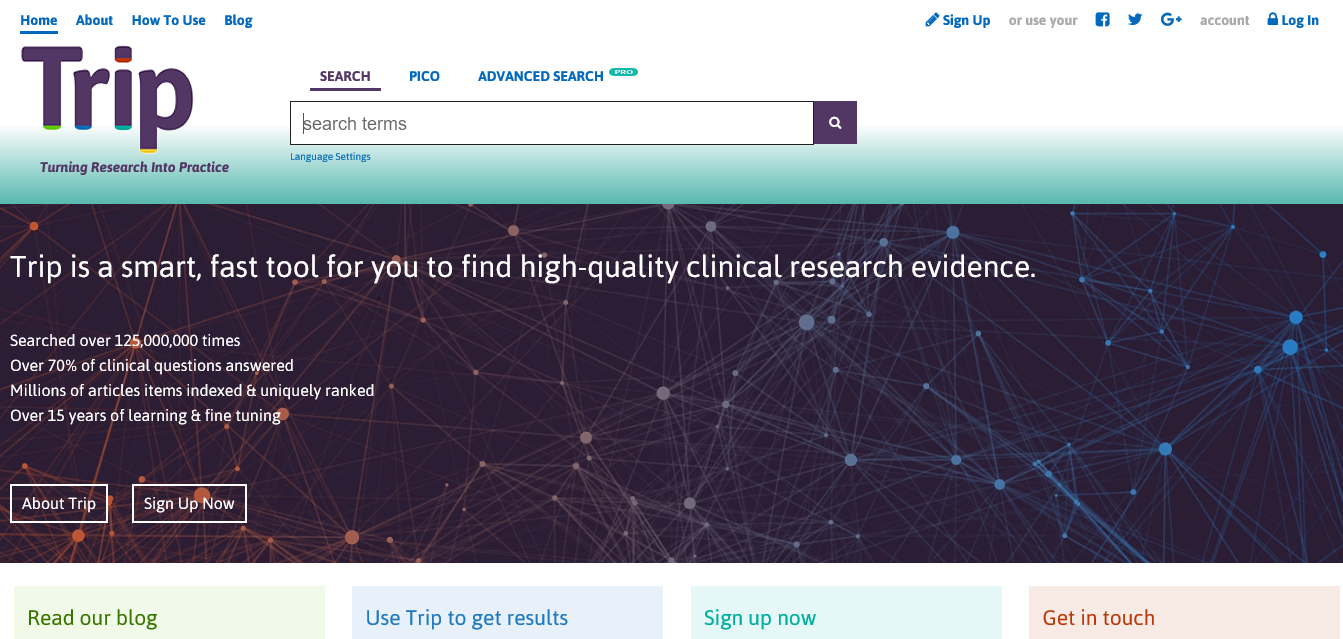
A beautiful new design which has been based on a in-depth analysis of user activity on the site.  So, similar functions are better grouped together.

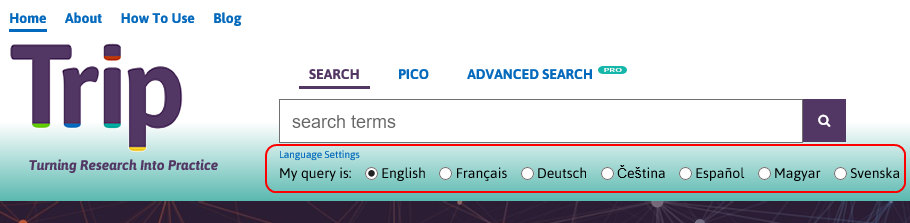
Three new extra languages supported in Trip.  These allow users to search in their own language and see results in their own language.  Feedback has clearly demonstrated that query formulation is the hardest translational activity for non-native English speakers.  The ability to search in your own language is a real boost.  The new languages are Spanish, Hungarian and Swedish.  These sit alongside French, German and Czech.  This language support has been made possible by our inclusion in the EU-funded, Horizon 2020, KConnect project.

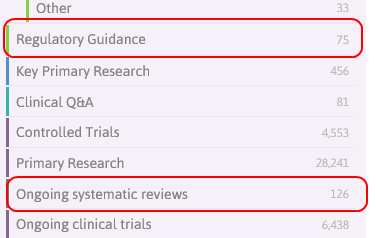
We’ve also added two new categories of results:

  • Regulatory guidance which includes NICE, IQWiG, SMC and new content to Trip – FDA and EMA drug evaluations.
  • Ongoing systematic review, via PROSPERO.

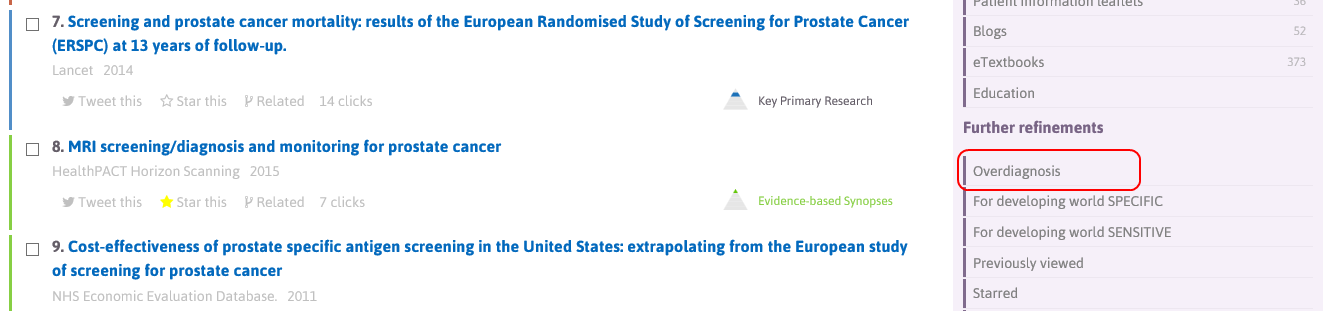
We have also created a filter for articles on Overdiagnosis.  Once you’ve searched you just click the button and we return documents on overdiagnosis and overtreatment.

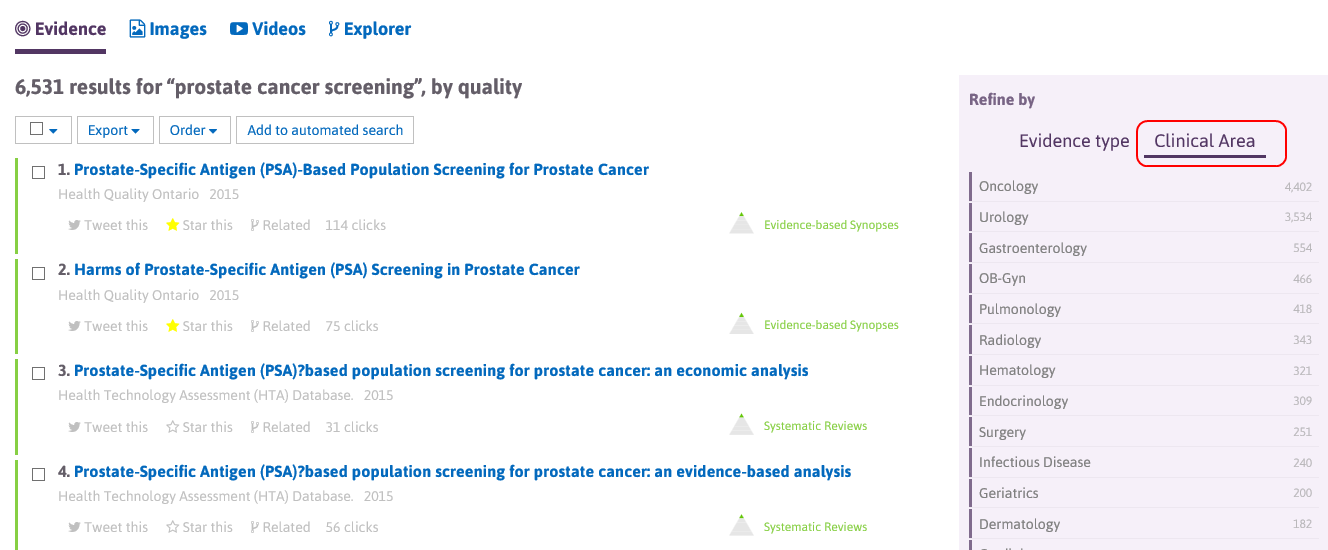
We have noticed, from our analysis of site usage, that the ability to refine initial search results by clinical area is really popular.  So, we’ve promoted it to make it more prominent.  It’s another way to refine your results so it now sits alongside ‘refine by evidence type’.

Other highlights include:

  • Renaming of ‘Trip Premium’ to ‘Trip Pro’
  • Simplified the functionality around each article e.g. tweet this, starring etc.
  • Functions such as search history, login are all consistent and grouped together.
  • A further simplification has been the different evidence types.  This has meant that patient information is now included in the main search leaving the ‘Pro’ content of Videos and Images available from just above the search results.
  • Creation of an explorer function (again located at the top of the search results) which was previously called the search safety net.  At the time of typing this is still being copied over to the new site so won’t be live till later today/tomorrow!

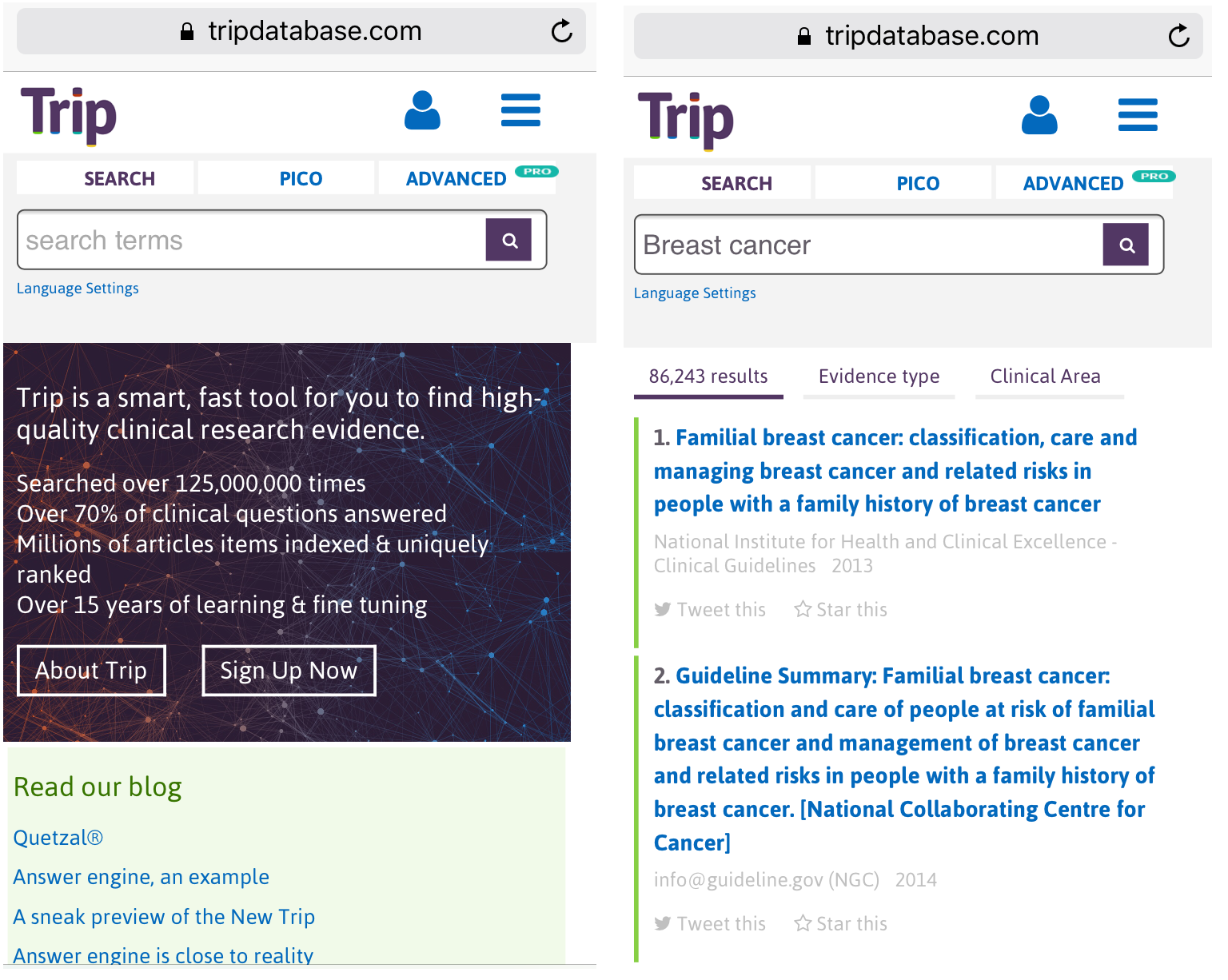
Finally, mobile is increasingly important way of users accessing Trip and as part of the redesign we have significantly enhanced our mobile offering.

Quetzal®

The following guest blog has been provided by our friends at Quertle.  Like Trip, Quertle is a small independent organization.  To help us both thrive and stay independent we are exploring ways to support each other and highlighting each other’s products seems like a nice first step!  So, on with the guest blog….

When you need to find evidence-based information, you know Trip is the tool of choice.  But, there are many times when you need broader information.

Like most people, you probably have been frustrated by PubMed, Google Scholar, and even the expensive paid search engines.  That is because traditional search engines work to find anything that might possibly be relevant, leaving it to you to weed through long lists of results to find what you need.  How many times have you looked past page 1 or 2 of the results?  Instead you start narrowing down your search to get more relevant results.  As a consequence, more often than not, you end up eliminating some of the most critical documents you were looking for.  In fact, up to 30% of R&D budgets are wasted on rediscovering existing information.

Fortunately, there is now a quantum leap in search technologyQuetzal® Search and Communication is powered by Quantum Logic Linguistics™.  “Sure,” you say, while rolling your eyes, “another search engine.” But, just watch this short video clip to see just one example of how different search can, and should, be.  Then, just imagine:

  • Being able to answer questions (such as what genes are relevant to diabetes), seeing the papers, and having a list of those genes;
  • Finding relevant documents not only from PubMed, but also NIH Grants, Toxline, AHRQ Treatment Protocols, Patent Grants and Applications, and much more, including full-text searching;
  • Having free access to over 10 million PDFs with a single click;
  • and much more.

Interested? Try Quetzal or contact Quertle for more information. Quetzal is available via subscription, or as a custom deployment within your organization.  And, for being a fan of Trip, please use Coupon Code 6Cwy4ZW&c-3-1 when you register for Quetzal Advanced (monthly subscription) to receive one free month of access.

Blog at WordPress.com.

Up ↑