Search

Trip Database Blog

Liberating the literature

Author

jrbtrip

Combination search

The combination search is back (for Pro users)!

It went missing when we moved to the new design and it’s taken a while to put it back and integrate it.

Combination search

Each search on Trip (in a single session) is given a number eg #1, #2 etc.  You can then combine these via the ‘Recent’ tab (see image above).  It allows users to fairly easily build up complex searches.

I’m very glad it’s back.


How to use Trip

We have now produced a number of very nice videos on how to get the best out of Trip.  They cover a range of topics such as how to refine your search, PICO search etc.  The full list can be seen on our YouTube Channel.  But I’ve pasted a few examples below.

These videos have already been a big success and so I’m planning to add to these in two main ways:

  • Additional ‘how to’ guides.  If there’s anything you’d like to see then drop me a line or leave a comment.
  • Guided topic search.  ‘How to’ guides are great but sometimes working through an actual search example adds an extra insight.  So, I need some example searches.  I can make my own up but it might be nice to accept searches that people have tried and possibly had sub-optimal results. So, if you have a search you’d like me to work through then again drop me a line or leave a comment.

Now, the example videos…:

Refining your search

The Star function

Regulatory Guidance

Regulatory guidance is content typically published by national (or European) government agencies e.g. FDA, NICE, IQWiG, European Medicines Agency EMA).  It’s a fairly new category of evidence, released in the new design, and most of the content relates to pharmaceutical drugs.  It works like every other category, you search and then click on the ‘Regulatory Guidance’ link in the ‘Refine’ box on the right hand side of the results page, see the two images below.

This is an incredibly powerful feature.  Searching sites like the FDA and EMA can be challenging to say the least and Trip makes it easy.  This content is really useful, featuring additional content not included in journal articles (e.g. see this Brexpiprazole review) and has typically been rigorously assessed by the relevant agency.

Why not try it now with these two canned searches (just click on the link):

Trip – making evidence easy

Reg guidance 1

Reg guidance

Medical images on Trip

Trip’s image search is unique and based on a database of millions of images.  As with all things at Trip it’s designed to be easy to use and still deliver great results.  Access to our images is a ‘Pro’ feature and to see other benefits of ‘Pro’ visit our upgrade page.

Below are four examples of screengrabs for a given search.  For each example you can see the search term used and a sample of the images returned:

xray clavicle  Hip arthoplasty AlopeciaCT stroke


Would you share your knowledge?

Trip’s primary aim is to answer the clinical questions of health professionals.  We’re pretty good, answering over 70% of them.  But what about the remaining 30%?

If you don’t know the answer to a question it’s hard, but if you know the answer it’s easy – it stands to reason.  So, what if Trip allowed users to ask questions they have not been able to answer and forward them to people we think may be able to answer it?

So, a general/family practitioner may have a question on heart failure.  We could allow the user to record their question and we would forward it to people on Trip with an interest in cardiology/heart failure.  One imagines, if the user knows the answer, it’ll only take a short amount of time to post a reply.

The above all makes sense but relies on Trip users sharing their knowledge.  So, an open question – would you? Please let us know via the ‘Sharing Knowledge’ poll below!

The impact of Trip, first quarter 2016

The main purpose of Trip is to improve patient care.  Our approach to achieve this is to support health professionals to answer their clinical questions using the best available evidence. While we’re not perfect we’re pretty good (there’s always room for improvement).  Previous studies have shown that if we look at 1,000 searches of Trip this is how they may break down:

  • 1000 searches of which 79.1% are from users who manage patients or are patients themselves = 791 searches
  • Of these 791 searches, 72.9% relate to patient care = 576.6
  • Of these 576.6 searches, 70.7% help improve patient care = 407.7

So, around 40.8% of searches of Trip result in improved patient care (a whopping 70.7% of the times clinicians come to Trip to get answers to support their care, they get an answer).  While the figures should be taken highly sceptically (we’re written why they may overestimate and underestimate impact) they offer us a reasonable figure to base our impact measurement. Therefore, to approximate the impact of Trip we multiple the number of searches of Trip by 40.77%.

For January-March 2016 we were searched approximately 713,000 times.  Therefore, Trip positively impacted on care around 290,700 times.  The equates to around:

  • 97,000 per month
  • 22,360 per week
  • 3,194 per day

Those figures have got to be seen positively, but why be content with 3,194 per day, why not 50,000 per day?  With the forthcoming changes to Trip (improved search results, answer engine, better content management) this should surely be our goal.

KConnect

I’m just back from a meeting of KConnect, an EU funded consortium bringing together academia, SMEs and care providers with a view to improving health care.  This is the 3rd meeting in two months and thankfully this one was in London (the others being in Luxembourg and Vienna).

There was lots of exciting developments and the following apply to Trip:

Answer engine.  The answer engine is a system designed to infer questions from a users search terms and pull through the best answer (as well as the usual search results). We have a proof of concept model, which is great. However, there are a few issues with it.  A few conversations with consortia members and it looks like that will be fixed fairly easily.  With the prototype I estimate we got between 50-60% right and with the new tweaks, when they’re rolled should see that rise to over 80%.

The answer engine relies on being able to match search queries to articles.  That needs us to accurately reduce document titles down to medical concepts.  We should now be able to do this more accurately, more quickly and it’ll give us lots more flexibility with how we display the results.

Search log analysis.  I typically refer to this as clickstream data, but search log analysis appears the favoured term.  A new feature that we’ll be rolling out relates to search refinement and this will manifest itself in two ways:

  • During search.  We currently have a drop-down list of suggestions, supplied via PubMed.  However, it’s very ‘dry’ and never feels particularly ‘human’.  By using real-life data from Trip we’re confident that our system will be more real for our users.
  • Post-search.  Users typically only search using 1-2 terms.  This system can be used to suggest additional terms to bring the user closer to the results they need.

Below is a list of query suggestions based on a search for hypertension:

  • 976 hypertension pulmonary
  • 715 hypertension arterial
  • 694 hypertension treatment
  • 572 hypertension pregnancy
  • 439 hypertension diabetes
  • 401 hypertension stroke
  • 248 hypertension exercise

So, if you’ve search for hypertension we might show the above and say, something like ‘are you interested in hypertension pulmonary, hypertension arterial etc.  A user clicking on a search phrase will see the search automatically undertaken.

This should be rolled out shortly and we’ll test it to ensure it actually improves things!

Algorithm changes. Already planned from my visit to Vienna but further refinement of the specification which will see us trying multiple tweaks – in isolation and in combination – to try to ensure an optimal new search algorithm.

There are a few other bits and bobs that significantly affect Trip’s future development – but these are outside of KConnect and therefore can wait for another post.  But, rest assured, these changes are all ambitious and doable!

Oops, we missed a bit

Large sites, such as Trip, are complex and when you create a new design things can be missed and the following is a case in point.

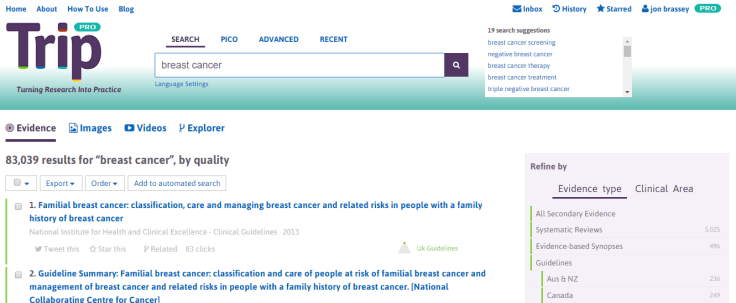
At the top of the image (above) is the advanced search from the old site and below that is the new site.  Apart from the design there is a bit of functionality missing – the ability to combine search (called ‘recent searches’ at the top).  This allowed users to build up fairly complex searches.

We’re now aware of this and hope to get a fix out early next week!


Quality of content

Picture the scene – you’ve gone to Trip and searched for an article to answer your question.  You find a paper that looks interesting and click on the link – and it leads to a dead link.  I appreciate the frustration – I really do.

Websites change URLs for many reasons such as a new design for the site, withdrawing out of date content.  It’s a constant battle for Trip to keep up to date.  Thankfully we have a new and powerful tool to help with the release of a broken link system.  Here’s what it does:

  • It detects that a user has clicked on a link that has led to a ‘dead’ link.
  • After an hour we try the link again (sometimes sites – temporarily go down) and if the link still doesn’t work we remove it from the index and an email is sent to our content team.
  • They can then understand the reasons for the failure and either put in a new link to that single article or instigate an overhaul of all links for that particular site.

While it is not perfect it’s a significant enhancement to the site.

Linked to the notion of quality we have just introduced a new system to grab guidelines from the American guideline.gov.  This is a great site and our system broke when they changed their URL from guidelines.gov to guideline.gov!  But – from now – the links should work fine.  So, as well as grabbing new guidelines we should automatically remove ‘withdrawn’ guidelines.


Blog at WordPress.com.

Up ↑