Search

Trip Database Blog

Liberating the literature

Author

jrbtrip

Facebook update

I highlighted a while ago that I often add small comments to Facebook that I didn’t consider worthy of a blog post.  So, continuing the theme started then, a few highlights of comments I’ve made on Facebook.

  • I’ve updated all the Royal College guidelines – nearly 1,000 documents.
  • Asked about how to raise money to help to keep TRIP going and improving!
  • Highlighted a very nice net website – theNNT.
  • Exposed the new TILT logo to the world (see below)
  • Asked if people like the Q&A site Gas Exchange.
  • Announced that we’ve as good as secured funding for an African clinical search tool.
  • Not TRIP related, but what I do part-time for the NHS, is the Q&A service called ATTRACT. One feature we’ve just released in called tripe
  • Finally, we’re starting to look to improve our links to educational content and we’re starting that process!

As mentioned above – the TILT logo!

Popular papers

I’ve not done this for a while but, for another project, I was checking out the functionality so thought why not!  Below is a list of the top ten articles viewed from TRIP in September 2010:

  1. Physostigmine for dementia due to Alzheimer’s disease (Cochrane)
  2. Low glycaemic index diets for coronary heart disease (Cochrane)
  3. Music for stress and anxiety reduction in coronary heart disease patients (Cochrane)
  4. Intensive insulin therapy in the medical ICU — not so sweet? (Critical Care Journal Club)
  5. Down Syndrome (eMedicine)
  6. Leptin and coronary heart disease: prospective study and systematic review (J Am Coll Cardiol)
  7. Lipoprotein-associated phospholipase A2 is an independent predictor of incident coronary heart disease in an apparently healthy older population: the Rancho Bernardo Study (J Am Coll Cardiol.)
  8. Sebaceous Cyst – removal (Patient UK)
  9. Effect of raloxifene on stroke and venous thromboembolism according to subgroups in postmenopausal women at increased risk of coronary heart disease (Stroke)
  10. Coblation Tonsillectomy & Adenoidectomy (ENT USA). Video

An interesting mix of papers and I’m intrigued to see a video in the top ten.  We recently boosted our video ‘collection’ and now have over 3,100 videos, so good to see they’re useful!

Bing likes Facebook

Facebook is massive, Microsoft is massive, Bing (Microsoft’s search engine) is less than massive.  Bing want to change this and they’re hoping that a tie-in with Facebook will help.  See this Techcrunch article for further details.  As the article states:

“Starting today…. you will automatically start to see links that your friends have “liked.” These will appear in a separate module, with related social links called out. The example Microsoft gives is if you are searching for San Francisco steak houses and one of your friends liked Alexander’s Steakhouse in San Francisco, that would appear as a result along with the name of your friend.”

I like this idea a lot.  It’s dependent on a number of variables coming together, but at a high-level I like this.

I particularly like it as I can see something similar working in the world of health.  What’s better for a GP searching for an article on the diagnosis of prostate cancer than one that a trusted colleague has approved?  How about, using the extended social graph to identify experts in the field of prostate cancer – what do they like?  Finally, what does the evidence have to say (as shown in the current TRIP search)?

However, this also requires a number of variables coming together.  However, if Facebook/Bing paves the way, then why not?  An important component for this to work is a clinician’s functioning social graph – where can that comes from?

Let’s hope TILT works!!

TILT: you’ll be amazed at what you don’t know

The launch of TILT (which stands for Today I Learnt That) is fast approaching and we’re pulling together the design and the actual programming – so time for a bit more information.  First the logo, which we love!

At the simplest level TILT is an easy way for users to record any learning they may have experienced.  This was designed principally around clinicians who need to record this sort of information for revalidation/recertification. Although, from our pilot, it became obvious that clinicians like to record their learning even if it’s not specifically for revalidation.

However, the real beauty and strength of TILT is that the ‘TILTs’ are viewable by other clinicians. As in ‘real’ life clinicians can learn from each other.

Some example TILTs include:

  • PPIs associated with 1) fractures 2) LRTIs 3) C diff
  • There’s not enough evidence to recommend racecadotril in children with acute diarrhoea
  • I now (belatedly) appreciate the differences between the old UK90 growth charts and the new WHO charts (and the rationale behind the switch)

The clinicians in the pilot really enjoyed themselves and reported lots and lots of learning.  For me, the biggest joy was seeing the way clinicians transformed complex issues/articles into nuggets of learning.  From an information perspective this is gold dust.

The pilot involved around 10 active users and generated hundred’s of TILTs in 6 weeks. If we have 100 active clinicians what sort of impact will that have? What about 1,000? 

As one clinician fed back “you’ll be amazed at what you don’t know”

10,000 registered users, official and proper!

After a few false alarms we finally got the 10,000 registered users.  Now these figures have been audited – I’m very very happy with this figure.  I’ve done some analysis and the following are the top 25 countries where registrants come from:

  • UNITED KINGDOM
  • UNITED STATES
  • SPAIN
  • AUSTRALIA
  • CANADA
  • MEXICO
  • CHILE
  • ITALY
  • BRAZIL
  • PERU
  • INDIA
  • IRELAND
  • SAUDI ARABIA
  • ARGENTINA
  • COLOMBIA
  • NETHERLANDS
  • NEW ZEALAND
  • IRAN (ISLAMIC REPUBLIC OF)
  • EGYPT
  • INDONESIA
  • ISRAEL
  • BELGIUM
  • THAILAND
  • CHINA
  • PANAMA

TRIP truly is international!  And here’s a selection of countries where we only have a single registrant:

  • AMERICAN SAMOA
  • ANGOLA
  • ANTARCTICA
  • BURKINA FASO
  • CONGO
  • EAST TIMOR
  • ERITREA
  • GUADELOUPE
  • KOREA DEMOCRATIC PEOPLE’S REPUBLIC OF
  • LAO PEOPLE’S DEMOCRATIC REPUBLIC
  • LUXEMBOURG
  • MONACO
  • MYANMAR
  • NIEU
  • PITCAIRN
  • SAINT KITTS AND NEVIS
  • ST. HELENA
  • SURINAME
  • SVALBARD AND JAN MAYEN ISLANDS
  • TAJIKISTAN

I love running TRIP and this sort of milestone and analysis make me very proud.  I think the next milestone will come relatively quickly via Facebook, where we have 494 ‘fans’ – only 6 to go!

Oops, we made a mistake

On August 4th we announced that we had 10,000 registered users.  After some internal checks we now realise this was wrong.

The reason for the discrepancy was a number of spam accounts.  We became aware of these about 6 weeks ago (and introduced a CAPTCHA system to prevent future spam accounts) and have since been tracking down these accounts.  We now feel we have a pretty accurate figure for actual accounts and as of now, we have 9,873 registered users.

Keeping TRIP Going!

As you know money is always in short supply at TRIP. Our ideas always outstrip our income!
We’ve discussed asking for donations in the past and we’re still tempted. However, might asking people to sponser/adopt a search term be better? For instance, someone could sponsor ‘diabetes’ and everytime there is a search for diabetes a message appears somewhere on the results page ‘This search has been sponsored by…………..’.

What do people think?  Alternatively, has anyone else got any suggestions to increase our income?

Remember, TRIP is free to access, has made a massive contribution to healthcare (over 50 million searches) and has no significant backers.  All the income we get has to come through small, separate contracts where we can get them.

We’d like to think the many users of TRIP might like to help support us…..

Any specific ideas can be added via comments or emailed directly to me at jon.brassey@tripdatabase.com

Facebook, blogger and twitter

The above applications are widespread and TRIP has a presence on them all!  They all offer a way of TRIP to reach out to users and those with a shared interest.  It’s the blog that gives me the greatest worry, as I feel I should blog more regularly.  There’s no external pressure, I just feel I should blog once a week.

However, there lies the problem – I see blogs, Facebook and twitter in a different light.  Our Facebook presence gets the most attention and I think that’s due to the size of the posts (so I post more) and the possibly more interactive audience on Facebook (where it’s very easy to interact – just press a button).

I see the blog as a place for publishing longer pieces, twitter for very small and Facebook in between.  This medium size suits me as I’m not a big writer, if I can say something in 50 words I’ll do so, as opposed to some who’d prefer to use 500.

But, perhaps I need to precis what I’ve written on Facebook, here in the blog, so the blog audience doesn’t ‘miss out’. 

So, since the last blog article I’ve ‘Facebooked’:

  • I went and gave a hands on workshop at a CEBM training conference.  Once nice bit of feedback, from a clinician was – ‘before I found TRIP I was ploughing the field with a trowel, now I’m using a tractor’.
  • Reported on a meeting with the lovely Glycosmedia.
  • Revealed that we’ve now got 3,172 medical videos in TRIP.
  • It looks like we’re very close to secure an African version of TRIP, which I’m very excited about and follows on from our crowdsourcing of evidence for the developing world.
  • We had a little twitter experiment with the European Respiratory Society.
  • Highlighted that a training course was being undertaken in Chile as we had 20 registrations from Chile in the space of ten minutes.
  • Finally, reported on a ‘spring clean’ of all the UK Royal College’s clinical guidelines to fix broken URLs and to ensure the content was actually fresh.

Having summarised the Facebook activity I think it works quite well!  It’s good to see a summary of our activity.  Now, I must rush – I’ve got a meeting with our techie (Phil) and designers about our new project – TILT!


    Visibility of features on TRIP

    I was recently invited to attend a workshop held by the Centre for Evidence-Based Medicine in Oxford.  This wasn’t a formal demonstration of TRIP, it was more an informal chat to allow people to ask about TRIP various aspects of TRIP e.g.

    • How often is the site updated? Answer: most content is weekly or fortnightly and the rest on a monthly basis.
    • What is involved in updating the site? Answer: Most content is automatically added via various clever bits of technology.  However, for a number of sites I still have to visit them monthly and manually add the content.
    • How does the boolean work?  Answer: Use the advanced search to show you – as this builds the boolean for you.

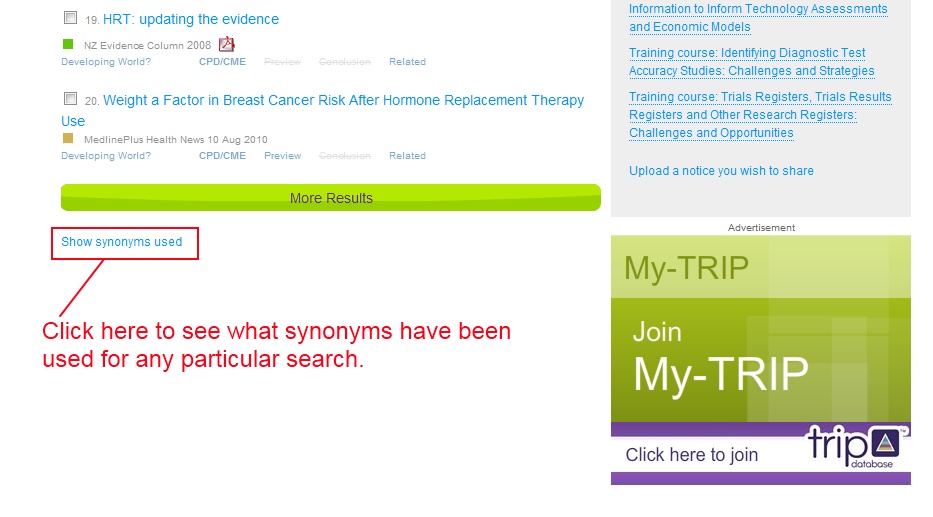
    Then, a person who had used TRIP for years said they weren’t aware of this feature.  Over the course of the session people highlighted they hadn’t seen:

    It’s an interesting issue/problem.  It’s trying to get the balance right between making features visible and not over-powering.  I’m really not sure how to resolve this!  Possibly create a monthly ‘Feature’ area which would allow me the ability to focus on a given feature. One to ponder!

    One very memorable quote was from a clinician who said:

    ‘before I found TRIP I was ploughing the field with a trowel, now I’m using a tractor’

    Blog at WordPress.com.

    Up ↑