Search

Trip Database Blog

Liberating the literature

Category

Uncategorized

Synonyms

In 2014 I wrote this:

We have a manual system for handling synonyms in our search. This means that if someone searches for IBS we automatically search for irritable bowel syndrome. I’m currently undertaking a review of these synonyms, a long-winded and problematic process – but well worth doing.

When I say/said a manual list we started the synonyms in Trip by exploring the top used search terms in Trip (I think it was the top 8-10,000 terms) and manually looking through them to see if any might have synonyms. So, when I came across IBS in the list, I would add irritable bowel syndrome. When a user searched on Trip for IBS we would effectively insert the other term, making it IBS OR irritable bowel syndrome. This is a crude but surprisingly effective system and – with the new back-end work finally coming to the end, it’s time to review them again.

This is what I’m looking at:
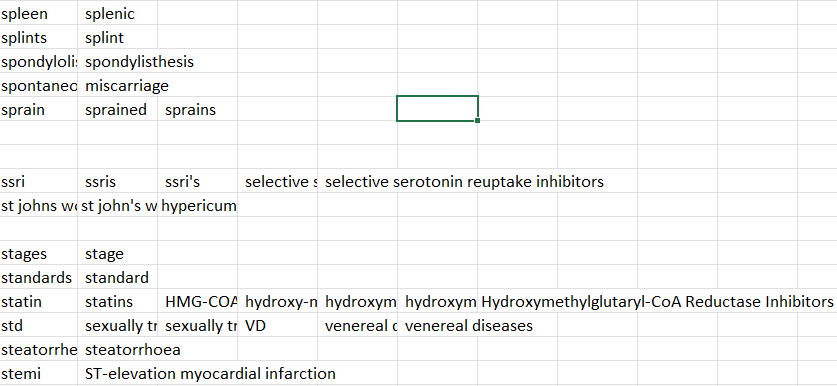
This might take a while πŸ™‚

Monkeypox

Learning lessons from Covid-19, Trip has started actively adding higher-quality content related to Monkeypox. Trip users are actively searching for information and the information ‘landscape’ is changing rapidly. As such, Trip is accelerating it’s content ‘acquisition’.

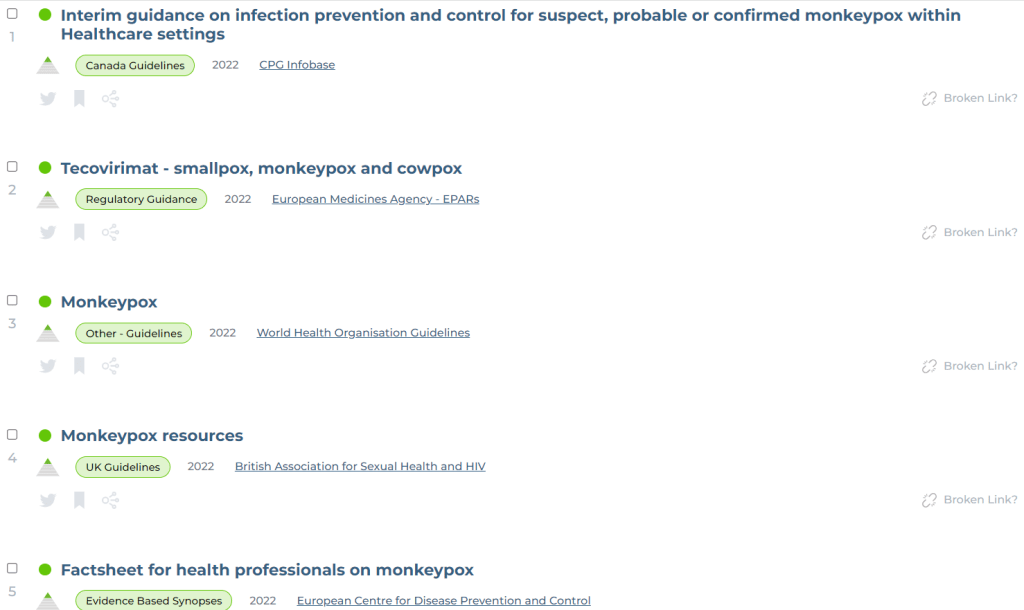
A search for monkeypox on Trip currently has these results in the top 5:

If you know of any great resources, please let Trip know via monkeypox@tripdatabase.com.

Making Trip Pro available for health professionals in Africa

Ariadne Labs is a joint center for health systems innovation at Brigham and Women’s Hospital and the Harvard T.H. Chan School of Public Health. They approached Trip earlier in the year to take part in their Better Evidence initiative and this has resulted in Trip Pro being made available, for free, in 20 schools across 12 countries in Africa.

Searching for evidence to improve care during wartime

In little over 24 hours we’ve made some significant changes to the combat injuries filter. We’ve increased the yield of higher-quality articles from 2,000 to nearly 4,000. In conversation with people it’s become apparent that simply pointing to a large number of results isn’t great – as it suggests the user will have to browse the articles. In actual fact, they are more likely to have a clinical question.

So, we’re going to try to create an evidence table, pre-loaded with possible questions. As with the previous post, this table should be added to as and when people reach out. If you have suggestions, please send them to jon.brassey@tripdatabase.com. And, to be clear, we’re not experts in this domain, hence being very open to help.

TopicCombat setting (higher-quality evidence)Combat setting (all evidence)Any setting (higher-quality evidence)Any setting (all evidence)
Amputation121 results965 results1,613 results13,515 results
Antibiotics504 results4,100 results11,793 results148,176 results
Anxiety702 results2,628 results12,273 results87,007 results
Bullet wounds65 results522 results65 results522 results
Burns572 results2,719 results4,005 results28,571 results
Compartment syndrome174 results963 results947 results14,125 results
First aid93 results266 results402 results1,752 results
PTSD611 results2,979 results3,123 results17,085 results
Tranexamic acid42 results111 results696 results3,226 results
Venous thromboembolism164 results464 results3,192 results14,389 results

Thanks to Tom for highlighting refugee health. The following do not have any combat setting filter, they’re just total topic results:

TopicHigher-quality evidenceAll evidence
PTSD refugees207 results565 results
Refugee health648 results2,782 results
Refugee mental health455 results1,292 results
Unaccompanied minor refugees36 results92 results

Kate has highlighted the wonderful Evidence Aid. They have a number of pertinent evidence collections, including Health of refugees and asylum seekers.

Again, any suggestions via jon.brassey@tripdatabase.com

Search filter for combat injuries

Earlier today I heard on the radio about two British surgeons running online training on military surgical techniques for surgeons/doctors in Ukraine. As Trip is a global repository of some of the best evidence available we thought it might be beneficial to try to bring together some of the best ‘combat’ evidence. To that end we have started work on a search filter. This is our starting list:

  • (shrapnel AND (wound OR injury))
  • military
  • soldier
  • (post-traumatic stress disorder AND (soldier or military))
  • (bomb AND injuries)
  • (bullet AND (wound OR injury))
  • (bomb AND (wound OR injury))

These translates to this search string, which is 20,000 results. If you restrict to ‘evidence based’ content (this search string) it drops to a more manageable 2,000 results. However, this is still too many so it possibly requires more filtering. For instance:

Can you help us improve our offering? I guess this comes in two parts (1) improve the filter to locate more military-related articles, and (2) suggestions for pre-formulated searches (such as the surgery or shrapnel searches above)

Any suggestions please send them to jon.brassey@tripdatabase.com

UPDATE (15:26 on 06/03/2022)

Thanks to Becky I’ve added some additional terms:

  • “armed forces”
  • warfare
  • army
  • navy
  • airforce

This finds extra articles, unfiltered it’s now just over 28,000 results, and just over 2,600 higher quality articles.

UPDATE (11:52 on 07/03/2022)

Thanks to Lina we’ve identified a number of new terms:

  • gunshot
  • firearm
  • blast
  • explosion

This now gives just over 44,000 results, and just over 3,500 for higher-quality content.

Update (14:01 on 07/03/2022)

Thank you to Igor and Tracy we’ve identified some other useful terms:

  • shelling
  • grenade
  • “land mine”
  • landmine
  • artillery

This now gives just over 50,000 total results with nearly 4,000 higher-quality results.

Years covered by Trip

We’ve just been contacted by a doctor undertaking a systematic review and he asked, for writing up the search strategy, how far back do our records go. Unfortunately it is not possible to give a definitive answer!

In part this relates to the recent post Journal coverage in Trip where we highlight the nature of incorporating documents. We typically say that the bulk of our content is from the year 2000 onwards. However, as we grab all the RCTs and systematic reviews in PubMed, those are our earliest records. So, we’ve got some systematic reviews and and RCTs from the 1950s (although the definition of these research types may well have changed since then) and our earliest guideline appears to be from the late 1990s!.

New sources added to Trip

Trip is only as good as the content it searches, and as such, we are constantly exploring new sources of evidence to add. We are supported in this by our users who often contact us to alert us to content we don’t already include and we typically add new sources every month. This month has been particularly productive with 5 new publications. Four of theseΒ  (the Health Technology Assessments) were highlighted by a senior HTA investigator. The new sources are:

  • Adelaide Health Technology Assessment
  • AETSA HTA (Spain)
  • Government of Alberta HTA
  • Council for Choices in Health Care HTA (Finland)
  • American Diabetes Association – guidelines

If you know of a source you think would be useful for Trip and it’s users then please get in touch sources@tripdatabase.com.

An important collection of posts to help you use and understand Trip

We regularly post blog articles highlighting a particular aspect of Trip. As these grow, having them in one place makes sense, so here we go!

Obtaining an overview of Trip

Getting the most from Trip – highlighting two videos that give users – both new and experienced – to get better results from Trip

Subscribing to Trip

The difference between free and Pro Trip

Institutional subscriptions – the costs involved in obtaining institutional access

Features

Understanding the full-text icons on Trip

Advanced search tip

Deleting β€˜Recent’ search activity

Pyramids are back

Using Trip via mobiles or tablets

Content

Adding new content to Trip

Journal coverage in Trip

Years covered by Trip

Sources searched by Trip – a bit dated with some content no longer available and other content added, but it still gives a good account of what we cover.

This blog will expand over time as relevant articles are added. If you’d like to suggest new topics to cover then please let us know via jon.brassey@tripdatabase.com

Journal coverage in Trip

As well as our secondary evidence content, Trip also includes a large number of journal articles. The coverage is complicated and this post sets out what we include, journal wise, in Trip.

Key Primary Research: We include all the journal articles from the big 5 internal medicine journals – NEJM, Lancet, JAMA, BMJ and Annals of Internal Medicine. In addition we include all the content from the wonderful EvidenceAlerts.

PubMed’s core content: We include all the articles from PubMed’s core content (~110 journals)

Additional journal coverage: For our clinical areas (we have around 30 and cover topics such as cardiology, oncology) we selected the top journals based on Impact Factor for each area. These were then reviewed to ensure they were clinically focussed (many are at the academic scale of things, so these were excluded).

In total we grab all the articles from around 550 journals.

Randomised controlled trials (RCTs): We grab all the randomised controlled trials from ANY journal in PubMed (I believe they cover 5000 journals).

Systematic Reviews: As with RCTs we attempt to grab all the systematic reviews from PubMed. And we have a separate system to identify systematic reviews in non-PubMed journals.

In total we have approximately 4.5 million journal articles (compared to 33 million in PubMed).

Full-text: Final point! For Pro subscribers we offer links to full-text to approximately 70-75% of all our journal articles (~ 3.1-3.4 million articles).

Blog at WordPress.com.

Up ↑