Search

Trip Database Blog

Liberating the literature

What’s important for our Rapid Review system?

This is the year we build our rapid review system.  In short it’s a step-by-step ‘wizard’ that supports users (either via automation or community support) to rapidly generate evidence reviews. The steps are as follows:

  • Question setting/clarification, including the extraction of search terms.
  • Search and document selection, including various techniques to unearth articles that may have been missed.
  • Data extraction to produce an evidence table.
  • Narrative review including a conclusion or clinical bottom line (to be decided).
  • Review finalisation. All the above parts pulled together to produce an easy to read rapid review.
  • Publication and peer review.

To help us understand where to particularly focus can you select which elements below are really important – please select the 5 most important aspects. If you think we’ve missed something (or have any general comments) please let us know via the ‘Other’ box:

Thank you

Looking back on 2018 and forward to 2019

I traditionally start the year highlighting the impact of Trip. Unfortunately this relies on Google Analytics and for some reason our Analytics disappeared mid-year and Google cannot tell me why or how this happened.  So, over ten years of data gone.  But, tellingly, we’ve not reinstalled it as I never had the time to spend understanding the data and acting upon it.  It reminds me of the Einstein quote “Many of the things you can count, don’t count. Many of the things you can’t count really count.”.

If we look back at the results for 2017 we improved care, globally, on a massive scale.  This year our usage is more likely to be higher than lower – so our impact grows and grows!

But what are the other highlights:

Clinical Guidelines – the National Guideline Clearinghouse was shut down mid-2018 and so, as a premier source of guidelines, we stepped in and further boosted our guideline coverage. We now have unrivalled guideline coverage and we featured recently in this article: National Guideline Clearinghouse Is No More: Keep Calm and Search On.

Automated evidence synthesis – The main fruit from our Horizon 2020 funded project appeared in mid-2018 – our automated evidence mapping work. It’s great to get it out there and we hope to do further work later on this year. I’ve finally submitted a paper describing it so, fingers crossed, that’ll appear in the near future.  This was a lot of work and it’s sad that the KConnect project has now ended.

Cochrane ‘crisis’ – that hit in September. I’ve long been critical of Cochrane so it was perhaps not as surprising to me as to others. Still, it was unpleasant for many and the implications will take time to be realised.

Trip Evidence Service – I was particularly pleased with the release of the Evidence Service as we started Trip to support reactive – manual – clinical Q&A services we were involved in. I still enjoy undertaking rapid reviews to support clinical care/policy. The evidence service was produced to take advantage of our skills and also support others with a lack of access to the time/skills to do the reviews themselves. But still a little way off my dream of working full-time on Trip!

Snippets – A small improvement but one that I was happy to see!

Academic papers – I’m not a big writer of papers but occasionally get involved and these are the stand out ones:

Business side of things – We’ve had a Freemium business model for a few years now and it really has proved our saving grace.  We have no organisational/government backers so we need to earn everything we spend.  It’s both perilous but also rewarding to be so independent. Last year we significantly increased our institutional subscribers and that’s left us in a pretty good financial position.  This has been supplemented by the Evidence Service and also a number of consultancy pieces of work around evidence and automation.


2019 – Plans for this year

Hopefully, by the end of January, we’ll be rolling out two major developments:

  • Mobile app – we’re in the final stages of testing
  • Increased full-text coverage – currently, via our linking to PubMedCentral, 38% of all our journal articles link to full-text (for Pro subscribers). We’re working with UnPayWall and that will see coverage increase to 57%. This is a really important addition and we’re delighted.

We’re already working on a more substantial upgrade which will cover:

  • Community – creating a system to encourage our users to support each other.
  • Rapid review system – using community support and a ‘wizard’ (step-by-step support) to create timely rapid reviews.
  • Clinical Q&A – we’re still working on this but it might well end up looking a bit like Quora for health professionals.

Then, who knows about the second-half of the year! I think we’ll do some further work on the automation project but the rest we’ll see how things develop.  If you have any ideas then please get in touch.

Have a great year
Snippets on Trip

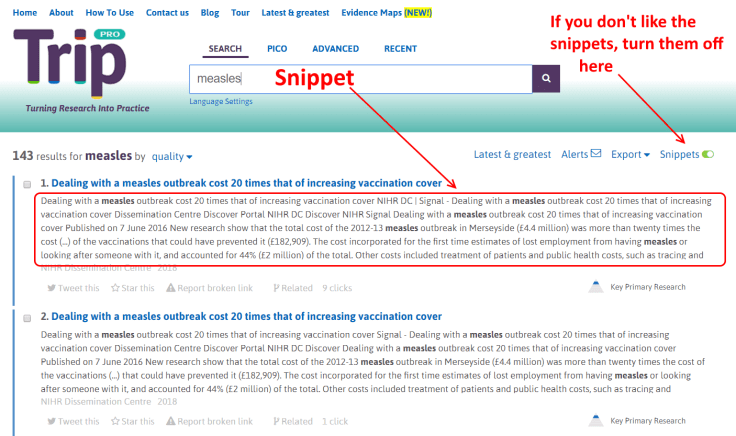
We’ve just released snippets to improve our search results.  Snippets are small, auto-generated, passages of text that appears under the document title:


The aim is to make search more efficient as it helps the user to better understand what the article is about before they click on it.

We understand that snippets aren’t for everyone. In our testing health professionals tended to like them and information specialists less so.  As a result, as you’ll see in the image above, there is an ‘on/off’ switch.

One other thing to note, as they’re auto-generated they can sometimes generate strange results.  In which case either ignore or let us know – we can then better understand how we can improve them.

Enjoy.

Ongoing trials and systematic reviews

One of Trip’s strengths is its amazing coverage of content. This ranges from secondary evidence such as systematic review and guidelines through to primary research (ie journal articles) and on to eTextbooks – with much in between.

One of these other areas, which gets relatively little attention, is ongoing clinical trials and ongoing systematic reviews

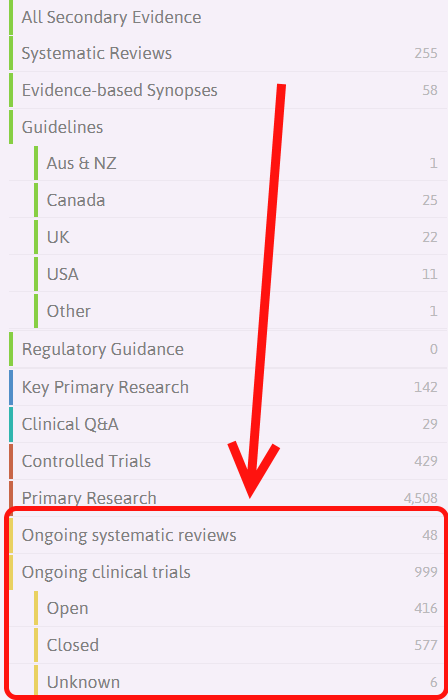
Ongoing systematic reviews: We include all the ongoing systematic reviews included in PROSPERO; at the time of writing that was over 40,000 reviews.

Ongoing clinical trials: We link to all the trials in ClinicalTrials.gov; at the time of writing that was nearly 300,000 separate trials. NOTE: this is a ‘Pro’ only feature.

These can be specifically looked for via the Trip filtering system on the right-hand side of the results page:

Do your search and click on the link of interest – it really is that simple!

One really important thing to consider, which was highlighted in this NEJM article is:

As of October 2016, ClinicalTrials.gov contained more than 227,000 records, and nearly 23,000 of those records had posted results entries; we estimate that results are published in the literature for only half those trials.

If you’re interested in a broad coverage of the literature the content on clinicaltrials.gov includes unpublished data. Find it easily via Trip.

Trip Rapid Review System – structure

On the Rapid-Reviews blog I highlighted the decision to create the Trip Rapid Review System (TRRS).  It got me thinking that it’s both about RRs and Trip – hence me mirroring this new post below. I suspect there are different audiences for each blog!

In thinking about the TRRS I see it being a multi-step process supported, where possible, with technology to automate the process as much as possible.  The steps are as follows:

  • Question setting/clarification, including the extraction of search terms.
  • Search and document selection, including various techniques to unearth articles that may have been missed.
  • Data extraction to produce an evidence table.
  • Narrative review including a conclusion or clinical bottom line (to be decided).
  • Review finalisation. All the above parts pulled together to produce an easy to read rapid review.
  • Publication and peer review.

Over time I will expand on each step, highlighting how it could work. It’s good for me to do as I need to think through all the issues and it gives readers the opportunity to give feedback.

Trip mobile app. It’s getting there!

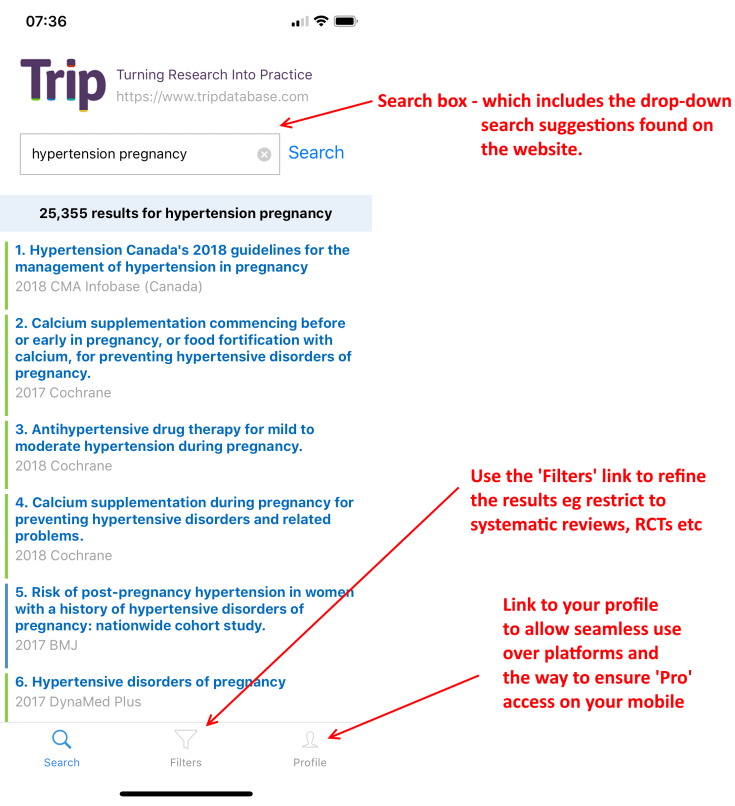
We’ve been working on a mobile app for Trip and the trial version I’ve been playing with has been really impressive.  You might say that mine is a biased opinion, but believe me I’m our harshest critic as I always want to exceed expectations. With the app I think we’ve got a great chance!  An annotated screenshot is below.

Not 100% sure when it’ll be out, possibly the biggest hurdle will be app store bureaucracy, but we’ll see.

What we’re up to

We’re currently lovely and busy and working on the following:

  • Evidence Maps. I’m very close to finishing the paper describing our evidence maps. I don’t write many papers so no idea if it’ll get published – hopefully the skills of my co-authors will see it get accepted!
  • MeSH. We’re currently working to add MeSH to Trip. Grabbing the MeSH terms from the articles we grab from PubMed is really easy, auto-annotating non-PubMed articles is more of a challenge – but we think it’s in hand!
  • Algorithm – Search is at the heart of Trip and we’re working with a specialist third-party search company to improve our search results. This could/should be massively important.
  • App – We’re making very good progress on developing our first mobile app.

A lot of work which will hopefully all be finished by the end of the year

Using Trip to support research prioritisation

Research prioritisation is really important – it ensures the research that’s undertaken (be it primary research or evidence reviewing) answers important topics that have – as yet – not been answered.

So, how might Trip help?

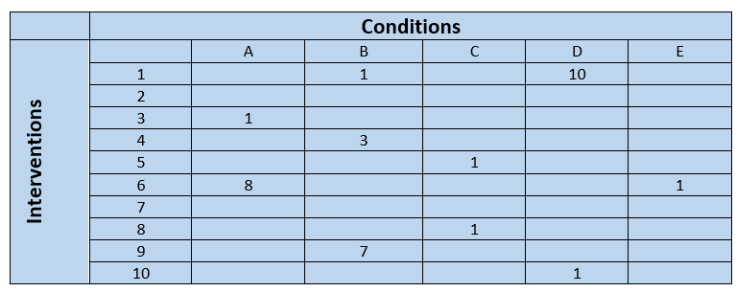
We’ve been involved in some research which should be published shortly that explored transforming the search patterns of Trip into clinical questions.  For example, if a search was for acne and minocyline we can infer the clinical question was ‘Is minocycline useful in the management of acne?‘.  Our work focused on a small clinical area and was able to isolate and chart the distribution of searches/questions in a chart – with the condition on one axis and intervention on the other. Interestingly, the majority of questions occurred in a small number of areas.  Using a ficitious example here is how a chart might look:

So, in the above you can see that for condition A there have been eight searches relating to intervention 6 and one search for condition A and intervention 3.

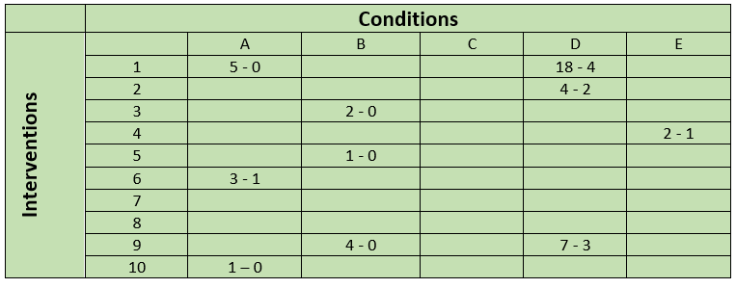
Now, using the automated PICO annotation system we have labelled all the RCTs and systematic reviews (SR) and these can be charted in a similar way:

In the above for condition A and intervention 1 there are five RCTs and zero SRs and for condition A and intervention 6 there are three RCTs and one SRs.

So, how does that help us?

Example one: We can say that there is a lot of interest in condition D and intervention 1 and we can see that it is well served with RCTs (18) and SRs (4).  We could go further and report on how up to date the SRs are and if there are many new RCTs that might not be included in the SRs.  We could even see if users are clicking on the individual RCTs and SRs to see if they are meeting the needs of the user.  In other words, of those 18+4 studies users may click on some and not others and this can give us a further clue as to the users intentions and therefore improve potential procurement of new research.

Example two: Condition B and intervention 9 is popular. We can see there are 4 RCTs but no SRs. Surely a candidate for an SR?

Example three: Condition B and intervention 4 is popular but there are no RCTs and SRs which indicates a potential area for research procurement. This could be verified by exploring what articles the user clicked on when doing that search – again useful insight.

Sounds plausible to me but I’d welcome some insight from others!

Trip and the Evidence Ecosystem

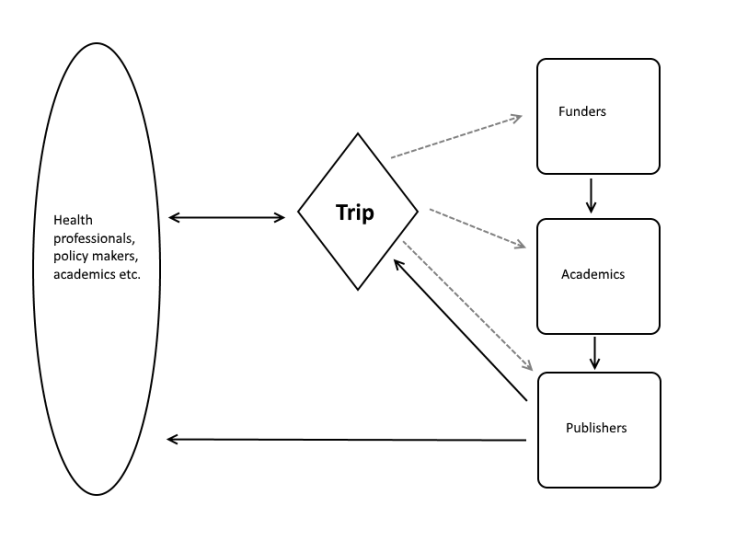
I’ve been trying to see how Trip fits in to the evidence ecosystem and have attempted to draw it.  However, my imagination has let me down so I need some help!  This is what I’ve got so far:


So, what am I trying to say?

Funders give money to academics to produce research which is then published.  The published material can be viewed directly by health professionals but it can also be accessed via Trip.

The dotted grey lines, from Trip to those on the right-hand side are relationships that could be developed with regard the needs of the health professionals.  So, we could help funders understand the type of material users are asking for (we have a paper on that due soon) and that should be of use to academics.  And, for publishers, we could give comparative information as to how their content performs relative to other publishers.

We tend to focus our relationships on the left-hand side, but we could – for influence and business purposes – look increasingly to the right-hand side.

So, the help needed is to perfect the image!  Have I missed relationships?  Can you articulate how Trip might support those on the right-hand side?  Anything else obvious that might help me visualise Trip’s role in the evidence ecosystem??

Thank you in advance 🙂


Blog at WordPress.com.

Up ↑